Search

Philosophy


Friday, August 2nd, 2019

Punkt vor Tante Sally

Kennen Sie diese Sorte von Mathematik-Aufgabe aus sozialen Medien? Oft sind es extrem einfache Rechnungen, zum Beispiel:

Was ergibt 8/2*(2+2)?

Und drunter stehen hunderte falscher Antworten.

Das Zeug geistert immer wieder durch Facebook und Twitter, und es erscheint unerklärlich, bei einer doch vermeintlich exakten Lehre wie der Mathematik, dass es da immer wieder so große Meinungsverschiedenheiten geben kann. In diesem Fall berechnen die zwei größten Löse-Lager 16 beziehungsweise 1. Zu welchem der Lager gehören Sie? Was halten Sie von den Rechenkünsten der Leute im anderen Lager? Und wieso sind solche Aufgaben im englischen Sprachraum noch viel beliebter als bei uns?

Klären wir erstmal, wie es überhaupt zur Meinungsverschiedenheit kommen kann. Mathematische Formeln sind ja nichts als aufgeschriebene Rezepte für Berechnungen. Nimm eine 2, pack noch eine 2 dazu, dann multipliziere das Ergebnis mit…, und so weiter, bis zum Ergebnis.

Das funktioniert nur, weil die Übersetzung der Zeichen ins Rezept eindeutig (1) ist. Weil man sich auf Regeln für diese Übersetzung geeinigt hat. Die Faustregel, die Schulkinder bei uns lernen ist: Zuerst Klammen, dann Potenzen, dann Punkt vor Strich, alles von links nach rechts. Das ist die globale Konvention, und mit dieser Konvention berechnet man oben eine 16.

In den USA handelt die entsprechende Eselsbrücke aber nicht von Punkten und Strichen, sondern von der lieben Tante Sally, der man bitte verzeihen soll: Please Excuse My Dear Aunt Sally, PEMDAS. Das steht für: Parentheses, Exponents, Multiplication, Division, Addition, Subtraction. Und erweckt leider den Eindruck, Multiplikation müsste vor der Division ausgeführt werden und die Addition vor der Subtraktion.

Daran wäre gar nichts falsch, das könnte man so machen. Dann würden wir hier eben erst die Klammer berechnen, dann das Ergebnis 4 mit der 2 multiplizieren, und dann die 8 durch dieses Zwischenergebnis 8 teilen. Ergebnis 1.

Ob man es so oder so macht, hat mit Mathematik, und mit richtigem oder falschem Rechnen nichts zu tun. Es handelt sich um reine Konvention. Man kann auch in beiden Konventionen die jeweils andere Berechnung aufschreiben. Man braucht nur zusätzliche Klammern. Also 8/(2*(2+2)) um trotz Punkt-vor-Strich eine 1 zu berechnen, beziehungsweise (8/2)*(2+2), wenn man Tante Sally weiterhin falsch verstehen will und trotzdem 16 als Antwort möchte. Falsches Rechnen wäre, nach 4 mal 4 gefragt zu werden und 15 zu antworten. Hier passiert etwas ganz anderes.

Denn das eigentliche Problem hier ist nicht, dass die Leute im anderen Lager nicht rechnen können (geben Sie ruhig zu, dass sie das oben gedacht haben), sondern dass die Regel der Tante Sally zu diesem Missverständnis einlädt. Das Problem ist eine lausige Eselsbrücke, und der Fehler liegt eigentlich nicht bei dem, der sich da verrechnet, sondern bei dem, der es ihm irreführend beigebracht hat.

Übrigens, wo wir grade beim Thema sind: was ergibt 230-220*0,5?
Sie werdens vermutlich nicht glauben, aber die Antwort ist 5!

(1) Für die Mathe-Freaks: ein-eindeutig ist diese Übersetzung nicht, weil man ja jeder Formel jederzeit noch Klammern zufügen kann, die an den Berechnungen gar nichts ändern.

Thursday, July 18th, 2019

Harris/Gervais/Hitchens

Tipp für alle, die des Englischen mächtig genug sind, mit einem flott auf Niveau dahergeplauderten Gespräch fertig zu werden. Der Podcast von Sam Harris ist regelmäßig großartig und inspirierend, aber diese Woche schlägt er selbst für seine Verhältnisse besondere Funken. Er hat Ricky Gervais zu Gast (beziehungsweise hat er ihn in London besucht), und das ist für mich nicht nur großartig, weil hier zwei sehr kluge und lustige Köpfe aufeinandertreffen (es klingt nach Buch, Herr Lichtenberg), sondern auch weil ich meine Bewunderung für die beiden Herren bislang in recht unterschiedlichen Schubladen aufbewahrt hatte und jetzt gewissermaßen den Inhalt der einen in die andere schütten kann. Provokanter Humor und besonnene Rationalität, zwei Seiten einer extrem wichtigen Medaille.

Und dann reden sie am Ende auch noch über die Rückkehr von Christopher “Hitch” Hitchens, der auf einem von Richard Dawkins geklonten T-Rex in die Stadt reiten soll, wenn ich das recht verstanden habe.

Den Podcast findet man hier auf der Webseite von Sam Harris.

Dass ich dem Argument des Cartesius, so weit ich es verstehe – dass das Gedachtwerden des Vorgangs eines Zweifels unbestreitbar ein denkendes Ich voraussetzt, und also an der Existenz dieses Ich nicht zu zweifeln sei – selbst zweifelnd gegenüberstehe, habe ich ja schon mal geschrieben. Ich sehe keinen unbezweifelbaren Grund, aus dem ein System, das “Ich denke” denken kann, auch ein Ich enthalten muss, das den gesamten epistemologischen Reichtum repräsentiert, der mit dem Ich verbunden wird. Kann sein, dass es so ist, kann auch sein, dass ein Zombie “ich denke” denken könnte, aber jedenfalls ist es nicht unbezweifelbar und eignet sich also nicht als Fundament eines Welt- oder Geistgebäudes.

Unbezweifelbar ist aber doch die Existenz des Zweifels selbst. Denn wenn ich bezweifle, dass es den Zweifel gibt, dann bestätige ich ja grade damit seine Existenz. Das klingt jetzt wie ein billiges Wortspiel oder Paradoxon, mir ist es aber ernst.

Der Vorgang des Zweifelns beinhaltet die Existenz einer Alternative: um zu zweifeln muss ein Subjekt der Ansicht sein, eine Reihe von Sinnesdaten habe eine bestimmte Erklärung, aber zugleich gewahr sein, dass auch eine andere Erklärung zutreffen könne. Was mit anderen Worten nicht bezweifelt werden kann, ist, dass mentales Erleben eine metaphysisch nicht fundierbare Konstruktion ist, deren jedes Element immer auch seine mögliche Negation enthält. Jeder mentale Inhalt ist, was er ist, indem er auf das verweist, was er nicht ist.

Ich zweifle, also bin ich. Vielleicht.

Wednesday, June 23rd, 2010

Shermer’s Folly

Figure 6: Some nonsense (not to scale)This plot is from chapter 4 of Michael Shermer’s book “Why People Believe Weird Things”, and it’s quite amusing.
The section of the book this is from concerns ESP experiments. Participants in these experiments have to predict one of five symbols on an unseen card, and the plot is meant to show the chance of a participant getting x of the answers right when being asked 25 times. Predictably, getting 5 right out of 25 is the most likely, but higher numbers of hits are entirely expected, and their occurence alone does not mean much. Shermer stops with the negative statement – high performance doesn’t mean ESP – and doesn’t spell out what a correct analysis would look like – not looking at a single result, but comparing a distribution of results to that predicted from chance – but this unfortunate focus on gleeful debunking rather than the education of the reader isn’t my concern. It’s the plot itself. Look at it.

Its x axis runs from -2.5 to 12.5. Bars of unit width indicate the probabilities of getting a certain number of answers right, and a Gaussian curve (Shermer calls it a Bell curve in the legend, and a normal distribution in the chapter text) to fit the bar data. Pretty much all of this is awful. First of all, fractions of x make no sense. The number of correct answers can only be a whole number, therefore probabilities should be plotted for whole numbers alone. If you want to use bars, make them discontinuous to emphasize their discrete character. Additionally, both the Gaussian and the leftmost bar extend into negative values, which also do not make sense for x. Negative values shouldn’t be on this plot at all. All this could be simply due to sloppy graphical design, of course, but the Gaussian extending into the negative is in fact a hint of the biggest error here: this distribution is not a normal distribution at all. To show a Gaussian here is a blatant statistical and conceptual error.

Random answering in a task like this in fact follows a binomial distribution. Interestingly, the numbers on the bars are from the correct binomial (except for 0.0238, which should have read 0.0236), meaning that whoever prepared the data knew what they were doing. But Shermer, fitting a Bell curve to them, clearly does not. You can even see it’s a bad fit. The bars don’t look symmetrical at all. Furthermore, the claim in the legend that “in a group of 25 several scores [above 7] will always occur purely by chance” is also quite false. He himself provides the probability for scoring below 8, which is 89.1%. Thus, in a group of 25, the chance of everybody scoring below 8 is 89.9% to the 25th power, or 5.56%. In other words, roughly one in eighteen such groups will have nobody scoring 8 or higher. There are lies, damn lies, and statistics done by fools.

Claims of the paranormal are emotionally and spiritually appealing, and it is important to counter them both on their own grounds by providing equally appealing stories about the world, and also by clearly showing where their purported proofs are untenable. Michael Shermer is the founder of the Skeptics Society, who claims this as their task, and he adopts a smug tone of intellectual superiority over the misled and uneducated foolish masses throughout this book. Yet apparently he doesn’t know what he’s talking about himself. He even told me so at the end of his foreword: “why should [you] believe anything [I] say? […] You shouldn’t.”

In the end, the whole thing is probably just a clever lesson in scepticisim. Or is it?

Wednesday, April 28th, 2010

A story about Fodor

And here [Pinker] is on why we like to read fiction: ‘Fictional narratives supply us with a mental catalogue of the fatal conundrums we might face someday and the outcomes of strategies we could deploy in them. What are the options if I were to suspect that my uncle killed my father, took his position, and married my mother?’ Good question. Or what if it turns out that, having just used the ring that I got by kidnapping a dwarf to pay off the giants who built me my new castle, I should discover that it is the very ring that I need in order to continue to be immortal and rule the world? It’s important to think out the options betimes, because a thing like that could happen to anyone and you can never have too much insurance.

Says Jerry Fodor, in his review of Pinker’s How the Mind Works. I am fascinated whenever clever people say stupid things, and this certainly looks like a prime specimen. Can Fodor really think that the above constitutes a valid argument of any kind? That stories, if they are useful as mental sandboxes, must be literal mental sandboxes? That rings must be rings, dwarves must be dwarves and immortals must never die? That, in other words, there is a naively naturalistic mapping for everything mentioned in a story to the identical thing in the world, and allegory and metaphor do not even exist, nor usually carry intentional and ofter moral arguments? Surely that would be ludicrous, but just as surely, the above “argument” seems founded on such ludicrosity.

There certainly are interesting things one could learn from this, about how one’s pet theories bias the mind, or how being too immersed in the dreamy Language of Thought will make one ignore reality. It’s called cognitive dissonance and quite a fascinating phenomenon itself. But I think what I’ll take away is not to read book reviews by people I heartily disagree with and listen to Das Rheingold instead. Wagala weia.

Thursday, April 1st, 2010

welt des wissens

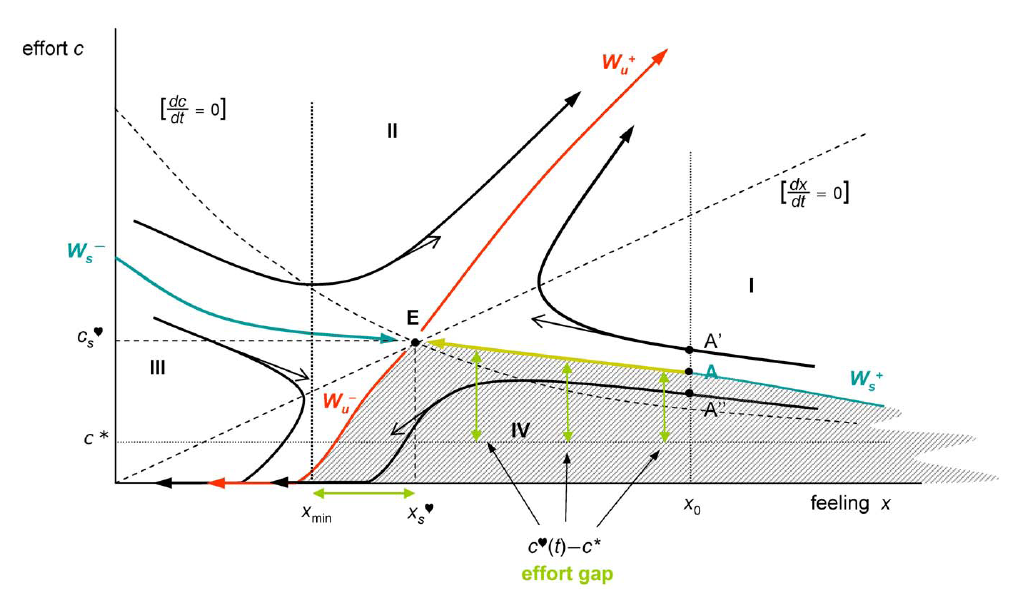
Durable relationships

Diese Grafik trägt den Titel “durable relationships” und stammt aus dem gestern erschienenen Aufsatz A Mathematical Model of Sentimental Dynamics Accounting for Marital Dissolution von José-Manuel Rey. Sie trägt Anstrengung gegen Gefühl auf, enthält zwei Variablen die zur herzten Potenz erhoben wurden, zahlreiche Pfeile und das sentimentale Gleichgewicht E.

Mehr ist dazu nicht zu sagen.

Wednesday, March 31st, 2010

multiple choice

Wenn man sich in zahllosen Diskussionen neurophilosophischer Probleme und Problemchen eine Position zu einigen der prominentesten Argumente der Dualisten erarbeitet hat, zu Jacksons farbenblinder Fantasiegestalt Mary zum Beispiel, und spezieller noch das Argument, dass wenn die farbenblinde Mary alles über die Neurowissenschaft des Farbsehens wisse, sie dann ja wohl auch bei der ersten Begegnung mit einem roten Objekt sich erschliessen können müsste, dass das Objekt eben rot ist, und also die Privatheit dieser Qualität in diesem Szenario plausibel bestritten werden kann, wenn man dieses Argument einer Spezialistin des Themas, nach ihrem Bewerbungsvortrag dazu, dargelegt und sich gefreut hat, dass es ihr neu und interessant war, und wenn man dann aber das Buch Neurophilosophie von Patricia Churchland aus dem Jahr 1986 liest, und da steht das ganz genau so drin, dann, also dann, ja, was eigentlich?

Freut man sich, dass man kluge Dinge selbst herausgefunden hat? Ärgert man sich, weil man wegen Unbelesenheit knapp 25 Jahre hinter dem Stand der Debatte her hinkt, oder wundert man sich, dass es der klassischen Philosophie offenbar ganz genauso geht? Antwort: D) All of the above.

Tuesday, September 8th, 2009

taost phulosophy

Strive to always fall on the bittered side.

Wednesday, August 19th, 2009

finite complaint

I am reading David Foster Wallace’s Infinite Jest, and I need to complain. If you haven’t read it, and plan to, don’t worry, I won’t spoil it for you. If you hate nitpicking, on the other hand, maybe do worry a bit, because I will pick nits. Three of them.

Overall, the book is fabulous so far (page 100), and I love the combination of low brow comments with language so erudite it often borders on the pretentious. This is a great stylistic game to play, and it is enhanced by esoteric factoids, partly made up, partly accurate. But for it to work it needs to stay on the light side of the pretentiousness boundary, and the author needs to be in control of the pieces of knowledge he’s throwing around. Now lets pick some nits.

Nit the first. In a discussion of the philosophical aspects of tennis, Hal’s father is cited, obliquely, as telling people about how a tennis move affords n responses, and how there then are 2^n responses to that move, soon spiraling into “a Cantorian continuum of infinities”. Now, firstly, the correct formula for this is n^2. Wallace might have done this on purpose – somewhat suggestive is the fact that the date of Cantor’s diagonal argument is given in the endnote as 1905 (Einstein’s two seminal papers came out that year) instead of the actual 1891. This is probably a purposeful mixup put into the mouth of the fictitious narrator to highlight the distant past-ness of it all – but if so, I fail to see the point of giving the wrong formula. On top of that, however, talking about a continuum of infinities is not quite accurate. The number of replies approaches the number of elements in the continuum only for games with countably infinite many moves, and any transfinity beyond that (the actual family of infinities Cantor discovered and Wallace alludes to) is unreachable by any tennis match. Overall, the passage sounds like a bit of finitely hot air to me, unlikely to come out of the mouth of an MIT educated polymath with an actual interest in Cantor.

Nit the second. When we first meet the assassin Marathe on the mountainside, he watches his shadow wander out in the setting sun toward the city of Tucson and, as the sun gets low enough, eventually reach it across the plains. This can not happen. A circular object of 20 cm diameter (a human head, say), has the same angular size as the sun (about half a degree) at a distance of roughly 22 meters (or yards). At distances greater than that, the object can no longer fully block the sun and casts no total shadow, or umbra. Moreover, the darkest point of the penumbra actually cast rapidly loses contrast and definition. At 44 meters, the darkest point will have 75% of the luminance of the surround, at 88 it’s up to close to 94%. A shadow of a human or anything smaller, cast by the sun and reaching out visibly for kilometers, is a physical impossibility.

Nit the third. Again concerning shadows, in that same scene: when the sun finally sets, Marathe sees his shadow return to him up the incline. This would happen with a rising sun, not a setting, and of course he’d have to face west, not east. If the sun were a point, the shadow cast out by a sunset would retain definition across large distances and grow longer and longer until it hits the advancing terminator and fuses with it. It would not shorten back toward the object casting it.

Is it sloppy writing and editing? Or a deliberate ruse to tick off obsessive compulsive physicists like me? It doesn’t really matter, because the book is still great, and these are tiny complaints.

Later Addition: The term Bröckengespenst Wallace uses for his fictional shadow is a) inappropriate, since a Brockengespenst is actually a shadow cast into fog or clouds, and b) has false diacritical marks on the o. This German spelling SNÄFÜ is in tune however with his german character later on calling his students “mein kinder”, which sports the wrong numerus of the possessive. “Meine Kinder” would have been correct. I’m leaning toward the sloppy writing hypothesis.

Thursday, April 23rd, 2009

Alleinstellungsmerkmal

Man is the only animal continuously on the lookout for some way in which he is different from the other animals. His need to be special is quite unique.