Search
Wednesday, March 15th, 2006

Michelangelo Antonioni – L’Avventura (3)

This was praised and much discussed when it came out in the late sixties for its refreshingly novel cinematic way of storytelling – or so the Netflix cover blurb tells us. The story is that of a bunch of rich people, bored to glassy stares byu their eventless lives, vacationing among the Aeolic Islands. One of the women vanishes, and her best friend and her lover embark on a quest to solve the mystery and find her, and get close in the process. Or the equivalent of closeness in artsy cinema overcharged with undertones and cranked up to a maximum of meaning with a minimum of substance. That might seem unfair, but I find it unfair to have to watch beautiful women and great cinematography without plot or point, so I guess we’re even, Mr. Antonioni.

This is not to say that there is anything wrong with the story of Noodles, the way it’s woven together with prohibition history, and the final plot resolution. But this movie is just way too long. I don’t really recall much from seeing the original version, but even that might have been a bit on the tedious side, but this reedit is excruciatingly slow. In addition, the way past and present are intercut doesn’t really work all that way in several places. But the biggest problem is that this ultimately fairly simple tale of betrayed friendship doesn’t justify taking up almost four hours of my time. I’d much rather watch Once Upon a Time in the West twice.

Sunday, March 12th, 2006

Fisch her, das ist ein Überfall

all your base are belongs to me
(Abbildung ähnlich)

Die Waschmaschine müsste jetzt, daran erinnert mich das penetrante Pfeifen des Herdes, genauer: das penetrante Pfeifen der in den Herd eingebauten Stoppuhr, die Karate-Gis ausreichend durchgewalkt und somit fürs maschinelle Anpusten im Anpuster vorbereitet haben. Ich verlasse daher die Wohnung, die Tür lasse ich keck angelehnt, steige zwo Stockwerke bergab in die kalifornsiche Kälte – es schneite gestern tatsächlich in San Franzisko. Ein Riss quasi im Weltgefüge -, zerre dicken, weissen Baumwollstoff aus der einen Maschine, stopfe ihn in die andere, reihe noch sechs Quarterdollarmünzen in den vorgesehen Schlitzen auf dem Geldeinwurfschlitten auf, schiebe den Schlitten ein (es rastet und rasselt) und drücke den Knopf. Der Anpuster beginnt, die Wäsche im Kreis zu drehen und anzupusten. Ich gehe wieder rauf und schliesse die Tür. Und als ich nun durchs Wohnzimmer gehe, kommt mir jemand entgegen. Das ist sonderbar, weil ich doch alleine zu Hause bin, und unpraktisch, weil die Kampfrüstung jetzt im Anpuster kreist, statt meinen Bierbauch in eine tödliche Kampfmaschine zu kaschieren. Macht aber nichts, denn mir kommt wieder erwarten kein Übeltäter, Gauner oder Halunke entgegen, sondern eine Katze. Also letztlich natürlich doch ein Halunke, aber anders.
Auch das ist sonderbar, denn wir haben ja gar keine Katze, aber wie ich schnell herausfinde sieht die Katze das anders. Vor ein paar Tagen haben wir den Fehler gemacht, auf ihr exzessives Katzengejammer erst mit Reinlassen und dann mit Fisch zu reagieren; jetzt also lässt das Tier sich schon selbst rein, bald wird es dann vermutlich auch die Fischdose selber öffnen. Vorerst geht das aber nicht, denn wir haben keinen Fisch mehr im Haus. Die Katze frass ihn auf. Nach fünf Minuten maunzen und durch die Wohnung paradieren sieht das Tier das dann auch ein und trollt sich. Ist ja grade nochmal gutgegangen.

Saturday, March 11th, 2006

Andrew Horvat – Japanese Beyond Words (2)

It’s always hard to get a feeling for a foreign culture without being immersed in it, and it’s probably even more difficult when the gap is as large as it is sure to be between so called western countries and Japan. I find the insistence of most introductions to stress the quaintness and formality of Japanese customs a bit irritating, for the blind eye it turns on equivalent behaviours in the reader’s home culture. Generally, a big deal is made for instance of the different distinct levels of politeness or about set phrases for different social situations, as though neither of these existed in other cultures. While this issue crops up in this book as well, much of the specific information in it is really helpful, and it is a nice read to boot.

There is a song by Tom Lehrer called Send the Marines with the lines “We’ll send them all we’ve got//John Wayne and Randolph Scott”, which I ever only understood half. I had heard of and seen movies with the Duke, but not even the name of Scott sounded familiar. I’m happy to report that this sad state of affairs has changed. Other than that, I liked this early Peckinpah for a nice peek into how life has been not too far from here in both time and space. I remember watching Western movies as fairy tales set in a mythical country with no connection to reality as I knew it – but now that I’ve seen the Central Valley and the Sierra, suddenly all the little plot details, the solitude of the religious nut and his daughter on their farm, the rough digger camp, make much more sense. Unfortunately, the story itself is none too interesting, a somewhat trite tale of friendship, betrayal and friendship again, complete with a heroic death at the end. Maybe it was novel then to have shades of grey, instead of good/bad guy ensembles, and I can certainly see how breaking with such a convention could have given enormous tension to this plot, but from todays point of view, the moral struggle of the straying friend and his rash yet good hearted sidekick is just not very captivating.

Thursday, March 9th, 2006

Hongo Mitsuru – Outlaw Star (3)

Having cute and ferocious female tigers with big boobs might not be generally considered the peak of sophisitication among science fiction afficionados, but the level of plot and design in general is higher than the screaming tiger lady would have you expect. The Japanese is simple enough to give this apprentice at Japanese occasional thrills of recognition (He said Ikemashoo! He said Ikemashoo!), and that almost seals the deal. But I think I’ll still stop watching this after episode three. So much to see, so little time.

Wednesday, March 8th, 2006

Nahrungsballs Abenteuer

Die Musik rappelt aus den Ohrkappen, vermutlich sehe ich aus wie ein Idiot damit, aber andererseits wohl kaum mehr als ohne, und dafür aber wie ein besser unterhaltener Idiot. Deal. Zwischen dem Sportgebäude und der Tiefgarage verläuft der Weg, entlang der ich mein frischverputztes Mittagessen nach Hause führe, aber grade jetzt führt er obendrein über gut vier Dutzend Männer und Frauen in Unterhemden, Tarnhosen und Fleckmützen weg. Beziehungsweise natürlich unter ihnen durch. Jedenfalls aber, das muss auch ein mittelalter Bartträger einsehen, der sich mit seinem Dreirad und den Einkäufen in des Dreirades Gepäckkorb mutig in die strammstehende Armee gewagt hat, führt der Weg nicht hindurch. Dreirad und Fahrer sind rettungslos zwischen dem Soldatennachwuchs verkeilt, es geht weder vor noch zurück. In Soldatengesichtern rührt sich kein Muskel. Schlaff hangen Flaggen vom Gestänge. Ich schlängle mich zwischen erstaunlich rundlichen und spannungslosen Leibern hindurch, und trage den Nahrungsball unter meinem Herzen weiter hügelan, als durch das Eelsgeschlängel plötzlich harsches Geschrei dringt. Ich erwürge den Ipod, drehe mich um, und sehe die Exerzizien in zwo Regimenter zerfallen, in Formation und Unterhemd heranjoggen, um dann in Fünfergruppen, unter “One, two, three, four”-Gebell des Fünfergruppeführenden, ins Sportgebäude einzurücken. Oder einzumarschieren, oder was. “Na, sage ich zum Nahrungsball, “da hast Du ja noch was erlebt”, gebe dem Ipod einen Reaktivierungsknuff und fahre mit der Verdauung fort.

Wednesday, March 8th, 2006

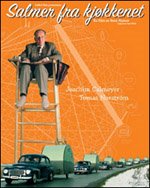
Bent Hamer – Salmer fra kjøkkenet (1)

I can’t praise this movie enough. It’s premise is utterly absurd, it’s characters subtle and lovable, the ending uncompromising, yet uplifting, and the undertones of the political and cultural history of Sweden and Norway masterfully woven in. The movie is about an old Norwegian farmer with a sick horse, who is sick himself. With promises of a new horse a Swedish research team lures him as a subject into a study of kitchen efficiency. The horse he receives is a little wooden one, and the study involves a Swedish researcher sitting in high chair in the subject’s kitchen, observing everything he does and taking notes, but forbidden to interfere. After initial hostilities the two become friends, to the chagrin of the study’s director, who insists on a positivist approach. A simple message – involvement begets understanding – in a marvellously absurd and laconically poetic setting. Go see it.

To anyone following European public discourse and politics, the anti-American bias should be obvious. It is a curious fact of human psychology that an argument based on correct facts can still be wrong, and this complication afflicts this book as well. There is no way to defend the current American administration against the criticisms leveled against it, nor is there a way to dispel the other prominent myths about American held in Europe, namely that its capitalist forces are out of control and that it’s wealth is based on exploitation. But when these criticism are voiced by powers that have no inherent interest in solving the underlying problems, but rather are the competition. As much as I would have liked to think of the European protest against the Iraq war as an outpouring of compassion, and to view the piles of Michael Moore’s books in german bookstores as the proof of genuine interest in opposing ruling power they would have been in the US, I know both are at least to a good degree expressions of less pure motives. Reading this book made me question my own approach in my parallel blog, where I collect little stories that seem to me to reflect tendencies of isolation and aggressive competition, somehow equating that with my experience here – as though I weren’t appalled by the cold and unfriendly behaviour of many Germans, too, every time I visit.

Tuesday, March 7th, 2006

hardware meditation

control

I post this so others don’t have to go through hours of painful hardware research, not because I think it is a particularly interesting story. If you just bought a new, large harddrive which is running inexplicably slow in windows, this story is for you. If you didn’t, it’s not.

The players in this particular story are a 250GB Seagate drive, a K7AMA ECS motherboard with an ALi chipset on it. The problem is, the harddrive runs extremely slow. And I mean extremely, about 15 times slower than the old, small one it was meant to replace.

Whenever you try to solve a simple hardware problem, like a harddrive running slowly, you invariably learn more about hardware than you wanted to know. You even learn more than your brain is capable of learning. It’s a mystery.

In this case, what I learned is that there are numerous operating modes for harddrives under windows. THere are several DMA and Ultra DMA modes, conveniently numbered for easy reference, and something dreadful called PIO. You don’t want PIO. But whenever something goes wrong with your harddrive, windows reduces the number of your DMA mode by one, and if enough things have gone wrong, and there are no more DMAs left to take away, to PIO you go. This is pretty much the only thing that comes up on first google searches of the problem, but unfortunately this has nothing to do with the problem. There should be a name for the particular feeling you get when you tracked down a solution for a nasty problem and realize it doesn’t work; that quick, thorough switch from elation to dread. I’ll call it Metus Repens, because latin sounds cool.
Just for the record: if your drive is ever stuck in PIO because of past errors, uninstalling the IDE channel it’s on will probably fix it. Or it might not. Good luck.

But fortunately we’re dealing with something else here. Upon booting, the BIOS properly reported the drive as UDMA 5 capable, and S.M.A.R.T., both of which Windows proved W.R.O.N.G.. But there was a small hint indicating that this was not a problem specific to windows. When autodetecting the drive in the BIOS setup, it was identified as a 137GB drive, which is a magical limit for some reason or another. If the BIOS didn’t properly recognize the drive, maybe there is some hardware issue windows is struggling with.

So now I did a Google search on K7AMA, PIO and hard drive, and indeed found about a dozen other people stuck with the same problem. There should be a name for that feeling, as well: the realization that your problem is common and does not have a solution. Its about the same feeling people must get when they are told they have an incurable disease. Horror Fatui. I’m not sure that’s even proper Latin, but it sounds good, so it’ll do.

What it came down to is that the cheapass chipset that ECS chose to put on the K7AMA motherboard does not, when run with its original drivers, like large disks. While both IDE channels should be fully capable of UDMA 5, they actually are not. And since the chipset is cheapass, there are no updated drivers to be found, anywhere. Not on ECS’s website, which has everything but the IDE drivers, not on ALi’s, which inexplicably doesn’t offer any downloads at all, but still has a few references to a drivers section strewn through the pages, all dead links, of course. Bastards.

At that stage I discovered this page, just because I had been searching for hours. Tracking it down again for linking to it just cost me fifteen minutes, in spite the fact that I knew it existed and remembered many keywords and that it was on a .edu server. This site had the ALi integrated IDE driver in a version compatible with my ALi chipset. I don’t know where the author got it from, and I don’t know why it changed both my IDE channels to SCSI, but I don’t care much either, since installing it fixed the speed problems.

I’m glad I got that off my chest. Aren’t you, too?

PS Sorry to add this, but after a few days of operationality, the PC died the true death. I suspect something in the mainboards IDE bridge circutiry was fried, but I can’t be sure. I’ve replaced the mainboard, reinstalled Windows, and everything’s fine now. So was it all for naught? Yes.