The second of the arguments against a materialistic theory of mind that I’m going to debunk is based on an article by Frank Jackson, “What Mary didn’t know”.
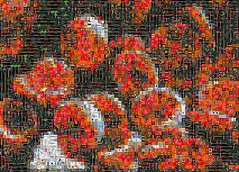
In it, there is a colour scientist, Mary, who has a full materialistic account of colour processing available, she knows everything there is to know about that. But she has lived in a black and white environment all her life. Now Mary is for the first time taken out of that environment and shown something red, the above mosaic of red blood cells, for example. Now, Jackson argues, she knows something she did not know before: she know what it feels like to see something red. Since we have assumed that she had a full materialistic account of colour vision, the quality of seeing is not included in that account. Thus, there is more than said account. QED.
Which, of course, more often than not stands for Quod erit demonstrandum – somthing that should be proven, but isn’t.
Let’s look at the argument in some detail, to see where it might go wrong. What exactly is it that Mary has learned when she sees the red? Specifically, if we asked her, could she tell us what it is she has learned? Alas, she could not. Anything about the experience of seeing red that she could describe in words – say if the experience suggested warmth to her – would necessarily be part of what she knew before. Remember? She knows everyhting there is to know about colour vision. She knows what happens when coloured light hits the retina, she knows how it tickles the brain, and what associations and processes are caused by it. She would even have known what it felt like to see red – in the theoretical meaning of the words, where she can deduce the causal consequences and side effects of such a feeling.
The only thing she can be said to have gained by being shown the mosaic, is the actual experience. But just as in the case of the bat, where being a bat is not a legitimate part of a theory of the bat’s mind, an experience is not something that can or should be part of the theory of mind. The theory should of course describe the experience in all detail and consequence. But it need not, and cannot, contain that experience, nor cause it.
In other words, after looking at the mosaic Mary’s brain is in a state it has not been in before, but which she indeed knew everything about beforehand (which in itself is probably impossible, but that’s beside the point here).
To require colour vision theory to contain actual brainstates is just as silly as to claim that hydrodynamics is incomplete, because there is no actual physical glass of water in it.
Deprecated: Function link_pages is deprecated since version 2.1.0! Use wp_link_pages() instead. in /mnt/web224/a3/17/5110917/htdocs/engine/wp-includes/functions.php on line 6170