Search

Engine


Saturday, January 28th, 2006

Jigsaw Pieces

two helmets

5
Die Ampel schaltet, als ich beinahe die Kreuzung erreicht habe, und ich bringe das Rad erst in der Mitte des Fussgängerstreifens zum Stehen. Niemand überquert die Strasse hier, ich bleibe also stehen und warte auf die nächste Schaltung. Während des Wartens erinnere ich mich, dass man auch in Kalifornien auch bei Rot rechts abbiegen darf, und ungleich Autos, die die rechte Spur zum gradeausfahren nutzen, kann ich auf meinem Rad dem Nachfolger Platz machen. Der Wagen hinter mir blinkt zwar nicht, aber das tun sie hier ohnehin selten. Ohne abzusteigen ziehe ich also das Rad nach rechts an den Strassenrand, und wirklich rollt sofort das Auto hinter mir voran, ist neben mir, und der Fahrer blafft durchs offene Fenster “I’ll roll your piece of shit over if you don’t get out of the way”, nimmt die Kurve und ist weg.

6
Der Weg von der Universität hügelab ist steil und nagt an den Bremsklötzen. Am rechten Strassenrand stehen die Linienbusse abfahrtbereit und warten auf Studentenfracht. Ich rolle in der Mitte der rechten Spur, einen Meter von der Busaussenseite entfernt, am Bus vorbei, und dann noch ein Stück weiter hügelab, ehe ich an den rechten Strassenrand ausweiche. Ein Mittelklassewagen schiebt sich an mir vorbei, durchs offene Seitenfenster bricht die überschlagende Stimme einer jungen Frau, Beifahrerin, “we’ll run you over”, vermutlich ist der Satz Teil der Führerscheinprüfung hier.

7
Shattuck teilt sich nördlich des Stadtzentrums von Berkeley, zwei Blocks lang, in zwei separate Einbahnstrassen. Mein Ziel ist das chinesische Restaurant auf der Westseite der Nordspur, ich halte mich also rechts auf der Fahrt nach Norden, grade schnell genug für die Ampelschaltungen, die Autos auf der rechten Spur fahren ein wenig schneller, und stehen je ein paar Sekunden an der noch roten Ampel des nächsten Blocks. Ich drehe mich um, und ein Kleinwagen folgt mir im Abstand von einem Meter. Bremse ich jetzt, falle ich vom Rad, blockiert der Umwerfer die Speichen des Hinterrades, das Auto muss mich überrollen, unmöglich für den Fahrer, schnell genug zu reagieren. Mein Leben für eine halbe Sekunde Zeitersparnis. Immerhin kein aggressiver Ausruf, diesmal.

Monday, January 23rd, 2006

Neal Stephenson – Cryptonomicon (2)

This book has it all, geeky and cool facts about cryptology, military, social and technological history, a fairly believable conspiracy plot, insights into high-tech investment politics and an epic breadth and richness of materials that stunds. So why did reading it feel so tedious, and why was I glad when it finally was over? Maybe it’s because of the odd feeling of detached interest that perfuses the work. Stephenson describes the human dimension of his adventure with the emotions of a boy watching ants through a magnifying glass on a sunny day, just before he decides to see what happens when he burns them. It’s a terrific story, but it felt like someone else was reading it.

Thursday, January 5th, 2006

Seeing words

ikeabears

A neat new study done right here at UC Berkeley finds that when the colours of a target has a different name from that of distractors, the left hemisphere is faster at finding the target than the right, while this advantage disappears for colours without a naming difference. The left hemisphere’s edge also disappeared when an additional task taxed verbal working memory, but not when spatial working memory was taxed instead.

So Worf had it right, after all, when he said “Sir, I protest – I am not a merry man!”. And Whorf was right, as well: language indeed does influence our brain’s operations on a very basic level.

Saturday, December 31st, 2005

Paying through the Nose

the nose

On an episode of Whad’ya Know taped in Wyoming I just heard about a man who can place a penny on his tongue, move it up his nose in the back of his throat and retrieve it through the nostrils. Amazing, isn’t it? He visited Letterman’s show to demonstrate the penny come out of his nose.

That could have been me! I’ve always been able to put my tongue behind my soft palate and probe my tonsils, but it never occured to me to launch a transportation industry back there. Maybe it’s not too late.

Friday, December 30th, 2005

Seeing Red

red blood cells

The second of the arguments against a materialistic theory of mind that I’m going to debunk is based on an article by Frank Jackson, “What Mary didn’t know”.

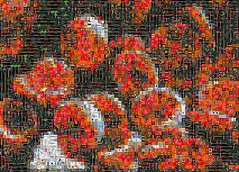
In it, there is a colour scientist, Mary, who has a full materialistic account of colour processing available, she knows everything there is to know about that. But she has lived in a black and white environment all her life. Now Mary is for the first time taken out of that environment and shown something red, the above mosaic of red blood cells, for example. Now, Jackson argues, she knows something she did not know before: she know what it feels like to see something red. Since we have assumed that she had a full materialistic account of colour vision, the quality of seeing is not included in that account. Thus, there is more than said account. QED.

Which, of course, more often than not stands for Quod erit demonstrandum – somthing that should be proven, but isn’t.

Let’s look at the argument in some detail, to see where it might go wrong. What exactly is it that Mary has learned when she sees the red? Specifically, if we asked her, could she tell us what it is she has learned? Alas, she could not. Anything about the experience of seeing red that she could describe in words – say if the experience suggested warmth to her – would necessarily be part of what she knew before. Remember? She knows everyhting there is to know about colour vision. She knows what happens when coloured light hits the retina, she knows how it tickles the brain, and what associations and processes are caused by it. She would even have known what it felt like to see red – in the theoretical meaning of the words, where she can deduce the causal consequences and side effects of such a feeling.

The only thing she can be said to have gained by being shown the mosaic, is the actual experience. But just as in the case of the bat, where being a bat is not a legitimate part of a theory of the bat’s mind, an experience is not something that can or should be part of the theory of mind. The theory should of course describe the experience in all detail and consequence. But it need not, and cannot, contain that experience, nor cause it.

In other words, after looking at the mosaic Mary’s brain is in a state it has not been in before, but which she indeed knew everything about beforehand (which in itself is probably impossible, but that’s beside the point here).

To require colour vision theory to contain actual brainstates is just as silly as to claim that hydrodynamics is incomplete, because there is no actual physical glass of water in it.

Saturday, December 24th, 2005

What is it like to be a squirrel?

curiosity

There seems to be a rather curious disconnect between the people doing basic neuroscience research and philosophers of mind. While the former operate on the implicit assumption that mental phenomena are reducible to physical phenomena, and that fully understanding the latter will imply understanding the former, philosophers are struggling with principled objections against this form of materialistic monism.

I recently attended some of John Searle’s Philosophy of Mind lectures, where he introduced seven such objections to materialism, including of course his own Chinese Room argument.

On none of the seven did he manage to convince me, and I’ll present my counterarguments here. I’ll start with the cuddliest of the arguments, put forward by Thomas Nagel, who famously asked

“What is it like to be a bat?”

The argument’s core, as I understand it, is: suppose we knew everything knowable about bats. That is a big assumption, and we never might, but even if this were true, Nagel argues, we’d still lack one crucial piece: we wouldn’t know what it’s lile to be one. Our theories and descriptions of the bat would quantify everything, but they wouldn’t capture the quality of batness. This is known as the argument of absent qualia, for obvious reasons, and it seems convincing on the surface – no physical theory about bats can show us what it’s like to be one, so being a bat is not part of a physical theory.

This argument is erroneous, and I think it’s central problem is a confusion of hierarchies, which I’ll explain in a second. But first let’s have a look at an analogy. Suppose we knew everything there is to know about water. Would that tell us what it feels like to be wet? Of course it wouldn’t, because that is not, indeed cannot be the job of a theory. The theory can describe to us how adhesive and cohesive forces would work to cover our skin with a liquid film, it can tell us how the high specific heat capacity and evaporation will affect skin temperature, how all that combines to create certain nerve impulses, and so on. But to know what it’s like, we’ll have to jump into a river, or, lacking one, take a shower. Does that mean our theory of water is incomplete? No. All it means is that there is a difference between the theory and the real thing. Real water can be experienced, a theory of real water can’t. If there is a hole in a theory at all, it’s in the description of our own minds. But let’s not worry about that for a moment.

That took us off the bat, so let’s get back to it. A theory of the bat’s mind will not, indeed cannot, contain a description of what it’s like to be a bat, because that isn’t even part of the theory of bat minds. It’s part of the theory of human minds. We can perfectly describe what goes on inside the bat’s mind, relate sensory input to motor output via cognitive processes (if you like that way of describing things, which might turn out not to be too great in the end), without missing a thing.

So back to the description of ourselves. What I indeed can not obtain from the description of a bat is what it would feel like for me to be a bat. But there is two possible arguments against that being a problem. The first one is that is very probably a nonsensical question to ask. I am not a bat, and were I a bat, I wouldn’t be me, so it seems pretty close to being logically impossible for me to have the batness cake and feel it, so to speak.

But there is a more profound objection. What is it you want when you ask the above question? You want a theory that, in capturing the structure of the mind, enables you to implement that mind. In other words, you want a theory that produces that which it describes. Which seems even sillier than wanting to be a bat. It’s worse than complaining that your theory of water doesn’t make you feel wet; it’s like complaining that your water theory doesn’t make you wet other things, doesn’t make you emulate water.

Sounds silly. So why doesn’t the bat question sound equally silly? I think it’s because of the hierarchy confusion. The practical purpose of theories is to give you an understanding of it’s subject. So when the theory is one about mind, and thus about understanding, it seems natural to expect to obtain that understanding that is the subject of the theory, when in fact all the theory is going to give you is an understanding of that understanding.

In short: yes, qualia are absent from the theory. That’s because the qualia are not the substance, but the subject of the theory. It’s perfectly able to describe them, as much as any theory is able to describe anything. This is different from the real thing, of course, and that’s not special to the mind, nor is it a indication that more than the physical world needs describing.

Now go find some nuts. You must be hungry.

Monday, December 19th, 2005

Munching pills in darkened rooms

Cognitive Daily ? Video games: Are the myths true?

It’s a contentious issue – do computer games add to behavioral problems or are they a mere symptom. Every time I hear someone claim that violence is caused by games, I just want to whip out the rocket launcher and splash their brains on the pixelated wall; luckily I always remember the number one lesson playing the Doom series games taught me: don’t use a rocket launcher in a tight space. So I have to resort to reasoned arguments, like those presented by Dave Munger over at Cognitive Daily (link above). Doesn’t that prove somethingor other?

Worth mentioning in that context is the fabulous quote/joke “Computer games don’t affect kids; I mean if Pac-Man affected us as kids, we’d all be running around in darkened rooms, munching magic pills and listening to repetitive electronic music.” That quote is usually misattributed by non-factchecking geeks to some Nintendo CEO named Kristian Wilson. In fact, it’s been written by comedian Marcus Briggs, who is rightly proud of it.

Monday, December 19th, 2005

Ursula K. Le Guin – The Farthest Shore (2)

The final volume of the Earthsea Trilogy, and, to me, the strongest of the three. It’s main theme, the struggle caused by the realization that life and death are intricately linked (a thought which is part of the dualist/taoist thinking that weaves like a thread through the whole trilogy, and indeed much of Le Guin’s other writing) and one is impossible without the other, unfolds against a backdrop of exciting encounters, and the overall athmosphere of impending doom caused by the widespread refusal to accept mortality still has a very realistic tone today, more than 30 years after it was originally written.

Friday, December 16th, 2005

Stereotypes a go-go

Cognitive Daily – The negative impact of positive stereotypes

Three groups of asian women were given math tests to perform. Each of the three group got a different focal questionnaire before, the first focused on the contestant’s personality, the second on their race the third on their gender. Sounds like a fairy tale? There’s a reason.

The race group came out doing about 15% worse on the test (the cited article doesn’t provide statistics to put that difference into perspective, but 15% is big anyway, and if you go to the original paper, you’ll find it’s significant at p<0.025. Fair enough.), but the conclusion drawn is ludicrously ill-founded. Rather than conclude, for instance, that bringing up stressful subjects before a test disrupts performance, the performance drop is attributed to racial stereotypes of success and the pressure that puts on asians. It’s called “pulling causalities out of your ass”, I believe. Which, ironically, is one of the stereotypes I have of psychology research. It just disrupts my concentration.

Friday, December 16th, 2005

Jigsaw Pieces

digest this

4a

This ploy is quite popular among marketing fucks, it seems. This is the second one in two weeks I received. Send magazine advertisements that look like an invoice, and some percentage of recipients will be suckered into actually paying and thus subscribing to your quality rag. Why, it’s pure evil genius!

Update for this.