Wednesday, May 17th, 2006
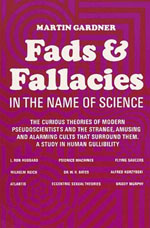 Crank science is fascinating to me, and the more elaborate the unfounded theories get, the more so. Just as a collection and overview of some of the classics of the cranks, this book is already invaluable. Above and beyond the pure review of mad scientists’ view of the world, this book raises the issue, in several places, of whether or not these cranks should be allowed to do what they do, and how the public should and should not receive them. Gardner wrote this in the late 1950s, and his perspective is clearly heavily influenced by the Velikovsky incident. Velikovsky published fairly outrageous and quite original theories on the influence of catastrophic astronomical events on world history, most notable the two near crashings of a comet that was later to become the planet Venus into historic Earth, and caused a big stir when scientists objected against Worlds in Collision having been published at all, and defenders of free speech rushed to the madman’s defense. Gardner’s position, as that of so many scientists, is unforgiving. He doesn’t want to restrict the ability of cranks to do their thing, but he doesn’t like them getting publicity when very clearly their work is not up to scientific standards. I am somewhat torn on this. I love the strange poetry and creativity in the these works, abd it would be a shame to lose these voices, even if their contributions to scientific discourse are not of the usual, incrementally explarative, kind.
The notion that an unsuspecting an uneducated public needs to be protected from misleading, sensationalist accounts that do damage to science education to me seems overly controlling and snobbish; but on the other hand, the statistics time and again prove that people do in fact believe in UFO’s, the existence of angels, the literal truth of the bible and any number of other theories at obvious odds with accepted scientific fact, and more importantly, more often than not, such beliefs will have negative practical consequences. It probably is a good idea, then, to prevent access of propagandists of these beliefs to institutions of higher education and the academic discourse, to avoid giving the public credibility they so hungrily desire. On the other hand, this shoehorning of thought into usability, fact and value leaves me somewhat uncomfortable.
Books, English, Geekstuffs, History, Must See, Science | No Comments »
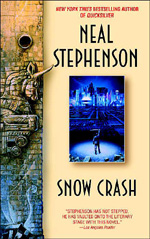 A very inventive story and cool story, with the same weakness Stephenson’s other books have in my opinion, a forced ending. Creating complexity, just to then shoehorn it into some resolution so readers can feel better is not something I approve of. Otherwise it’s quite flawless, though. It’s also quite interesting to see how Stephenson obviously churned on the themes he scratched upon in this novel for the later Diamond Age, and then took them into more realistic contemporary fiction with the Cryptonomicon.
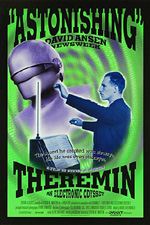 The staggering story of a Russian who invented one of the weirdest musical instruments of all time, single handedly launching electronic music, then got abducted by the KGB, for whom he then invented the electornic spy bug, and after decades got reunited with his friends, who didn’t know where he was, or whether he was still alive, should have made an awesome movie. Unfortunately, this is not that movie. The reliance of interview material that is less than thrilling and talking head shots instead of interactions draws out the plot, and it is only at the very end, when Theremin meets a woman he knew as a 18 year old singer before his abduction, when the tragedy of the story gets some stage – and five minutes later the movie is over. Still worth watching, but more for factual content than for its artistry.
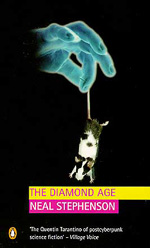 With the Cryptonomicon in mind, I expected a story similarly overfraught with meandering detail, but found myself pleasantly surprised. A well worked out future world, centered on changes in politics brought about by the development of nanotechnology, provides a nonintrusive background for a neo-victorian play on education and the value of the individuum that is as much fun as it is solid. While the psychology and character development, as is so unfortunately common in Science Fiction, take second stage after the geeky technostuff and the equally geeky ramifications of the technostuffs effects, the result is a delightful study. While the end is maybe a bit forced, this still makes me want to read Snowcrash now, Stephensons debut.
 I like the idea of multiplayer games, but this incarnation of it, with a rigid world full of unchanging story elements and a large number of people running around in it, doesn’t quite fulfill the promise. I’d like to see more interaction possibilities beyond the mere killing of monsters in a group, and some plasticity in the world makeup. As it is, the game is just a combination of chat and RPG. Nothing wrong with that, but nothing interesting about it, either.
 I’m not sure what it all means, if anything, but plugging Neuroscience into Google’s newest toy,
  Sometimes one opens a book, or reads a first line, and immediately it’s clear that the thoughts and concepts that went into the work were sorely missing from the world, yet nobody had realized it before. Such is the case with this gem of philosophical reasoning. An essay on the essence of bullshit, and an attempt to explain its apparently increasing dominance of today’s communication, this work should be the basis for a much more thorough study of the phenomenon. The exhilarating delight and sheer fun of reading a serious deliberation on the issue must not distract from the fact that this is not satire, nor is it humorous, except insofar as it is a surprising and complex study of a phenomenon commonly thought to be not worthy of such study. To be sure, this combination of surprise and incongruency of means and perceived complexity of the subject are what makes the first reading such a pleasure, and look superficially like a satire of moral philosophy. But to stop at that level would be to mistake the work for its subject, and to miss the chance to develop the tools to attack the toxic prevalence of bullshit in all the public spheres of communication.
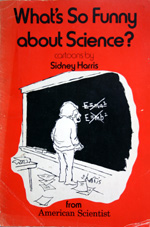 Sadly, this collection of cartoons mostly shows why Science and Humour are commonly considered to be unmixable substances. A few of the jokes are actually funny, but they’re rarely the ones that actually deal with scientists, or science as such, but rather ones inspired by or loosely based on scientific ideas. A few years back, Carl Djerassi wrote several novels in a genre he calls science-in-fiction (early Science Fiction writers probably would have been horrified by the necessity for that distinction), and if I remember correctly, none of them turned out particularly funny, though he sure tried. These cartoon have the additional disadvantage of stemming from strange, past decades, and so are mainly of interest to historians. Ah, historians, don’t get me started on those. Hilarious!