Saturday, December 24th, 2005

There seems to be a rather curious disconnect between the people doing basic neuroscience research and philosophers of mind. While the former operate on the implicit assumption that mental phenomena are reducible to physical phenomena, and that fully understanding the latter will imply understanding the former, philosophers are struggling with principled objections against this form of materialistic monism.
I recently attended some of John Searle’s Philosophy of Mind lectures, where he introduced seven such objections to materialism, including of course his own Chinese Room argument.
On none of the seven did he manage to convince me, and I’ll present my counterarguments here. I’ll start with the cuddliest of the arguments, put forward by Thomas Nagel, who famously asked
“What is it like to be a bat?”
The argument’s core, as I understand it, is: suppose we knew everything knowable about bats. That is a big assumption, and we never might, but even if this were true, Nagel argues, we’d still lack one crucial piece: we wouldn’t know what it’s lile to be one. Our theories and descriptions of the bat would quantify everything, but they wouldn’t capture the quality of batness. This is known as the argument of absent qualia, for obvious reasons, and it seems convincing on the surface – no physical theory about bats can show us what it’s like to be one, so being a bat is not part of a physical theory.
This argument is erroneous, and I think it’s central problem is a confusion of hierarchies, which I’ll explain in a second. But first let’s have a look at an analogy. Suppose we knew everything there is to know about water. Would that tell us what it feels like to be wet? Of course it wouldn’t, because that is not, indeed cannot be the job of a theory. The theory can describe to us how adhesive and cohesive forces would work to cover our skin with a liquid film, it can tell us how the high specific heat capacity and evaporation will affect skin temperature, how all that combines to create certain nerve impulses, and so on. But to know what it’s like, we’ll have to jump into a river, or, lacking one, take a shower. Does that mean our theory of water is incomplete? No. All it means is that there is a difference between the theory and the real thing. Real water can be experienced, a theory of real water can’t. If there is a hole in a theory at all, it’s in the description of our own minds. But let’s not worry about that for a moment.
That took us off the bat, so let’s get back to it. A theory of the bat’s mind will not, indeed cannot, contain a description of what it’s like to be a bat, because that isn’t even part of the theory of bat minds. It’s part of the theory of human minds. We can perfectly describe what goes on inside the bat’s mind, relate sensory input to motor output via cognitive processes (if you like that way of describing things, which might turn out not to be too great in the end), without missing a thing.
So back to the description of ourselves. What I indeed can not obtain from the description of a bat is what it would feel like for me to be a bat. But there is two possible arguments against that being a problem. The first one is that is very probably a nonsensical question to ask. I am not a bat, and were I a bat, I wouldn’t be me, so it seems pretty close to being logically impossible for me to have the batness cake and feel it, so to speak.
But there is a more profound objection. What is it you want when you ask the above question? You want a theory that, in capturing the structure of the mind, enables you to implement that mind. In other words, you want a theory that produces that which it describes. Which seems even sillier than wanting to be a bat. It’s worse than complaining that your theory of water doesn’t make you feel wet; it’s like complaining that your water theory doesn’t make you wet other things, doesn’t make you emulate water.
Sounds silly. So why doesn’t the bat question sound equally silly? I think it’s because of the hierarchy confusion. The practical purpose of theories is to give you an understanding of it’s subject. So when the theory is one about mind, and thus about understanding, it seems natural to expect to obtain that understanding that is the subject of the theory, when in fact all the theory is going to give you is an understanding of that understanding.
In short: yes, qualia are absent from the theory. That’s because the qualia are not the substance, but the subject of the theory. It’s perfectly able to describe them, as much as any theory is able to describe anything. This is different from the real thing, of course, and that’s not special to the mind, nor is it a indication that more than the physical world needs describing.
Now go find some nuts. You must be hungry.
English, Neuroscience, Philosophy, Science | No Comments »
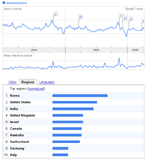 I’m not sure what it all means, if anything, but plugging Neuroscience into Google’s newest toy, Google Trends, reveals a downward trend of Neuroscience related searches in recent years, an upward trend in Neuroscience news items, and Korea to be the top nation in the world when it comes to searching for Neuroscience. Within the US, Washington suburb Bethesda leads the field, searching about four times as much as runner-up Baltimore. What does it all mean? Here’s the answer.
 Sometimes one opens a book, or reads a first line, and immediately it’s clear that the thoughts and concepts that went into the work were sorely missing from the world, yet nobody had realized it before. Such is the case with this gem of philosophical reasoning. An essay on the essence of bullshit, and an attempt to explain its apparently increasing dominance of today’s communication, this work should be the basis for a much more thorough study of the phenomenon. The exhilarating delight and sheer fun of reading a serious deliberation on the issue must not distract from the fact that this is not satire, nor is it humorous, except insofar as it is a surprising and complex study of a phenomenon commonly thought to be not worthy of such study. To be sure, this combination of surprise and incongruency of means and perceived complexity of the subject are what makes the first reading such a pleasure, and look superficially like a satire of moral philosophy. But to stop at that level would be to mistake the work for its subject, and to miss the chance to develop the tools to attack the toxic prevalence of bullshit in all the public spheres of communication.