Wednesday, May 17th, 2006
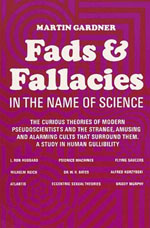 Crank science is fascinating to me, and the more elaborate the unfounded theories get, the more so. Just as a collection and overview of some of the classics of the cranks, this book is already invaluable. Above and beyond the pure review of mad scientists’ view of the world, this book raises the issue, in several places, of whether or not these cranks should be allowed to do what they do, and how the public should and should not receive them. Gardner wrote this in the late 1950s, and his perspective is clearly heavily influenced by the Velikovsky incident. Velikovsky published fairly outrageous and quite original theories on the influence of catastrophic astronomical events on world history, most notable the two near crashings of a comet that was later to become the planet Venus into historic Earth, and caused a big stir when scientists objected against Worlds in Collision having been published at all, and defenders of free speech rushed to the madman’s defense. Gardner’s position, as that of so many scientists, is unforgiving. He doesn’t want to restrict the ability of cranks to do their thing, but he doesn’t like them getting publicity when very clearly their work is not up to scientific standards. I am somewhat torn on this. I love the strange poetry and creativity in the these works, abd it would be a shame to lose these voices, even if their contributions to scientific discourse are not of the usual, incrementally explarative, kind.
The notion that an unsuspecting an uneducated public needs to be protected from misleading, sensationalist accounts that do damage to science education to me seems overly controlling and snobbish; but on the other hand, the statistics time and again prove that people do in fact believe in UFO’s, the existence of angels, the literal truth of the bible and any number of other theories at obvious odds with accepted scientific fact, and more importantly, more often than not, such beliefs will have negative practical consequences. It probably is a good idea, then, to prevent access of propagandists of these beliefs to institutions of higher education and the academic discourse, to avoid giving the public credibility they so hungrily desire. On the other hand, this shoehorning of thought into usability, fact and value leaves me somewhat uncomfortable.
Books, English, Geekstuffs, History, Must See, Science | No Comments »
 There isn’t much I’m going to say about this magnificent genre marriage of film noir thriller with highschool drama, except: go, see it. A remarkable script, pitch perfect performances, a multitude of lovely details and references: Just go, already.
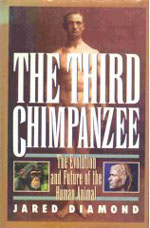 I have a weakness for the crop of evolutionary psychology and anthropology that has sprung up in recent years, and this one on the evolution of the human chimpanzee and the specific problematic baggage he brings from this evolutionary history is no exception. Of particular interest, both for content, as well as for the insight into the genesis of such book it provides, is the chapter on differential development of human societeties, that later bloomed into a full grown book of its own: Guns, Germs and Steel. Diamond writes delightfully entertaining, and his examples are fascinating. The only drawback is the bleak picture he paints for the future of this planet and our species, sounding just as correct today as it did 15 years ago, when he wrote it. The only difference being that the monster of major climate change caused by us monkeys no longer is something to be feared decades in the future, but seems to wait just around the corner. Maybe we can gang up on it, kill it and eat it. That strategy served us well in the past.
 It is a disturbing fact of post-war German history that plenty of active National Socialists continued on to positions of power and influence in the Bundesrepublik, partly because of a lack of skilled leadership personnel not involved with the regime, but also because the anti-communist notions of the old criminals fit well into the new political struggle emerging in Europe. Against this historical background, Riefenstahls particular story becomes all the more fascinating. Her unsettlingly effective propaganda documentaries, Triumph des Willes and Fest der Völker, on the 1935 Nuremberg rally and the 1936 Olympic Games, created a fame for her that was probably the reason for her fall after the war. She wasn’t able to make any more movies, and all her other creative efforts – most notably her photography of the people – got subjected to close scrutiny and harsh criticisms for suspicions of a fascist esthetic, and were always contextualized with her past. This movie portrays her both as the victim of scapegoating and a stubborn denier of aspects of her life, but most of all it paints the fascinating picture of a multifaceted woman, who had the misfortune to live in evil times. You might not like her after this documentary, but you won’t regret having seen it.