Thursday, June 15th, 2006
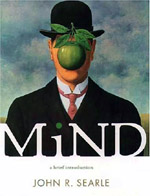 I consider this a great book, not so much because I agree with what Searle says in it. In fact, I don’t agree with hardly anything he says. But it does provide a nice, comprehensive introduction into the philosophy of mind, and it lists several recent major arguments in the field. Searle’s deliberately naive style, calling whole schools of thoughts “complete desasters”, is fun to read, and invites counterarguments. The downside might be that it encourages half baked criticism and opinionation much like what I’m putting down here. Did I say downside? Upside, I meant. So let’s start ranting.
The main thrust of his book is to provide an alternative to materialism and dualism, both of which Searle perceives as having failed to explain the mind. In the case of dualism, the arguments are hardly worth repeating, I’ll restrict myself to the main one, which is: if there is something that is distinct from the physical, how can it work as a causal agent or indeed, interact with the physical at all? Let’s leave it at that, dualism is a straw mean not worth beating on.
Much more interesting are the arguments against materialsm, in other words, the notion that the mental is nothing but the physical and identical with it. Cowardly shirking the technical arguments about type-identity and token-identity, for I admit a certain shakyness on the terminology, I find the rest of the bunch entirely unconvincing. Be it Mary the color scientist, the hapless bat whose experience we will never have, the Zombie arguments, the argument of history-without-mind, Searle’s own chinese room. All are designed to bring out an apparent contradiction, in effect saying: look, I assumed that the mental is the physical, and I arrive at an absurd or impossible conclusion, therefore it can’t be so.
For example, to pick one: assume we know everything there is to know about bat’s brains. Then we still don’t know what it’s like to be one, i.e. there is something about being a bat that all our knowledge doesn’t reveal to us. On a brief glance I see three things wrong with the argument. First, it’s not at all clear to me that it is possible to know everything there is to know about a bat’s brain. It might just turn out to be too complex a process to hold in a human mind. Second, I don’t see any evidence one way or the other that would allow me to conclude that knowing all there is to know about the bat would or would not allow me to have the experience. I think it’s unlikely, but as long as we don’t know what experiences are, arguing with hypothetical situations and claiming to know what experiences would and would not arise seems premature. Third, and most importantly, I’m pretty sure wanting to have the experience of being a bat is confusion. In a physical analogue, if I know everything there is to know about hydrodynamics and the physics of waves, will I physically be like a wave? More to the point, will the fact that I will not be physically like a wave prove there is something in addition to the physical about a wave? Some wavy-ness not capturable by any physical theory? Of course the answer is no, and the question is the result of a mixup: the theory is not the object.
Back to the bat: even if I could know all there is to know, and even if that didn’t give me access to everyhting it means to be feeling like a bat myself, all that says is that the actual object of my theory, the experience, exists independent of the theory. And it’s just silly shamanism to demand that we obtain properties of the described by describing it. The confusion arises because in the case of experiences the theory and its object seem to both be mental processes, but that is not relevant. The experience of the bat is a state of the bat’s brain, and of course I can’t be in that state. I’m not a bat’s brain, silly.
None of the other arguments work any better, they all are a mix of unfounded assumptions and unwarranted conclusions. The Chinese Room for example slyly axiomatically uses the common sense notion that following a bunch of cards will not produce understanding, and then, Heureka!, concludes triumphantly that algorithms can’t produce understanding. True, if you put it in as an assumption. Assume that they do, and suddenly the ficticious Searle in his room will shuffle cards and understand what he’s doing, whatever that means.
The main reason all these arguments have to be fallacious is that they try to deduce an empirical fact from first principles. Whether or not the mind is physical, algorithmical or reducible is an empirical question for neuroscience, and all the counterarguments tell us more about the internal structure of our minds, the things we take for granted and the things we can think than they do about these empirical facts. Searle sees this for some of the issues, but is blind to it whenever his own beliefs are concerned.
So his eternal mantra that the syntacic can’t cause the semantic, and his argument for freedom of will, based mostly on his hunch that nature wouldn’t have made us think we have freedom of choice if we didn’t, share their weaknesses with those of the strawmen of materialism criticism his naive realism originally set out to burn.
Books, English, Good, Neuroscience, Nonfiction, Philosophy, Science | No Comments »

 I found this a somewhat strange book. The central neuroscientific idea put forth is a fascinating one. When we separate feeling from emotion by declaring the former to be the inner state and the latter to be the outward expression of that state, we find complex interactions between the two, and a convincing argument can be made, that feeling in essence is a mapping of internal body states, and that the sinking feeling int he gut, the racing heart, the tenseness in the chest, aren’t side effects of feelings, they are in a sense what feelings are. They are their substance.
 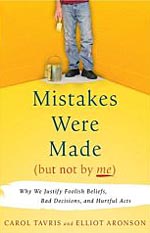 This book about cognitive dissonance is a good read, and an interesting account of both the theory of why our decisions and opinions can be so much at odds with reality sometimes and a number of examples from history and daily life, where the principle can be observed in action. Yet through much of it, it felt like being a bit lost in someones attempt to make sense of the subject, and as though going to Festinger’s original work might be more illuminating. This in spite of the fact that I don’t think he ever wrote something comprehensive like this on top of his individual studies.
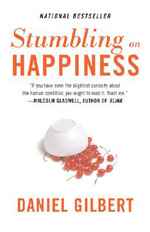 Why are we so notoriously bad at predicting what will make us happy, and why are we so often mistaken when we remember how we felt in the past? Gilbert’s hypothesis is that the nature of the neural system that allows us to imagine is to blame/ This system, which allows us both the filling in of the details of memories and the fleshing out of the nature of the future, draws on the same circuitry we use to feel the present, which is why both the past and the future are contaminated by how we feel right now. While the style of the book is maybe a tad forced in terms of wittyness, it is a delightful read, and the wealth of experiments Gilbert draws on to make his case was fascinating to read. At least that’s how I remember it.


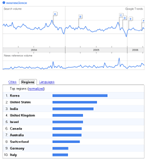 I’m not sure what it all means, if anything, but plugging Neuroscience into Google’s newest toy,
 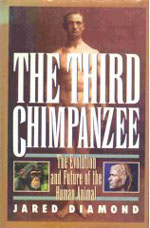 I have a weakness for the crop of evolutionary psychology and anthropology that has sprung up in recent years, and this one on the evolution of the human chimpanzee and the specific problematic baggage he brings from this evolutionary history is no exception. Of particular interest, both for content, as well as for the insight into the genesis of such book it provides, is the chapter on differential development of human societeties, that later bloomed into a full grown book of its own: Guns, Germs and Steel. Diamond writes delightfully entertaining, and his examples are fascinating. The only drawback is the bleak picture he paints for the future of this planet and our species, sounding just as correct today as it did 15 years ago, when he wrote it. The only difference being that the monster of major climate change caused by us monkeys no longer is something to be feared decades in the future, but seems to wait just around the corner. Maybe we can gang up on it, kill it and eat it. That strategy served us well in the past.