Search
Monday, December 19th, 2005

Munching pills in darkened rooms

Cognitive Daily ? Video games: Are the myths true?

It’s a contentious issue – do computer games add to behavioral problems or are they a mere symptom. Every time I hear someone claim that violence is caused by games, I just want to whip out the rocket launcher and splash their brains on the pixelated wall; luckily I always remember the number one lesson playing the Doom series games taught me: don’t use a rocket launcher in a tight space. So I have to resort to reasoned arguments, like those presented by Dave Munger over at Cognitive Daily (link above). Doesn’t that prove somethingor other?

Worth mentioning in that context is the fabulous quote/joke “Computer games don’t affect kids; I mean if Pac-Man affected us as kids, we’d all be running around in darkened rooms, munching magic pills and listening to repetitive electronic music.” That quote is usually misattributed by non-factchecking geeks to some Nintendo CEO named Kristian Wilson. In fact, it’s been written by comedian Marcus Briggs, who is rightly proud of it.

Monday, December 19th, 2005

Joe Haldeman – Forever Peace (2)

This is a story of many plots, ranging from the destruction of the universe, or a substantial fraction thereof, by nanotechnology, to modern warfare and social philosophy to moral conundrums of modern life – interracial dating, for example – and it tries to both set up these varying fields as enormous problem zones, and then present realistic solutions. Most of the central ideas and technologies, and the problems caused by them – the social impact of full automation both on the society controlling it and the societies controlled by it, or the psychological and military implications of remotely controlled superwarriors, to name two – are daring and impressive, and the extrapolation of US foreign policy into the year 2048 seems frighteningly believable. But against the tapestry of these towering problems, Haldemans solution falls somewhat short, both within the universe of his novel and our own. Still, with its very gripping, thoughtful and empathic plot, Forever Peace fully deserves the Hugo and Nebula awards it won.

Monday, December 19th, 2005

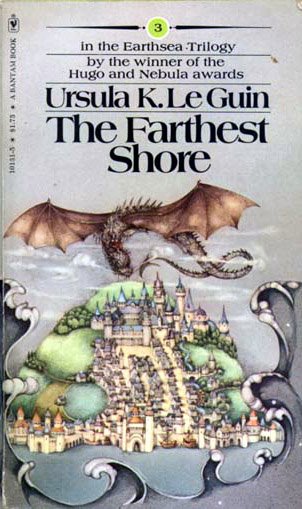
Ursula K. Le Guin – The Farthest Shore (2)

The final volume of the Earthsea Trilogy, and, to me, the strongest of the three. It’s main theme, the struggle caused by the realization that life and death are intricately linked (a thought which is part of the dualist/taoist thinking that weaves like a thread through the whole trilogy, and indeed much of Le Guin’s other writing) and one is impossible without the other, unfolds against a backdrop of exciting encounters, and the overall athmosphere of impending doom caused by the widespread refusal to accept mortality still has a very realistic tone today, more than 30 years after it was originally written.

Friday, December 16th, 2005

Stereotypes a go-go

Cognitive Daily – The negative impact of positive stereotypes

Three groups of asian women were given math tests to perform. Each of the three group got a different focal questionnaire before, the first focused on the contestant’s personality, the second on their race the third on their gender. Sounds like a fairy tale? There’s a reason.

The race group came out doing about 15% worse on the test (the cited article doesn’t provide statistics to put that difference into perspective, but 15% is big anyway, and if you go to the original paper, you’ll find it’s significant at p<0.025. Fair enough.), but the conclusion drawn is ludicrously ill-founded. Rather than conclude, for instance, that bringing up stressful subjects before a test disrupts performance, the performance drop is attributed to racial stereotypes of success and the pressure that puts on asians. It’s called “pulling causalities out of your ass”, I believe. Which, ironically, is one of the stereotypes I have of psychology research. It just disrupts my concentration.

Friday, December 16th, 2005

Amanita Design – Samorost (1)

This game is just brilliant in design, storyboard and execution. Very otherworldly level designs and a brilliantly surreal game logic, paired with cuteness – its only fault is that it is too short.

Samorost | Samorost 2

Friday, December 16th, 2005

Jigsaw Pieces

digest this

4a

This ploy is quite popular among marketing fucks, it seems. This is the second one in two weeks I received. Send magazine advertisements that look like an invoice, and some percentage of recipients will be suckered into actually paying and thus subscribing to your quality rag. Why, it’s pure evil genius!

Update for this.

Friday, December 16th, 2005

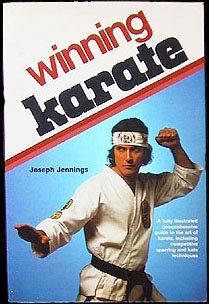
Joseph Jennings – Winning Karate (3)

With martial arts training, it’s mre about the form, the spirit and the attitude of the student than it is about the actual specific movement or skill that’s trained. So a physical description of the basic techniques provides technical rather than spiritual insight – at least when it’s read rather than physically studied. On the other hand, the illustrations in this book demonstrating how to deal with an attacker armed with a gun, knife or rifle, are extremely spiritual. And by spiritual I mean funny.

A while ago, at an SfN meeting, I attended a ethics panel, where one of the questions discussed was the growing of human neurons in animal brain. Other than being vaguely creeped out by the concept in spite of my better knowledge, I only remember one of the researchers talking about how very, very much they discuss this in the ethics panel at Stanford. I guess he sorta knew that people would be vaguely creeped out.

Now the Frankenmice have made Yahoo News, and no doubt the religious nuts are already collecting their wits for an assault against the perversity of science! So let me be quick to point out that this mousebrained thing is a great idea, for it brings us one step closer to creating Franky and Benjy, the two mouse overlords from The Hitchhikers Guide to the Galaxy.

Read more at news.yahoo.com/s/ap/200…

Thursday, December 15th, 2005

On Humour – Simon Critchley (3)

It is a very common notion that the study of humour is a dry and boring thing to attempt. While that is true, it is not necessarily a bad thing. We wouldn’t expect hydrodynamics to be wet, or neuroscience to be clever, so why should humour theory have to be funny, or even just entertaining? It should, however, have substance, and here most attempts are lacking, this book being no exception. It is little more than a collection of quotes and tidbits from humour theorists over the centuries, with a lot of the name dropping which is so oddly popular in the humanities. “This is what X means, when he says Y” seems to take on the force and role of a stringent logical argument, and rather than being a mepotistic anecdote, it’s supposed to illustrate something deep. But I digress.

The main theses the reader is left with in the end are that the highest moral value o slaughter is achieved when it’s reflective; when we laugh at ourselves, and that humour is the uniquely human ability to counter the absurdity of physical existence with a psychological distancing movement, and a mocking finger pointed at the physical from afar. Which, of course, is just reactionary balderdash.

Thursday, December 15th, 2005

Arrested Development (1)

If you’ve watched this show at all, it doesn’t come as news to you that oftentimes hilarity is caused by it. But recent episode five of season three, titled Mr. F, surpasses anything they’ve done so far. The whole episode is an elaborate sequence of absurd coincidences that set up a climactic scene, where a group of Japanese investors is shown a miniature city (which they believe to be the real size model homes they are about to help finance) being trashed by Tobias in a mole suit and George Michael with a jet pack. I have not seen anything so funny on TV in quite a long time. Sheerr brilliance.