Search

Books


Friday, December 16th, 2005

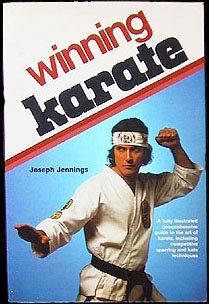
Joseph Jennings – Winning Karate (3)

With martial arts training, it’s mre about the form, the spirit and the attitude of the student than it is about the actual specific movement or skill that’s trained. So a physical description of the basic techniques provides technical rather than spiritual insight – at least when it’s read rather than physically studied. On the other hand, the illustrations in this book demonstrating how to deal with an attacker armed with a gun, knife or rifle, are extremely spiritual. And by spiritual I mean funny.

Thursday, December 15th, 2005

On Humour – Simon Critchley (3)

It is a very common notion that the study of humour is a dry and boring thing to attempt. While that is true, it is not necessarily a bad thing. We wouldn’t expect hydrodynamics to be wet, or neuroscience to be clever, so why should humour theory have to be funny, or even just entertaining? It should, however, have substance, and here most attempts are lacking, this book being no exception. It is little more than a collection of quotes and tidbits from humour theorists over the centuries, with a lot of the name dropping which is so oddly popular in the humanities. “This is what X means, when he says Y” seems to take on the force and role of a stringent logical argument, and rather than being a mepotistic anecdote, it’s supposed to illustrate something deep. But I digress.

The main theses the reader is left with in the end are that the highest moral value o slaughter is achieved when it’s reflective; when we laugh at ourselves, and that humour is the uniquely human ability to counter the absurdity of physical existence with a psychological distancing movement, and a mocking finger pointed at the physical from afar. Which, of course, is just reactionary balderdash.

Wednesday, December 14th, 2005

The Karate Dojo – Peter Urban (3)

Partly insubstantial ramblings, partly interesting Martial Arts stories, this was a nice and entertaining read. Slightly annyoing that he mixes fact and fiction in his anecdotes, without making clear, which is which. But judging from his website, he’s just too great to care.

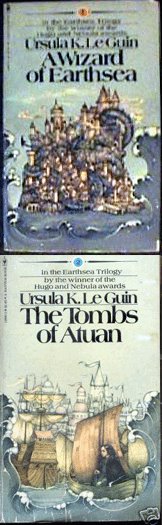
I loved Le Guins The Dispossessed and The Left Hand of Darkness, so even though I’m not very keen on people in pointy hats throwing speels (unless they’re called Gandalf, obviously) I thought I’d give Earthsea a shot, and I’m glad I did. Like with her other books, I found the most interesting element of these books their outright refusal to play by the base rules of the genre. While there are magical gadgets, spells, castles and monsters, it’s clearly not those that Le Guin is interested in. Where a Wizard of Earthsea was about one boy’s journey to discover and master the evil in himself, the Tombs is about a clash of worldviews and belief systems, one religiously closed and involved in power struggle, the other, though based in magic, rational and open, and striving to find balance. In a nutshell, these stories are driven by psychological archetypes (the dark of the tombs, the faceless evil) than by plot, in fact, so much so that I wondered why there needed to be any magic in them at all – the fantasy elements are, so far at least, quite superficial.

Monday, December 12th, 2005

Beklommene Stille

Vielleicht würde es, wenn man mehr davon wüsste, beklommen still werden um dieses Hauptwort “Geist” (Robert Musil, Der Mann ohne Eigenschaften)

Vielleicht aber auch nicht. Ohnehin fragwürdig, ob ausgerechnet der Autor dieses geschwätzigen Ziegelsteins sich über beklommene Stille verbreiten sollte.

Monday, December 12th, 2005

Way Station – Clifford D. Simak (2)

Simak won the Hugo in 1964 for this quiet piece. Enoch Wallace, a civil war veteran from southwestern Wisconsin, is chosen by Galactic Central to operate a way station on earth, where alien lifeforms pass through on their way elsewhere.

While there is a dramatic plot, Simak clearly puts the emphasis on fleshing out the central idea of a brotherhood of all beings, to which humanity, even though standing on the brink of self-extinction from an atomic war, seeks admission. It is a nice read – and also an interesting piece of 60s optimistic pessimism.

While in the end the brotherhood of sophonts is sustained, nuclear war averted, and balance is returned to the force (possibly one more “inspiration” for all-around plot-thief Lucas, otherwise just a common cliche), this is achieved only because of sheer luck, the special sensibilities of an outcast, and a magical Deus-Ex-Machina superdevice.

Friday, November 4th, 2005

Frans de Waal – Chimpanzee Politics (2)


Ein Klassiker der Primatenforschung, und faszinierender Einblick in die seelische Verfassung unserer nächsten Verwandten. Ein Gutteil dieser Faszination speist sich daraus, dass trotz aller Parallelen zu menschlichem Verhalten die Gefühlswelt und das Verhalten der Schimpansen von anderen Prinzipien regiert werden als unsere, die Tiere uns aber ähnlich genug sind, dass wir ihnen die dem äusseren Verhalten entsprechenden menschlichen Regungen unterstellen. Eine Lektion nicht nur in Primatenpsychologie, sondern auch in den Mechanismen, durch die unsere Vorurteile unsere Wahrnehmung gestalten; vermutlich sind diese aber ohnehin Teil jener.

Eine der rührendsten Anekdoten des Buches erzählt vom Moment im Frühjahr, in dem die den Winter über im Primatengebäude verstauten Schimpansen die unsichtbare Klappe ins Freie sich am Ende des Ganges öffnen hören, und sofort in lautes Geschrei, aufgeregte Sprünge und Umarmungen ausbrechen.

Tuesday, November 1st, 2005

Networking, Not Working?

strung

I’m growing increasingly weary of people linking to Amazon for books they want to recommend. Shouldn’t there be a website where people can search books online and then order them at their neighbourhood independent bookstore? buchhandel.de does this for german books, but a quick search unearthed nothing similar for the american market. The closest match I could find was BookSense.com, but that’s not a catalog at all, just a store directory. Does this really not exist yet?

Friday, October 28th, 2005

Education, 1986

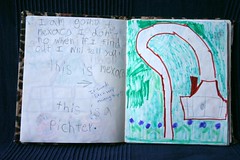
a pichter of mexaco

A few weeks ago I found a child’s diary in a cardboard box at the side of the road. The diary is from early 1986, starting in the middle of January and ending probably some time in February. A teacher named Karen encouraged 7 year old Miranda to keep a diary, and added questions and comments to it.

The diary is very sweet, and Miranda’s private spelling quite endearing. A strange “pichter” of Miranda’s life in 1986 emerges from its pages. She describes a visit to her grandparents in New York, which she was very excited about, her problems and friends at her new school, writes about her parents, her brother and her imaginary, double initialed friends. Very touching.

See the whole set.

Thursday, April 28th, 2005

infected minds

portrait

Richard Dawkins argues that religion is like biological and digital viruses, spreading from mind to mind, epidemically. Unlike science, which Dawkins likens to nonviral software, religion spreads not because people willfully accept its ideas, but because these ideas carry a “Copy Me!” command.

While I like his description of the spread of ideas as an epidemic, and the notion that complexes of ideas, just like complexes of genes, will tend to spread together if they favour each other, I think the fundamental thrust of his argument, which tries to taint religion by likening it to disease, is flawed.

As he readily admits, the phenomenology of the spread of scientific ideas is indistinguishable from that of any other belief system. The difference, Dawkin’s argues, is that science adheres to empirical testing, while religion does not. But that alone establishes a perfect symmetry, where the zealot could triumphantly cry “exactly! and that’s why religion is superior. Quia absurdum!”

The problem with religion is not that it’s an attractive set of mutually enforcing beliefs that spreads through populations of minds – that’s true for science, as well. It’s that these beliefs claim jurisdiction over empirical matters, when at their very core is a disdain for empirical process.

In short, not the viral form of religion, but its content, is what should bring us in opposition. Its virulence just makes it a more formidable and frustrating enemy.