Search

Books


Wednesday, January 4th, 2006

Bruce Lee – Tao of Jeet Kune Do (2)

This is Lee’s posthumously published founding document for his own brand of kickass, Jeet Kune Do, that brought him both fame and severe criticism for boldly breaking with tradition and fusing different styles, taking what he would from each. The book, while roughly structured into chapters, reads more like a collection of small pieces than a unit. In part this reflects the limitations of editing somebody else’s work his untimely death put on the editor, his wife Linda, but I suppose to a degree this is a reflection of the inherent notion he expresses multiple times. Go with the flow, do not become rigid in rules, be flexible within your limit. The motto of Jeet Kune Do, set around the unique logo with the Yin/Yang encircled by two chasing arrows, reads ‘Using no way as way, having no limitation as limitation’. Which of course is all part of the ancient asian art of making sense through not making sense.

Bei manchen dokumentarischen Büchern fragt man sich unweigerlich, warum man sich die deprimierende Abfolge unheilvoller Tatsachen ins Denkgebäude schraubt. Nun ist es andererseits natürlich Unsinn auf dem Niveau der Erstmal-besser-machen Kritikverneiner, Unschönes nur deshalb abzulehnen, weil es keine konstruktiven Schlüsse anzubieten hat, aber erbaulich hätte ich es doch gefunden, nach der Durchsicht all der Naziwiderlichkeiten rund um Vertriebene und ihre Zentren, Kriegsgeschichte und Schuldausgleich ein paar Vorschläge zu finden, wie man das Pack zum Schweigen und die Geschichte auf einen guten Weg brächte. So ganz ohne das ist das Buch jedenfalls nicht der Diskussionsbeitrag, der es sein möchte, sondern eher die Grundlage für einen. Muss dann eben jemand anders schreiben.

Die für mich interessanteste Detailinformation betrifft das Verbot der Todesstrafe im Deutschen Grundgesetz, das mir angesichts der sonstigen Kontinuitäten von Mordbubenwirtschaft und Gewaltapparat immer ein wenig inkonsistent vorkam. Später schildert, wie ein Vertriebenenfunktionär sich für die Abschaffung verwendet, um seine alten Nazikumpane vor den Galgen der Alliierten zu retten. Das ging schief, weil die Alliierten sich bei den Hinrichtungen ums Grundgesetz der Besiegten nicht recht scheren mochten, und der Plan, die Todesstrafe für gemeine Mörder flugs wieder einzuführen, scheiterte dann ebenfalls. Sie kennen doch unser heiteres Suchspiel? In der Geschichte hat der Weltgeist Sepp Arnemann eine konstruktive Lehre über den Umgang mit repressiven gesellschaftlichen Kräften versteckt. Suchen Sie sie selbst, mir gefällt sie nicht.

Nachtrag: konkret dokumentiert in der aktuellen Ausgabe die Reaktionen Vertriebener auf Späters Buch, und ich nehme einen Teil des oben gesagten zurück. Wer derart die Hunde zum Bellen bringt, hat allerhand richtig gemacht.

Friday, December 30th, 2005

Jeffrey Eugenides – Middlesex (2)

A fiction so convincing that I needed to remind myself several times that I was not reading an autobiographical account. The story of a hermaphrodite growing up in Detroit, and his/her family’s history stretching back into Turkey are told in epic breadth, and with a lot of fascinating historic detail. The narrative holding it all together, that of the girl Callie turning into the man Cal, seems to dissolve to little significance against that background, making me wonder if more focus on the story and main character itself wouldn’t have served the overall experience better.

Wednesday, December 28th, 2005

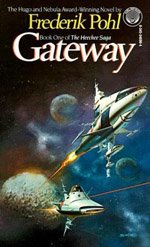
Frederik Pohl – Gateway (2)

I’ve been busy checking out the Hugo and Nebula award winners, and this one was a particular delight. An unknown alien species, the Heechee, disappeared a long time ago, but left some artifacts, most notable a space station equipped with hundreds of interstellar ships attached. The ships are mostly operational, but nobody knows how the course setting machine works, what the destinations are, and how long the trip will be. Mortality on these trips is high, with most coming back emptyhanded, so the exploration of the Heechee legacy is run as a kind of lottery, where explorers might die or disappear, but might also come back with incredible new artifacts or knowledge, making them rich for life. This is the background to the story of one man, who struck it rich on one of these trips, but can’t cope with what happened, and what he had to do to survive. We witness his therapy sixteen years later, and the original events unfolding in parallel, with documentary material, like classifieds from the station’s newspaper, ingeniously strewn in.

Monday, December 26th, 2005

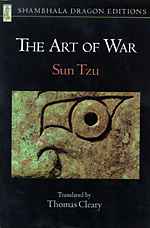
Sun Tzu – The Art of War (3)

When a dog pees on a mountain, does the mountain care? Depends on the size of the dog, you might answer, but in general it won’t. General – what better segway than that to lead into my two cents on Sun Tzu’s Art of War, commonly hailed as the essential read for business strategists, soldiers, garbage collectors, and, really, everybody, for war is a metaphor for life, and we all have one of these, after all. In spite of that Master Sun’s strategic nuggets of wisdom were a bit lost on me. I don’t object to anything said, and the style of the translation, and, I presume, the original, is very concise and poetic in it’s condension, but what in this book I find applicable is obvious, and what isn’t obvious doesn’t seem applicable. On top of that this edition has been translated an edited by Thomas Cleary. Cleary follow every few sentences of Sun’s text with serveral different commentaries, and the sequence of Sun’s dense, poetic writing, and the commentators clumsy, wordy rephrasing makes this an odd comedic experience.

Friday, December 23rd, 2005

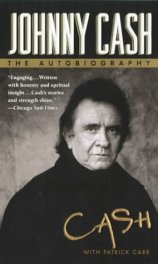
Johhny Cash (with Patrick Carr) – Cash (3)

Johnny Cash was an amazing artist, and his recent death has been a great loss. I love the recent American Recordings series of records as well as his older stuff. Sadly, he is not quite as amazing an author, and Carr’s co-authoring didn’t fix the shortcomings. There are cool stories in this book, but they are often told in a laundry-list fashion, where people, events and facts roll by without much coherence or reflection. Biggest eye-rubber: Cash’s admission that he and June avoided shopping in towns that had no Wal-Marts and even graded them by the number of evil moneysucking behemoths (“tomorrow is a two Wal-Marter”). Biggest chuckle: to get out of a contract with a record company in the early nineties, Cash wrote a whole abysmal album, including a song called “Chicken in Black“. It worked.

Thursday, December 22nd, 2005

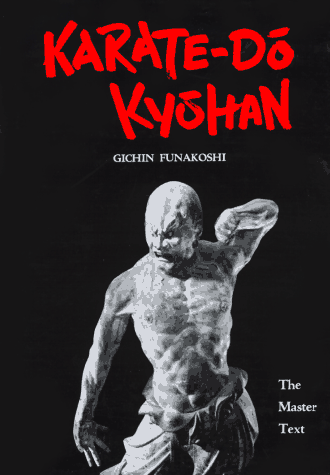
Gichin Funakoshi – Karate-do Kyohan (1)

This is a wonderful and concise introduction to all mayor aspects of karate, from the basics and kata to free sparring. What I found most fascinating – besides the insightfully detailed kata descriptions – was how meaningful those detailed notes become when you don’t read them as descriptions or recipes, but as commentaries on something you already know – or, even more interesting, know in a similar shape. Since I’ve been studying all the Kata’s in their Wado form, Funakoshi’s reasoning is most intriguing where he describes the rationale for doing something different from how we do it. The dialectics of form become apparent, the fact that one needs to be restricted, to see the unfoundedness of that restriction, and thus overcome it. Which makes me realize that Hegel was a very eastern kind of Swabe.

Wednesday, December 21st, 2005

Frank Herbert – The Green Brain (3)

Probably one of the first science fiction novels to have the ecological threat posed by modern humanity at the core of its plot, this 1966 action drama puts all its effort into getting the message through, with very little meaningful plot. It’s an unfortunate choice, as the central premise – being under extinction pressure from an Orwellianly named International Ecological Agency, insects adapt by cooperating to form complex and conscious societies, capable of concerted action and motion – would have been fascinating to explore in depth. Instead, the book spends most of its time following a subplot of international politics and intrigue, and its protagonists down a jungle river, and ends when things would become interesting, with what feels like a compromise between a happy ending and gloomy doomsaying. The book leaves the distinct feeling that Herbert wasn’t quite happy with his setup, and didn’t want to put too much effort into working it through. Maybe that’s why he revisited the hive mind a few years later in The Hive.

Monday, December 19th, 2005

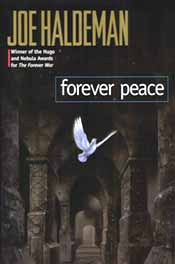
Joe Haldeman – Forever Peace (2)

This is a story of many plots, ranging from the destruction of the universe, or a substantial fraction thereof, by nanotechnology, to modern warfare and social philosophy to moral conundrums of modern life – interracial dating, for example – and it tries to both set up these varying fields as enormous problem zones, and then present realistic solutions. Most of the central ideas and technologies, and the problems caused by them – the social impact of full automation both on the society controlling it and the societies controlled by it, or the psychological and military implications of remotely controlled superwarriors, to name two – are daring and impressive, and the extrapolation of US foreign policy into the year 2048 seems frighteningly believable. But against the tapestry of these towering problems, Haldemans solution falls somewhat short, both within the universe of his novel and our own. Still, with its very gripping, thoughtful and empathic plot, Forever Peace fully deserves the Hugo and Nebula awards it won.

Monday, December 19th, 2005

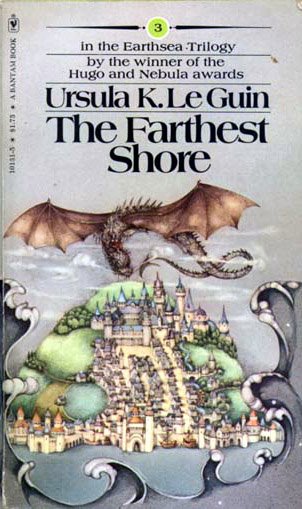
Ursula K. Le Guin – The Farthest Shore (2)

The final volume of the Earthsea Trilogy, and, to me, the strongest of the three. It’s main theme, the struggle caused by the realization that life and death are intricately linked (a thought which is part of the dualist/taoist thinking that weaves like a thread through the whole trilogy, and indeed much of Le Guin’s other writing) and one is impossible without the other, unfolds against a backdrop of exciting encounters, and the overall athmosphere of impending doom caused by the widespread refusal to accept mortality still has a very realistic tone today, more than 30 years after it was originally written.