Search

Books


Wednesday, February 22nd, 2006

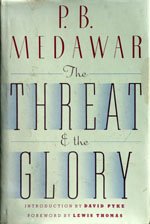
Peter Medawar – The Threat and the Glory (2)

Some names have a positive aura for reasons we have forgotten since we first encountered them. Maybe it was something we read, someone talking about the person, or quoting them in an interesting context. So it was with me and Medawar, and I’m very happy I bought the book at the yard sale I found it at. Medawar treats his often complex subjects with amazing clarity and levity, yet never compromises in terms of accuracy, and the problems he writes about are as unsolved today as they were thirty years ago. How do we balance the benefits of science with its dangers, to fulfill the inherent promise of progress rather than invoking an army of brooms that will sweep us away? Medawar doesn’t have answers, of course, but he does ask the right questions, and that is the bigger achievement anyway.

Tuesday, February 21st, 2006

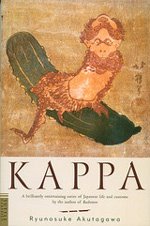
Akutagawa Ryunosuke – Kappa (2)

The cover blurb calls this a satire on Japanese society and its customs, and when I randomly opened at some place, it indeed seemed a very funny and acerbic recasting of the Japanese into the Kappa. While this turned out to be quite misleading, it also turned me onto a book I probably wouldn’t have read otherwise. A lucky turn. The story is of a human being suddenly cast into Kappa society, the Kappa being somewhat malevolent mythological creatures of Japanese rivers, scaly amphibians apt to drag children into the water and drown them. The tone and setting is more than a bit reminiscent of Abbott’s Flatland, which Ryunosuke well might have read, and the absurdity of the goings on in the land of the Kappa reminded me of Daniil Kharms, but all in all, this is quite a solitary achievement. Born, as Ryunosuke himself said, out of his disgust with everything, especially himself, this story presents a caricature of humanity unlike anything I’ve read before.

Monday, February 13th, 2006

Paola Cavalieri – The Animal Question (2)

The caveat first: this is not exactly a book written for a general audience. It is a treatise of ethical philosophy, and the reasoning and phrasing is, I felt, even denses in some places than reverence to the esteemed traditions of academic discourse, let alone the subject matter, should have had it be (Though not having tried to set a thorough study of the intricacies of a system of moral acting in popular prose, I of course might be entirely mistaken and this book the closest anyone can get to simplicity in what is without a doubt an discomfortingly complex matter).

Cavalieri sets out to evaluate what entities are moral entities, in the sense that they figure into moral considerations of the actions of moral agents. A thorough review of opinions of the past reveals that none of them can be made consistent. Cavalieri then suggests that the best possible solution for our current state of knowledge of the cognitive life of other species is to extend the notion of human rights to all mammals and birds. Unfortunately, her case is solid, so this is the rare case of a book that has the potential to change my life. No more burgers. Poor me.

Monday, February 6th, 2006

Michael Gazzaniga – The Social Brain (2)

I was unable to find any image of the cover of this book online – which tells you something about it’s age. The Social Brain came out in the 80s, and it proposed, based in Gazzaniga’s own groundbreaking research on split brain patients, that the brain was a combined structure of separate and somewhat independent modules, and that the unfied mental life we seem to have is a constructed illusion rather than a controlling entity. The descriptions of the experiments are as amazing today as they must have been when they were first done, the speculative general part seems to vague to be either true or false, and the final chapter, in which Gazzaniga reverently interviews himself, instead of just saying what he wants to say, for no good reason, is slightly embarrasing.

This is a profoundly silly book, about magic symbols and masonic references on the US 1$ bill. Some of them are surprising and interesting (like the etymology of Dollar, the significance of the pyramid, or the source for the $ symbol), but most of the letter and word counting and geometric analysis of what appears where seems more like an unhealthy obsession than an informative analysis. I know Gematria is very honorable quackery, but it obviously is possible to overdo it. Who would have thunk?

Saturday, February 4th, 2006

Dan Simmons – The Fall of Hyperion (2)

In this sequel to Hyperion, we learn a lot more about what the Shrike is, who built the Time Tombs and why, and what the enigmatic events in the first book meant. In a way, these revelations destroy the sense of mystery that surrounded the time tombs and the Shrike. The necessity to keep a plotline that goes back and forth in time from folding unto itself and creating a know makes this book hard to follow in places, and gives a feeling of contrivance to what seemed a monumentally powerful force. The explanations, on the other hand, work well enough, and the overarching theme of death, suffering and how organic life can keep its dignity in the face of them and strive to be free of them without destroying everything in the process is fascinating to follow. The combination with Keats’ romantic poetry, while adding a very unusual touch to this space opera, doesn’t work all that well for me, but that might mainly be because I’m not too smitten with romantic literature and find the hyperbole and godlyness of subject matter and language tiring.

I am sufficiently interested in Simmons vision to someday go on to read Endymion and Rise of Endymion, the next two installments in the Hyperion saga, but not very soon. I’m too afraid to find religious mayhem similar to what happened in Herbert’s progressively less accessible Dune series.

Sunday, January 29th, 2006
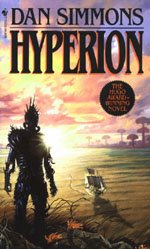
Dan Simmons – Hyperion (1)

An excellent crossover between literary history, theological treatise and captivating worldbuilding science fiction, the only shortcoming of this book is that it ends just when things start to become interesting. Not until the last few pages did I realize that the confrontation with the frightening entity called the Shrike, the opening of the Time Tombs and the outcome of the big conflict between human and AI madness would be subject of the sequel. Still, this collection of the life stories of six people, bound together by a pilgrimage (Hello, Chaucer), weaves a picture of a future, where technology and metaphysics blend into a web of awe.

It’s interesting to see Simmons trying to deal with a technical detail problem facing every attempt at Science Fiction with some cultural and historical background: either every reference has to be composed and explained in detail, or all the references come from 19th and 20th century culture, which becomes increasingly improbable the further in the future the plot is set. The fact that his plot contains people from many different epochs makes up for some of that asymmetry. That device almost justifies the pilgrims singing “We’re off to see the Wizard” when they go to face the Shrike, and the difference is made up by the creepiness of that very image. But overall, it still doesn’t quite come together, the lists of artists that are mentioned in a few places always separate nicely into the ones the reader knows and those unkonown names just plugged in to indicate the passing of time. But if the past is any indication for the future, hardly anybody from our time will still be known 600 years hence. Maybe Simmons is as close as one can get to solving that particular problem here.

Monday, January 23rd, 2006

Neal Stephenson – Cryptonomicon (2)

This book has it all, geeky and cool facts about cryptology, military, social and technological history, a fairly believable conspiracy plot, insights into high-tech investment politics and an epic breadth and richness of materials that stunds. So why did reading it feel so tedious, and why was I glad when it finally was over? Maybe it’s because of the odd feeling of detached interest that perfuses the work. Stephenson describes the human dimension of his adventure with the emotions of a boy watching ants through a magnifying glass on a sunny day, just before he decides to see what happens when he burns them. It’s a terrific story, but it felt like someone else was reading it.

Sunday, January 8th, 2006

Yamamoto Tsunetomo – Hagakure (2)

The more I learn about Japanese history, the more I wonder how it is possible that the European captains found anybody alive there at all when they arrived. They should have disembarked, a fearful expression on their faces, and waded in blood, among the guts and remains of the honorable dead, who slashed themselves open to maybe make amends for an ill chosen colour of off-white for the master’s new lampshade, or some such. This makes for very fascinating reading, but it is indeed hard to understand how a society, in which disrespect leads to fights to the death, which in turn means seppuku for those who started them, could have functioned, Maybe, then, Yamamoto exaggerates wildly. This is somewhat more plausible for modern readers when they realize that some of his short texts read like they are the direct inspirations for Monty Python’s suicide squad lead by Otto in The Life of Brian, and the Black Knight in the Holy Grail – now of course available as a plush doll, which probably would have horrified old Tsunetomo right into killing himself.

This book has won both the Hugo and the Nebula, and while I don’t fully agree with quite so much formalized praise, its central character, a geostationary tower 40.000 kilometers high, rising from the slightly shifted island of Sri Lanka, is a fascinating and awe inspiring invention. It’s story, intertwined with that of it’s engineer, Vannevar Morgan, is nicely contrasted to that of an ancient king, who reached for the stars of his time and found death in the process, just as Morgan does. I think it’s this undercurrent of engineering and progress as substitutes for religion, which is painted as their opposite, and seems to include anything not logically deducible, that makes this tiring to read. Not accidentally, the humans in the story are shallow and lifeless, and the final chapter betrays the mix of engineering and Nietzsche that seems to fuel Clarke’s world view: at the great noon, the superman will come in a chariot from the stars, to unite with the child and found the future. An engineer’s dream of electric sheep.