This Digital Age
 I used the infamous and controversial Google Books for the first time yesterday, finding several obscure references to Stereophotography. Most of them were rather mundane mentions, but one talked about a stereophotography guide from 1859, when the new art wasn’t quite dry behind the ears yet, written by a famous (I found) Californian unitarian Minister named Thomas Starr King. Fascinating as it was, locating the guide itself proved impossible, so I went back to the original quote on Google Books. It didn’t mention anything else, but the quote from the guide had a footnote associated, presumably providing some reference. Or rather, it was an endnote on an entirely different page. Getting a specific page from Google Books is a bit of an ordeal, since the copyright zealots only allow the 2 pages surrounding the search results to be accessible, so I had to work my way up two pages at a time, until I found – that Google had made an error in scanning the pages containing the endnotes. The one I needed was missing.
I then located the source book on the UCB campus here, walked up to the shelf, found it missing, squeezed the information out of the catalogue that the book was on reserve in a different library, and found, after physically going there, that the staff there couldn’t locate it, either. Something to do with the semester having just ended. Seems that while the golden age of digital search has arrived, we can just hope the age of digital finding will follow on its heels soon.
 Sometimes one opens a book, or reads a first line, and immediately it’s clear that the thoughts and concepts that went into the work were sorely missing from the world, yet nobody had realized it before. Such is the case with this gem of philosophical reasoning. An essay on the essence of bullshit, and an attempt to explain its apparently increasing dominance of today’s communication, this work should be the basis for a much more thorough study of the phenomenon. The exhilarating delight and sheer fun of reading a serious deliberation on the issue must not distract from the fact that this is not satire, nor is it humorous, except insofar as it is a surprising and complex study of a phenomenon commonly thought to be not worthy of such study. To be sure, this combination of surprise and incongruency of means and perceived complexity of the subject are what makes the first reading such a pleasure, and look superficially like a satire of moral philosophy. But to stop at that level would be to mistake the work for its subject, and to miss the chance to develop the tools to attack the toxic prevalence of bullshit in all the public spheres of communication.
 There is mythological evidence from the middle ages, suggesting the Swabians were a jolly, lively people then, full of vigour and joy. You wouldn’t think it today, and the introductory section of this book, meant to show Swabians in the best possible light and endowed with a preface by Cleverle Späth, is a case in point. The most salient features of the Swabian mind, his thriftyness, his shrewdness, his xenophobia, take some stretching to be made into qualities, and with some, most notably the Kehrwoche, even Larson’s well meaning prose fails to create any appeal or sense. The anecdote of Larson interacting with Willy Reichert, Arnulf Klett and the likes are positively painful, but admittedly that might be just to me, and just because they hit too close to home.
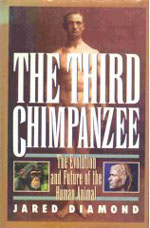 I have a weakness for the crop of evolutionary psychology and anthropology that has sprung up in recent years, and this one on the evolution of the human chimpanzee and the specific problematic baggage he brings from this evolutionary history is no exception. Of particular interest, both for content, as well as for the insight into the genesis of such book it provides, is the chapter on differential development of human societeties, that later bloomed into a full grown book of its own: Guns, Germs and Steel. Diamond writes delightfully entertaining, and his examples are fascinating. The only drawback is the bleak picture he paints for the future of this planet and our species, sounding just as correct today as it did 15 years ago, when he wrote it. The only difference being that the monster of major climate change caused by us monkeys no longer is something to be feared decades in the future, but seems to wait just around the corner. Maybe we can gang up on it, kill it and eat it. That strategy served us well in the past.
 A curious feature of downtown Seattle is its underground, a collection of basement like areas below the streets, that include sidewalks and doorways. In places it looks like an older city got covered in an avalanche of road, and the inhabitants just accepted the new road levels. Speidel’s book, besides telling the story of early Seattle, centers on an account of how this underground city came to be. He claims that both sanitation (sewer backflow on high tides) and road layout of the downtown area left much to be desired, but attempts to widen and raise the roads met with fierce opposition by the downtown merchants and with legal and bureaucratic obstacles. When in June 1889 a big fire leveled all of downtown, the time had finally come, the city widened and filled in the roads over the following years, and the merchants rebuilt their houses from the ground level up, having to abandon these ground levels once the roads reached their final height and rebuild an entrance in a higher story. Both the books and the guided tours that Speidel’s company still provides in Seattle are a lot of fun – though I hear historians aren’t all too happy with his dramatizations, inaccuracies and lack of proper documentation of dubious sources. But with that caveat as to it’s truthfulness kept in mind, the book is quite entertaining, and the Underground well worth a visit.
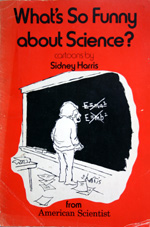 Sadly, this collection of cartoons mostly shows why Science and Humour are commonly considered to be unmixable substances. A few of the jokes are actually funny, but they’re rarely the ones that actually deal with scientists, or science as such, but rather ones inspired by or loosely based on scientific ideas. A few years back, Carl Djerassi wrote several novels in a genre he calls science-in-fiction (early Science Fiction writers probably would have been horrified by the necessity for that distinction), and if I remember correctly, none of them turned out particularly funny, though he sure tried. These cartoon have the additional disadvantage of stemming from strange, past decades, and so are mainly of interest to historians. Ah, historians, don’t get me started on those. Hilarious!
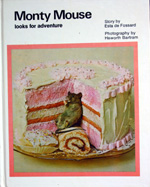 This is the story of Monty Mouse, his adventures in the world, and his eventual return to his mother and his home. No need to leaf through the thing, for the cover shows all that’s wrong with this book in a nutshell. To wits: Monty “Mouse” is not a mouse, he’s a stuffed, dead rat, or, more likely, a collection of similar looking, stuffed dead rats. Upon realizing this, the adventurous and quirky photographs instantly turn very tasteless and cruel, not to mention the fact that I feel fooled by the author selling me one mammal for another. Some learning experience. But the worst fault lies with the story itself, for young Monty’s ingenious adventures invariably turn sour, and in the end send him running home for mom with nothing to show for all his inventiveness but a dirty coat. What a rotten message. Look at Monty’s stuffed carcass hanging miserably in what should be the world’s sweetest spot. No doubt he just spoiled his appetite for a nice Brussel sprout dinner, because he is sick from all the cake. That’ll teach him – and it teaches me, too: to run.
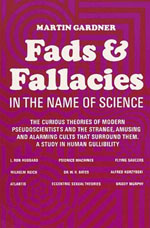 Crank science is fascinating to me, and the more elaborate the unfounded theories get, the more so. Just as a collection and overview of some of the classics of the cranks, this book is already invaluable. Above and beyond the pure review of mad scientists’ view of the world, this book raises the issue, in several places, of whether or not these cranks should be allowed to do what they do, and how the public should and should not receive them. Gardner wrote this in the late 1950s, and his perspective is clearly heavily influenced by the Velikovsky incident. Velikovsky published fairly outrageous and quite original theories on the influence of catastrophic astronomical events on world history, most notable the two near crashings of a comet that was later to become the planet Venus into historic Earth, and caused a big stir when scientists objected against Worlds in Collision having been published at all, and defenders of free speech rushed to the madman’s defense. Gardner’s position, as that of so many scientists, is unforgiving. He doesn’t want to restrict the ability of cranks to do their thing, but he doesn’t like them getting publicity when very clearly their work is not up to scientific standards. I am somewhat torn on this. I love the strange poetry and creativity in the these works, abd it would be a shame to lose these voices, even if their contributions to scientific discourse are not of the usual, incrementally explarative, kind.
  The central idea of this book – Pilate pardons Jesus, the Roman empire thus survives the centuries and still dominates in modern times – seemed ludicrous yet original enough for me to buy the book, and the task of depicting a modernized roman empire promised to be interestingly amibitious. But, not surprisingly, the execution falls quite a bit short of the aim. Counterfactual history requires a depth of understanding and elaborate world building skills, and Mitchell posesses neither. His Roman empire is the cliched version of B movies, with a few gadgets added without rhyme, reason or technological context. The story itself is uninspired, too, dealing with an uprising of psychic rebels in the Anatolian province and an intrigue inside the empire, both told in brief abstract dialogues, interspersed with random action sequences, making the book a failure on pretty much all levels. It’s too bad, I still think the idea is cute.
 If some of the battling nerds on the movie’s IMDB page are to be believed, Miyazaki’s adaptation of this beloved children’s classic was a disgrace. I read the book (the existence of neither it nor its author I suspected until I checked said IMDB page) with that criticism in mind, and have to say: balderdash. While it is true that the two stories diverge in minute details, and that Miyazaki added elements typical for his work, and created visuals not prescribed in Jones’ book, the two are remarkably congruent. The story does make a bit more sense in the book, but then I’m not sure that’s necessarily a good thing in a book about demons falling from the sky and stealing hearts. I was smitten with the strangeness of Miyazaki’s take, and the straightforward resolution left me a bit underenchanted. On the other hand, the character’s behaviour makes more sense in the book, making them both more likeable and more interesting than the somewhat randomly bouncing anime folk.