Thursday, March 15th, 2007
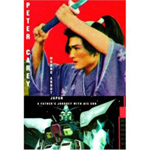 A cute book about the trip to Japan of a father and son, to meet some of Anime’s legendary figures, and to be shown, time and again, to be fundamentally wrong about Japanese culture. While this book stays on the surface of the issues a lot of the time, and some of the misunderstandings and oddities seem so naive to make me suspect exaggeration for the sake of the books thread, the subject itself is fascinating to me. Having never been to Japan, but being confronted with how utterly strange and alien the culture there is to Westerners, I find myself very unwilling to buy into it. Language books fuzz endlessly about the different politeness levels of Japanese speech, and what a unique concept that is, as though all words and phrases were applicable in all social situations in English. Likewise, many of the unfathomable quirks that are described in books like these seem to be a mix of different historical backgrounds and skewed perception on the side of the visitor, with some deliberate mythbuilding thrown in on the Japanese side, possibly as a means of establishing unity of the nation against foreign influences.
But that’s enough rambling out of me. If my plans to visit Japan this summer work out, I shall write down as much of my preconceptions as I possibly can, and try and chronicle their unfolding over the course of my stay. Maybe it’ll be as amusing as this book to read.
Books, English, Good, Japan, Western/Eastern | No Comments »
 This book about cognitive dissonance is a good read, and an interesting account of both the theory of why our decisions and opinions can be so much at odds with reality sometimes and a number of examples from history and daily life, where the principle can be observed in action. Yet through much of it, it felt like being a bit lost in someones attempt to make sense of the subject, and as though going to Festinger’s original work might be more illuminating. This in spite of the fact that I don’t think he ever wrote something comprehensive like this on top of his individual studies.
 When the Apocalypse caused by Germany came back to engulf it in its fire and destruction, there must have been immeasurable suffering and trauma, yet, as Sebald points out, almost none of it made it into the story of life as set down by the writers. Sebalds exploration of the reasons for this omission, are both deeply touching for his compassion even with those who caused the very desasters that struck them, and illuminating for their original and provocative view on the narrative of Germany.
 Why are we so notoriously bad at predicting what will make us happy, and why are we so often mistaken when we remember how we felt in the past? Gilbert’s hypothesis is that the nature of the neural system that allows us to imagine is to blame/ This system, which allows us both the filling in of the details of memories and the fleshing out of the nature of the future, draws on the same circuitry we use to feel the present, which is why both the past and the future are contaminated by how we feel right now. While the style of the book is maybe a tad forced in terms of wittyness, it is a delightful read, and the wealth of experiments Gilbert draws on to make his case was fascinating to read. At least that’s how I remember it.
 This collection of short pieces did not leave me quite as astounded and fascinated as did his longer story
 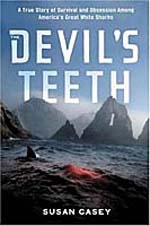 A fascinating look at animals and researchers surrounding the Great White Shark Project at the Farallone Islands off the coast of San Francisco. On a clean day you can just see these islands beyond the Golden Gate, and I am going to look out there with much more respect and curiosity now I’ve read the book. On the downside, Casey comes across as a somewhat irresponsible girl, whose obsession with untamed wildness and rugged men ultimately leads to severe consequences for everybody involved.
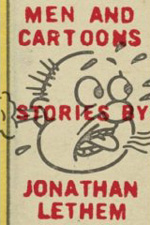 After having read much of Lethem’s work, I think I love his stuff more for the abundance of ideas than for the actual execution. There is often something oddly fragmented about his storytelling, creating a disaffected air, but many of his characters and situations are very acute and touchingly observed conundrums of human existence, cast into odd narratives. Oh god, would you listen to me. Or rather, don’t. Read Lethem instead.
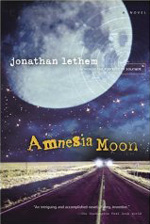 The premise is a marvelous riff on the post-apocalypse theme. Starting out as a classic, nuclear holocaust story set in the desert, complete with mutants and vigilantes in old cars. But we soon realize something isn’t quite as it seems, and as the protagonist makes his way from the desert back to San Francisco, we slowly understand that what has happened is much more apocalyptic than the mere destruction of the physical that bombs bring about: mental coherence, the very fabric of reality itself, has somehow been damaged, and dreams, paranoia and neuroses bloom freely and infest the world of the real. In keeping with the very lost feeling that pervades the story, we never learn the truth about what people call “the break”, though several alternatives of it are offered. And this, I feel, is also the shortcoming of Amnesia Moon: the exchangeability of the different narratives robs the story of some of its impact – when everything seems possible, nothing can mean much any more.
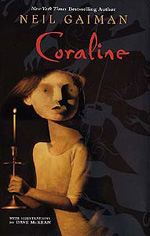 Reading Gaiman, I frequently marvel at the way he manages to circumvent my defenses. Things I would normally consider cliche or kitsch, are all right when he does them, and a scenario that reeks of Cirque de Soleil and the fake weirdness of professional quirkers, is genuinely creepy and rings true, when he touches it. Buttons for eyes? Dead children behind a mirror? A talking cat? A blind doorway that leads to a spooky place? Bring ’em on.
 About two thirds of the way through this magnificent medical thriller, I suddenly realized that the gripping storyline had made me turn the pages way too fast, glossing over much of the amazing artwork and visual detail. I then stopped for close scrutiny of one particularly rich panel – which in act had caused my realization in the first place – but soon returned to flipping the pages as fast as I could read the text. I’ll have to reread it, I suppose. Bummer.