Search

Movies


Saturday, March 25th, 2006

Robert Altman – McCabe and Mrs Miller (1)

The meticulous recreation of buildings and social networks of the little digger town somewhere in the cold American Northwest is enough to make this gem worth watching, but the story of McCabe and Mrs Miller that Altman set against this backdrop is in itself touching and rewarding. A very unusual Western, if you want to call it that, with an uncompromising ending. Very interesting to watch the special features, too. Some documentary on the making of the movie, and a movie trailer, both not badly done, but horribly, horribly dated, to the point of being hilarious, while the movie itself is timeless. must be the difference between art and craft.
Friday, March 24th, 2006

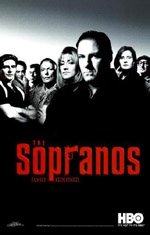
The Sopranos – Season 6 (2)

My favorite family of criminals is back, but so far I’m none too sure about how happy I should be about it. The first episode caused mostly consfusion, for its lack of continuity – for instance how come Tony and Carmela are as harmonious again as we see them, was there any fallout from the horrible murder of Adriana that made last seasons second to last episode so intensely hard to watch – and for its lack of direction. Nothing is happening we haven’t seen many times before, no plot is advanced, right up until the moment Tony gets shot by Junior, who seems to be truly demented by now, but also might be scheming again. The second episode then has us all watch Tony linger in limbo, while his spiritual and bodily fate are being decided. The metaphorical, dreamlike sequences are nice to watch, but once again the episode doesn’t advance much. Except maybe for AJ’s promise of a revenge killing.

Friday, March 17th, 2006

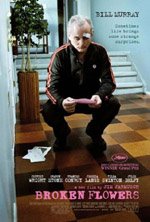
Jim Jarmusch – Broken Flowers (3)

Amazingly, having a wrinkled and depressed Bill Murray in a jumpsuit drive around coloring tress does not a good movie make. Who would have thought? In fairness, I was probably having my expectations too high, since I’m an admirer of both Jarmusch’s (Dead Man!) and Murray’s previous work. But even after correcting for that, I did not feel a connection with either Murray (who played essentially the same character, only much better, in Lost in Translation) or any of his former girlfriends, and the neighbour gone detective, as a grotesque caricature, doesn’t even qualify. Watch About Schmidt instead, it’s a much better movie.

Wednesday, March 15th, 2006

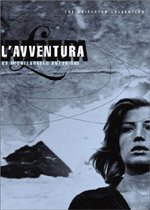
Michelangelo Antonioni – L’Avventura (3)

This was praised and much discussed when it came out in the late sixties for its refreshingly novel cinematic way of storytelling – or so the Netflix cover blurb tells us. The story is that of a bunch of rich people, bored to glassy stares byu their eventless lives, vacationing among the Aeolic Islands. One of the women vanishes, and her best friend and her lover embark on a quest to solve the mystery and find her, and get close in the process. Or the equivalent of closeness in artsy cinema overcharged with undertones and cranked up to a maximum of meaning with a minimum of substance. That might seem unfair, but I find it unfair to have to watch beautiful women and great cinematography without plot or point, so I guess we’re even, Mr. Antonioni.

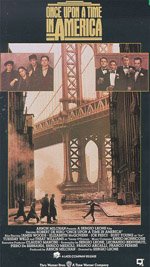
This is not to say that there is anything wrong with the story of Noodles, the way it’s woven together with prohibition history, and the final plot resolution. But this movie is just way too long. I don’t really recall much from seeing the original version, but even that might have been a bit on the tedious side, but this reedit is excruciatingly slow. In addition, the way past and present are intercut doesn’t really work all that way in several places. But the biggest problem is that this ultimately fairly simple tale of betrayed friendship doesn’t justify taking up almost four hours of my time. I’d much rather watch Once Upon a Time in the West twice.

There is a song by Tom Lehrer called Send the Marines with the lines “We’ll send them all we’ve got//John Wayne and Randolph Scott”, which I ever only understood half. I had heard of and seen movies with the Duke, but not even the name of Scott sounded familiar. I’m happy to report that this sad state of affairs has changed. Other than that, I liked this early Peckinpah for a nice peek into how life has been not too far from here in both time and space. I remember watching Western movies as fairy tales set in a mythical country with no connection to reality as I knew it – but now that I’ve seen the Central Valley and the Sierra, suddenly all the little plot details, the solitude of the religious nut and his daughter on their farm, the rough digger camp, make much more sense. Unfortunately, the story itself is none too interesting, a somewhat trite tale of friendship, betrayal and friendship again, complete with a heroic death at the end. Maybe it was novel then to have shades of grey, instead of good/bad guy ensembles, and I can certainly see how breaking with such a convention could have given enormous tension to this plot, but from todays point of view, the moral struggle of the straying friend and his rash yet good hearted sidekick is just not very captivating.

Wednesday, March 8th, 2006

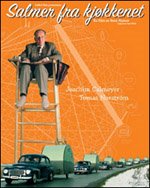
Bent Hamer – Salmer fra kjøkkenet (1)

I can’t praise this movie enough. It’s premise is utterly absurd, it’s characters subtle and lovable, the ending uncompromising, yet uplifting, and the undertones of the political and cultural history of Sweden and Norway masterfully woven in. The movie is about an old Norwegian farmer with a sick horse, who is sick himself. With promises of a new horse a Swedish research team lures him as a subject into a study of kitchen efficiency. The horse he receives is a little wooden one, and the study involves a Swedish researcher sitting in high chair in the subject’s kitchen, observing everything he does and taking notes, but forbidden to interfere. After initial hostilities the two become friends, to the chagrin of the study’s director, who insists on a positivist approach. A simple message – involvement begets understanding – in a marvellously absurd and laconically poetic setting. Go see it.

Monday, March 6th, 2006

Takeshi Kitano – Kikujiro (2)

Not before I looked the movie up on IMDB did I realize that the reason the main character looked familiar was that I had just seen him in Zatoichi, playing the title blind swordsman. As with Zatoichi, Kitano wrote the script, directed and played the lead in Kikujiro, the odd tale of a summer vacation a young kid spends with Kikujiro, a smalltime crook and loudmouth with a good heart. The movie felt a bit too long, but that might in part have been due to the strangeness of it all. Most of what the main character did didn’t make much sense to me emotionally, but not in the sense of it being written badly. Rather, all the relationships and communications here were partially opaque to me – in other words, adhering to strange conventions. Not knowing whether these are Kitano’s conventions, or those of Japanese culture in general, I can but try and unravel the mysteries of a character who is very abusive and mean, yet respected and humoured by everybody except the tough criminals he runs into at a fair. Cultural mysteries aside, there are wonderful images and ideas here, and lots of little surprises.

Friday, March 3rd, 2006

John Junkerman – Power and Terror (4)

Chomsky doesn’t deserve the movies made about him. Manufacturing Consent was an adequate representation in both content and style of the man who often appears to be the only sane person in a large room full of fanatics, but Distorted Morality and Power and Terror, both done by Jon Junkerman, are little more than badly edited recordings of public lectures, with no thread or narrative at all. What quality there is, is in Chomsky’s arguments, with the few ideas of moviemaking that went into it actually detracting from that. Junkerman opens chapters with a blank screen and a sentence or phrase taken from the lecture or interview segment that is to follow. The the original segment follows without a noticeable gap, making for a logical jump between the two things we hear Chomsky say, and the confusion is intensified when seconds later he repeats word for word what we just heard him say. It’s meant to structure the movie, but it’s entirely superficial and doesn’t work anyway. In the final scene, we see Chomsky on a stage far away, asking us whether we can hear him, clumsily alluding to the fact that he’s not very widely listened to and a lone caller in the darkness. It’s too bad that bad movies like this one contribute to that.

Friday, March 3rd, 2006

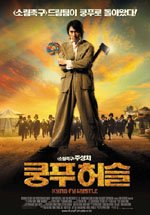
Stephen Chow – Kung-Fu Hustle (1)

The best martial arts movies combine poetry and action into something unique, and boy, does this one ever succeed at it. At once a parody of the genre, and a masterful example of it, humor and inventiveness make this an exhilarating masterpiece. The feeling of sheer delight was heightened considerably by the fact that for some reason I expected a Jackie Chan type comedy, with conventional humorous dialogue and moderately original fighting. I was completely unprepared for the cigarette smoking landlady, the dancing axe gang, the lion’s roar megaphone or the toad fighting technique or the numerous other elements of mayhem, and so was entirely without defences. Which is just as well.