Search

Science


Monday, December 12th, 2005

The buzz of bees

Bees can recognize human faces, study finds

More pseudo-news about animal superpowers. Like the ability of pigeons to distinguish painter’s styles, this is interesting for entirely different reasons than the general audience will think reading the article – rather than showing some uncanny humanness in bees, it shows the algorithmic generalityof some problems, and misleads one into thinking they are simple to solve computationally, because supposedly simple animals can solve them. I would be surprised, however, if these bees were doing better than face recognition software, in which case the point becomes moot.

Particularly interesting is the researcher’s quote “the bees probably don’t understand what a human face is” (my emphasis), indicating that it’s not just the journalists that are playing that angle for the publicity. Although on the other hand, maybe that does mean that killer bees can be trained to be truly deadly now. Winged assassins! Hold the presses!
Thursday, December 8th, 2005

Warmgefönt

don't do that

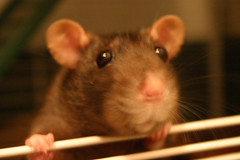
Nature berichtet in seiner aktuellen Ausgabe, dass man einen britischen Tierversuchs-Lobbyisten für eine Fernsehsendung den Alltag eines Versuchsnagetiers nacherleben liess. Unter anderem musste er dabei teuflisch warme Fussböden und brutal trockengefönte Haare erdulden. Wir Nagerfreunde begrüssen dergleichen Kaspereien natürlich, nicht nur als soliden Beitrag zu einer komplexen Diskussion, sondern auch als ersten Schritt in eine bessere Welt; denn erst wenn alle Menschen leben wie die Ratten ist unser Auftrag erfüllt. Oder Karnickel. Oder eben Vizcachas, wir sind da flexibel.

Vielleicht darf man sogar hoffen, bei der Ausstrahlung der Sendung am 14. Dezember auch eins der berüchtigtsten Rattenexperimente am Lobbyisten nachgestellt zu sehen; das nämlich, bei dem ermittelt wurde, um wieviel länger Ratten sich durch Strampeln vorm Ertrinken retten, wenn man ihnen zuvor den Eindruck verschafft hat, man würde sie schon beizeiten da rausholen. Zugegeben, das Originalexperiment ist recht alt, wurde schon in den 50er Jahren durchgeführt und würde heutzutage von keiner Ethikkomission mehr genehmigt. Aber ein kleines bisschen Unsachlichkeit ist ein geringer Preis für eine unterhaltsame Sendung, und zudem sind Lobbyisten ja in der Regel auch nicht mehr die Jüngsten.

(Dieser Beitrag erscheint parallel bei der Riesenmaschine).

Thursday, December 1st, 2005

Mainstreaming

captive audience

A few years ago at a Society for Neuroscience meeting, there was an ethics panel discussing animal research. I quickly realized that the panel’s discussion was not about whether or not animals should be used in research, but rather how to propagandize their use properly and avoid lawsuits and flamebombs. This seemed a somewhat conservative and backwards approach – if only in contrast with the discussion of animal consciousness and its consequences I had, in fact, expected to hear.

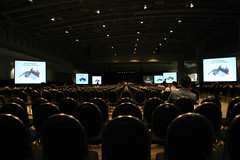
This year, one of the large talks – which are always held in a ludicrously big room, making them seem less well attended or received than they are – was on the subject of cognitive enhancement, and once more I expected to see some innovative debate of emerging technology and knowledge, and the dangers and opportunities inherent in messing with the very organ that creates experience, when we hardly understand the first thing about it.

Instead I heard a talk on performance enhancers in sports, with some lame joke about how everybody in the audience had taken some congnitive enhancer that very morning (meaning, of course, caffeine) coming the closest to the advertised subject.

It might be naive to expect cutting edge, or even just mildly surprising statements in presidential lectures at monster meetings like this. But that the most daring and controversial moment in the biggest meeting on Neuroscience comes when the Dalai Lama speaks for a few minutes on his understanding of meditation, something seems amiss.

(The foto above, by the way, was taken during a talk on animal consciousness, specifically on whether mental timetravel was unique to humans, presenting evidence from chaching behaviour of scrubjays, suggesting it might not be)

Wednesday, November 9th, 2005

Meditation

on my way

The Society for Neuroscience announces it’s most prominent speaker at this year’s meeting, plus a few special considerations:

“Special security procedures will be in effect, as directed by the U.S. State Department Office of Diplomatic Security, which provides security for the Dalai Lama when he is in the United States. We have been advised that each registrant attending the lecture will have to be screened by walking through a metal detector prior to entering Hall D, and will have to remove metal objects from their pockets and bags prior to passing through the metal detector.”

“For security reasons, the State Department asks that you not approach the podium or the microphones during the lecture. Those attendees in Hall D will be given cards when passing through the security check.”

“Beginning at 2 p.m., traffic flow within the convention center will change in preparation for the lecture.”

The title of the lecture is “The Neuroscience of Meditation”. Feel calm already?

Wednesday, November 9th, 2005

The Joys of Computing

When at 9:30pm the dreaded poster is finally taking shape, to be printed out early the next day, and a fuzzy feeling of happy relaxation invades the bodily cavities, for the body’s owner is to go home soon, and when then just seconds later, upon pressing the oft used keystroke combination of CTRL-SHIFT-LEFT in order to mark a word that is to be taken out of the beautiful composition of the poster, for it to become even more beautiful, Illustrator suddenly and quite unexpectedly vanishes without a peep, an error message or indeed any sign of distress other than its complete and utter diappearance, the contrast between the mentioned feeling of fuzzyness and the ensuing shock is not alleviated by the discovery that neither saved versions nor temporary files exist and the work of the last four hours is lost.

But when, four hours later, the very same keystroke (which, I hasten to add, did work just as intended many, many times in the four hours preceding this second incident) produces the very same result, the realization that in spite of knowing of this grave danger once again no intermediate versions have been saved, the feeling of anger toward the material world, the quality of which was of such at the first incident that a visible dent in the wall testifies silently, is replaced by one of personal inadequacy and general hopelessness.

Unfortunately, the fact that when the same thing happens yet another time the following day, a version of the file has been saved just seconds before, does not compensate with a feeling of joyful elation that can rival either of the previous evenings unpleasant cognitive events. Most unfair, that is.

Sunday, November 6th, 2005

Deceptive Imagery

The first thing I noticed when seeing this shot of Bush during his recent visit to Argentina were the rolled up sleeves, maybe because they’re so blatantly obvious, maybe because I was primed by the recently leaked email correspondence of then FEMA director Michael Brown, where he was advised to roll up his sleeves to appear more hardworking, while people in the hurrican’s wake were struggling to stay alive.

I realize, of course, that if a public person just behaves naturally, the resulting image will be anything close to honest. But doesn’t it seem odd that it is accepted, or indeed expected, of trusted public figures to be deliberately deceptive about themselves and mislead everybody?

And because I just finished it, I’ll throw in a little anecdote from de Waal’s book (see below). One day the then alpha male of the chimpanzee colony at Arnhem Zoo was challenged. He stood up very manly to the threat and showed no weakness. But after he had won, when he turned away and his face wasn’t visible to his rival any more, he immediately expressed his insecurity and fear in a wide, anxious grin. But who would compare Bush to a chimp, really?

Sunday, November 6th, 2005

Steaming Monkeys

Yesterday a neurophysiologist gave a talk here at Berkeley, on their usual subject of the correlation of electrical activity of a neuron in Macaque cortex with some thing or another. While the audience walked in, the speaker had a short movie of a wild Macaque sitting contently in a hot spring with snows all around, probably shot at Jigokudani. The movie’s tranquility and meditative mood seemed strangely at odds with the boring work experimental animals usually have to endure. Maybe the strangely beautiful closing sequence of Aguirre, where Kinski’s mad explorer chases monkeys around a doomed raft would be a better metaphor.

Friday, November 4th, 2005

Frans de Waal – Chimpanzee Politics (2)


Ein Klassiker der Primatenforschung, und faszinierender Einblick in die seelische Verfassung unserer nächsten Verwandten. Ein Gutteil dieser Faszination speist sich daraus, dass trotz aller Parallelen zu menschlichem Verhalten die Gefühlswelt und das Verhalten der Schimpansen von anderen Prinzipien regiert werden als unsere, die Tiere uns aber ähnlich genug sind, dass wir ihnen die dem äusseren Verhalten entsprechenden menschlichen Regungen unterstellen. Eine Lektion nicht nur in Primatenpsychologie, sondern auch in den Mechanismen, durch die unsere Vorurteile unsere Wahrnehmung gestalten; vermutlich sind diese aber ohnehin Teil jener.

Eine der rührendsten Anekdoten des Buches erzählt vom Moment im Frühjahr, in dem die den Winter über im Primatengebäude verstauten Schimpansen die unsichtbare Klappe ins Freie sich am Ende des Ganges öffnen hören, und sofort in lautes Geschrei, aufgeregte Sprünge und Umarmungen ausbrechen.

Saturday, October 22nd, 2005

The Spookiness of Inside

apparition

There is no mistaking the fact that after decades of intense research, we aren’t much closer to answering the questions about consciousness, and not even much closer to knowing what exactly it is we are asking. The inside of our skull still looks as mysterious as ever.

Thursday, June 9th, 2005

Eine kleine Nachtmusik

construction is at the center of all things

Die Pumpe des Heliumkühlsystems scharrt regelmaessig, vor einer Weile habe ich das mit dem Atmen eines grossen, respekteinflössenden Tiers verglichen, aber jetzt klingt es wie ein Schlagzeug. Die Lüftung, die Pumpe und das monotone Rattern des Scanners vermischen sich zu einem breiten Rauschcocktail unbekannter Farbe, das klingt wie ein Konzert am Ende einer sehr grossen, sehr leeren Halle, eine winzige Bühne steht da, man kann die Musiker kaum sehen, und hört auch nicht, was sie spielen, weil das entfernte Geräusch von allen Wänden wiederhallt. Ich glaube, Blasinstrumente zu hoeren, aber das ist natürlich Quatsch. Es ist ja keine Musik.

Mein Koerper ist betäubt, ein dummes Klischee, aber es fühlt sich wirklich an, als wäre ich in Watte gepackt. Wenn ich den Kopf drehe, hinkt er etwas hinterher, ein billiger Rückkopplungseffekt im Video. Hinter mir auf dem Bildschirm werden Herzschlag und Atmung eines anderen Menschen abstrahiert, die Atmung kann man kaum erkennen, das Signal ist zu verrauscht, ein dickes grünes Band aus sich überlagernden Zickzacklinien.

Manchmal meine ich für Sekunden, einen Sänger ausmachen zu können in der Geräuschkulisse, aber das ist natürlich Quatsch. Es ist ja gar keine Musik.