Search

Science Fiction


Saturday, February 4th, 2006

Dan Simmons – The Fall of Hyperion (2)

In this sequel to Hyperion, we learn a lot more about what the Shrike is, who built the Time Tombs and why, and what the enigmatic events in the first book meant. In a way, these revelations destroy the sense of mystery that surrounded the time tombs and the Shrike. The necessity to keep a plotline that goes back and forth in time from folding unto itself and creating a know makes this book hard to follow in places, and gives a feeling of contrivance to what seemed a monumentally powerful force. The explanations, on the other hand, work well enough, and the overarching theme of death, suffering and how organic life can keep its dignity in the face of them and strive to be free of them without destroying everything in the process is fascinating to follow. The combination with Keats’ romantic poetry, while adding a very unusual touch to this space opera, doesn’t work all that well for me, but that might mainly be because I’m not too smitten with romantic literature and find the hyperbole and godlyness of subject matter and language tiring.

I am sufficiently interested in Simmons vision to someday go on to read Endymion and Rise of Endymion, the next two installments in the Hyperion saga, but not very soon. I’m too afraid to find religious mayhem similar to what happened in Herbert’s progressively less accessible Dune series.

Sunday, January 29th, 2006

Dan Simmons – Hyperion (1)

An excellent crossover between literary history, theological treatise and captivating worldbuilding science fiction, the only shortcoming of this book is that it ends just when things start to become interesting. Not until the last few pages did I realize that the confrontation with the frightening entity called the Shrike, the opening of the Time Tombs and the outcome of the big conflict between human and AI madness would be subject of the sequel. Still, this collection of the life stories of six people, bound together by a pilgrimage (Hello, Chaucer), weaves a picture of a future, where technology and metaphysics blend into a web of awe.

It’s interesting to see Simmons trying to deal with a technical detail problem facing every attempt at Science Fiction with some cultural and historical background: either every reference has to be composed and explained in detail, or all the references come from 19th and 20th century culture, which becomes increasingly improbable the further in the future the plot is set. The fact that his plot contains people from many different epochs makes up for some of that asymmetry. That device almost justifies the pilgrims singing “We’re off to see the Wizard” when they go to face the Shrike, and the difference is made up by the creepiness of that very image. But overall, it still doesn’t quite come together, the lists of artists that are mentioned in a few places always separate nicely into the ones the reader knows and those unkonown names just plugged in to indicate the passing of time. But if the past is any indication for the future, hardly anybody from our time will still be known 600 years hence. Maybe Simmons is as close as one can get to solving that particular problem here.

This book has won both the Hugo and the Nebula, and while I don’t fully agree with quite so much formalized praise, its central character, a geostationary tower 40.000 kilometers high, rising from the slightly shifted island of Sri Lanka, is a fascinating and awe inspiring invention. It’s story, intertwined with that of it’s engineer, Vannevar Morgan, is nicely contrasted to that of an ancient king, who reached for the stars of his time and found death in the process, just as Morgan does. I think it’s this undercurrent of engineering and progress as substitutes for religion, which is painted as their opposite, and seems to include anything not logically deducible, that makes this tiring to read. Not accidentally, the humans in the story are shallow and lifeless, and the final chapter betrays the mix of engineering and Nietzsche that seems to fuel Clarke’s world view: at the great noon, the superman will come in a chariot from the stars, to unite with the child and found the future. An engineer’s dream of electric sheep.

Though the lack of meaning and its pulpy plot development are part of the concept of this highly stylish science fiction comic come alive, it drags a bit toward the end, when even the vestiges of development devolve into a series of ever fancier military gadgetry being deployed. The design is quite nice, but with a bit more reflection on the history and significance of the original artwork it could have also had significance. Ah, well.

Wednesday, December 28th, 2005

Frederik Pohl – Gateway (2)

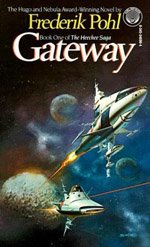
I’ve been busy checking out the Hugo and Nebula award winners, and this one was a particular delight. An unknown alien species, the Heechee, disappeared a long time ago, but left some artifacts, most notable a space station equipped with hundreds of interstellar ships attached. The ships are mostly operational, but nobody knows how the course setting machine works, what the destinations are, and how long the trip will be. Mortality on these trips is high, with most coming back emptyhanded, so the exploration of the Heechee legacy is run as a kind of lottery, where explorers might die or disappear, but might also come back with incredible new artifacts or knowledge, making them rich for life. This is the background to the story of one man, who struck it rich on one of these trips, but can’t cope with what happened, and what he had to do to survive. We witness his therapy sixteen years later, and the original events unfolding in parallel, with documentary material, like classifieds from the station’s newspaper, ingeniously strewn in.

Friday, December 23rd, 2005

For All Mankind (1)

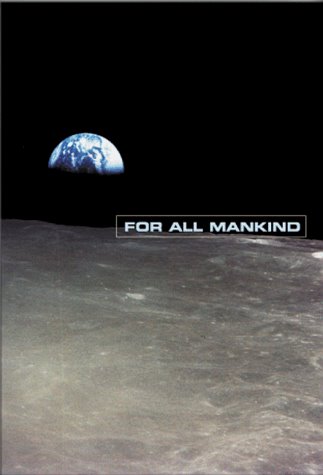
The story of lunar exploration, from Apollo 11 in July 1969 to Apollo 17 in Dezember 1972, in a beautiful collage, narrated from the original recordings and additional comments from the people who have been up there. Amazing footage gives you a glimpse of what it might be like to go where now man has gone before. It’s a bit unfortunate that they emphasized a seamless narrative over historic accuracy, blending the 7 missions into one long trip to Luna, but in the end, it doesn’t matter.Earth, floating in blackness, yet struck by the intense light from the sun, made me realize for the first time the intuitive oddness of space close to a star: dark and empty, not for lack of light, but for lack of illuminable things. That’s got to be an analogy for something.

Friday, December 23rd, 2005

Robots (5)

If there’s anything meaningful that’s not sickeningly cute and mindlessly inspirational in this movie after the first fifteen minutes, feel free to knock up the rating to a solid “4/avoid”. We switched off when pabot told sonbot to follow his life’s dream, cause pabot never did and now sorely regrets it. Sniff. To think of all the cool gadgets that could have been made from the robot parts if the moviemakers (Two directors! Two writers! Ack!) would have done as father did, not as he says.

Wednesday, December 21st, 2005

Frank Herbert – The Green Brain (3)

Probably one of the first science fiction novels to have the ecological threat posed by modern humanity at the core of its plot, this 1966 action drama puts all its effort into getting the message through, with very little meaningful plot. It’s an unfortunate choice, as the central premise – being under extinction pressure from an Orwellianly named International Ecological Agency, insects adapt by cooperating to form complex and conscious societies, capable of concerted action and motion – would have been fascinating to explore in depth. Instead, the book spends most of its time following a subplot of international politics and intrigue, and its protagonists down a jungle river, and ends when things would become interesting, with what feels like a compromise between a happy ending and gloomy doomsaying. The book leaves the distinct feeling that Herbert wasn’t quite happy with his setup, and didn’t want to put too much effort into working it through. Maybe that’s why he revisited the hive mind a few years later in The Hive.

Monday, December 19th, 2005

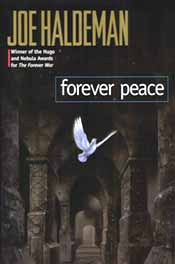
Joe Haldeman – Forever Peace (2)

This is a story of many plots, ranging from the destruction of the universe, or a substantial fraction thereof, by nanotechnology, to modern warfare and social philosophy to moral conundrums of modern life – interracial dating, for example – and it tries to both set up these varying fields as enormous problem zones, and then present realistic solutions. Most of the central ideas and technologies, and the problems caused by them – the social impact of full automation both on the society controlling it and the societies controlled by it, or the psychological and military implications of remotely controlled superwarriors, to name two – are daring and impressive, and the extrapolation of US foreign policy into the year 2048 seems frighteningly believable. But against the tapestry of these towering problems, Haldemans solution falls somewhat short, both within the universe of his novel and our own. Still, with its very gripping, thoughtful and empathic plot, Forever Peace fully deserves the Hugo and Nebula awards it won.

A while ago, at an SfN meeting, I attended a ethics panel, where one of the questions discussed was the growing of human neurons in animal brain. Other than being vaguely creeped out by the concept in spite of my better knowledge, I only remember one of the researchers talking about how very, very much they discuss this in the ethics panel at Stanford. I guess he sorta knew that people would be vaguely creeped out.

Now the Frankenmice have made Yahoo News, and no doubt the religious nuts are already collecting their wits for an assault against the perversity of science! So let me be quick to point out that this mousebrained thing is a great idea, for it brings us one step closer to creating Franky and Benjy, the two mouse overlords from The Hitchhikers Guide to the Galaxy.

Read more at news.yahoo.com/s/ap/200…