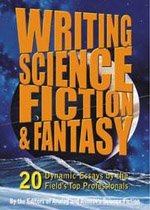
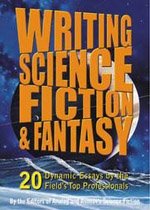
 An interesting anecdote which maybe doesn’t sum up this volume of writing advice, but certainly illuminates it, has Mozart being asked for hints on symphony composition by a young, aspiring composer. He advises to start with small pieces and work up, and when the composer is confused by this and points out that Mozart himself wrote symphonies at quite an early age, Mozart replies “Yes, but I never asked for hints”. That doesn’t necessarily mean that the advice in this volume only applies to writers of mediocre talent, or that it isn’t useful for experts. While the individual essays in this volume vary greatly in quality, with Asimov providing the largest number of essays, and has the least substance to his superficial und uncultered boasts, there are a few pieces that delve deeply into the problems of building entire worlds from scratch. This problem is arguably one of the most important reasons for the gap in literary quality between science fiction and the rest of it – where ordinary narrative can rely on the reader’s ability to fill in gaps in background, characterization and psychology, science fiction must often close them, using original material for it. The seams of implausibility that result whenever this goes wrong wreak havoc with characters, plot and world plausibility, requiring the aspiring writer to pay much more attention to minute details and work it all out. Incidentally and as an aside, the other big reason for the quality gap would be the fact that writers genuinely interested in general themes of human existence rather than scientific what-if-narrative will naturally shy away from setting their plots against an artificial background, leaving a large faction of people like Asimov, who openly admit that they care not one bit about subtelties of storytelling and characterization, and that ideas are all that matters. It’s too bad, really.
The high points of this collection are the essays by Poul Anderson on world building, Norman Spinrad’s somewhat dated sounding advice on how to project current trends using simple cyclical models – it’s a funny moment when he reports in awe that the spreadsheet he uses is a file of gargantuan 600 kilobytes. Good old days -, Hal Clements advice on how to create believable psychologies in an unknown world, and Connie Willis treatise on humourour writing – though technically that last one doesn’t belong here, since she herself points out that there is nothing peculiar to writing funny SF opposed to funny anything else. Also entertaining is Stanley Schmids list of cliches editors will not ever want the read, though I have to say that if you indeed want to write an Adam and Eve story because you think the idea is highly original, another line of work might be better suited.
Books, English, Good, Guides, Science Fiction | No Comments »
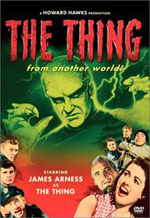 I had heard that his movie was good, but I was surprised to find just how well this 1951 SciFi-Horror crossover has withstood the test of time. An intelligent script and believable characters, a stroy relying on try suspense instead of cheap effects, a truly frightening creature and well acted and filmed scenes all make this a gem worth remembering. While Carpenter’s remake, especially its intense atmosphere of paranoia, is superior in some ways, I would find it hard to compare the two overall. Which means that for its sheer age, Nyby’s version wins. Yay Nyby!
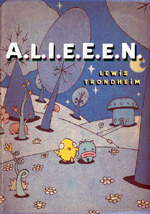 Trondheim’s marvellous style, applied to a quirky story of alien mishaps, told in hardly decodable symbol language and asynchronously. The result is a delightfully trippy little comic book. An interesting side note concerns the preface, which seems to have been written specifically for the american edition (which I assume is otherwise identical to the french edition, unless there are different kinds of unintelligible geometric symbols in the two cultures) and mentions a camping trip of Trondheim’s into the Catskills. Merely translation of ideas rather than words, or an attempt to conceal the European original of the work for sales’ sake?
 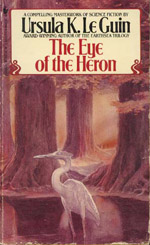 I like LeGuin’s work in general, but this tale of freedom and repression is not her best work. Two groups of exiles coexist on a wild, uncharted planet, one composed of the descendants of prisoners, the other of political exiles, sent away for their disturbing pacifism. When some people in the city try to increase their power and wealth by exploiting the pacifists, whom they perceive as weak, a struggle ensues, that ends in a murky compromise and further exile for a subgroup of the pacifists, who realise that they can only live their dream in complete isolation.