Search

English


Thursday, September 24th, 2009

the shark jumped house – an eruption
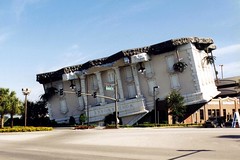
Oh, come on, for the love of something that you scriptwriting people actually love, your gnawed pencils, perhaps, or your iPhones with the witty applications. Not that I have any hope that writing this stuff down will do any good externally, meaning as it concerns you scriptwriting folk, but venting does help the entity that is letting go of steam, thus in this case, me. It’s self-medication, really, right up your alley. Pompeji likely might be less of an attraction of death and doom today if Mount Vesuvius had vented just a little more and exploded in fire and brimstone and rivers of ash a little less.

So I saw the double hour season premiere of House last night, and was, by and large, not very much amused. To frame the impending venting, House has always been a glorified soap opera. The medical profession that the show supposedly was about was never portrayed in anything resembling realism, the acerbic wit and deep insights were ever only shallow facade to elevate Laurie’s unshaven jerk, and greater responsibilities are on the mind of hardly anybody on TV, it would seem, no matter how multimillioned the audience. Sure, walk into MR rooms to have a secret chat without checking your pockets, it’s only TV after all, and if you do it in real life and kill a patient, it’s your own bloody fault.

And that’s not even the venting, yet. So the season opening shows House dealing with his depression and darkness, except it doesn’t. The message of these two hours is that all it takes to emerge from an existential crisis is a stretched out hand and a few pills, and the shallowness and sheer stupidity of such an assertion in the face of a civilization choking on epidemic numbers of the clinically depressed is astounding. I say this, of course, assuming that following episodes will not put the lie to this soppy, infuriating opener.

Which isn’t the main beef necessitating venting, at all. They also missed a very obvious pun for Mr Smartass to make, when he referred to the new treatment method of blackmail, it should have been blackmail by a black male, much more acerbically witty this way, and unsubtly active-agressive, indicating this and that, though, in fairness, that might have been implied in his saying blackmail the way he did, though again on the other hand, this would be uncharacteristically subtle in an episode where everything gets named and thus nothing gets pointed out at all.

But that’s a bit beside the point and not raising the gas pressure very much at all, either, of course. So then House steals a car, abducts a delusional patient and endangers the guy’s life, all to prove a point. And but what should happen next but him getting absolution from a cringe inducing German, Franka Potente of all people, for his improvised manslaughter attempt, because, get this: he meant well. Says the German, in her German accent. Hugs all around. Aww.

Which still isn’t the truly upsetting part and not what I would want to vent superheated acidic gases from a rocky orifice for under normal circumstances. But now if I am somehow connecting this to politics, in a country recently obsessed with Nazis and socialists and its bloody misguided war in the Middle East, parsing Bush as the leader type with issues who took Iraq out for a ride to make a point, and, oops, Iraq jumped off a crumbling wall, if I make this connection and then hear an American written German absolve the whole mess because, hey, at least he meant well, then the sheer level of lack of reflection, emotional or intellectual depth, and moral bancrupcy becomes a tad much to bear. It’s OK to ruin someone, as long as you MOVE ON ALREADY, like the Deutschländer did. Uh huh. Thanks, daddy-o, feeling much better already, moving on, nothing to see here.

So that finally this now is the actual lava-deferring and eruption-avoiding hot air bubbling to the surface here in the middle of this wasteland of a post: why on the face of this abominably hurling rock of dirt and shit and seas full of plastic waste, all stuck together by quark and glue am I even watching this mindless drivel, still, and will very likely tune in again next Monday, see if I don’t? Just what kind of a passively watching mindless superdrone am I?

Do not answer this, please. Ha, see? I control your mind now. All through the power of venting.

Saturday, September 19th, 2009

inkling of jest

More evidence is accumulating, and so to dispose some of the anxiety of soon having to leave the dear world of tennis, addiction and myths of feral babies, I take some time off the story and its footnoted branches, and instead review some new occurrences of numeral confusion, and a possible explanation, to boot.

In the odd insert of Himself’s fond look back upon his younger years, the event of a sheared off doorknob leads him into his future work in annulation, or at least is presented as a foundation for this future work. The description of the rotation of the circle on a stalk on the hard floor is faultless, and the mathematical discussion of the cycloid that ensues, is quite flawless until this bit of information intrudes: “But since here, on the bedroom’s floor, a circle was rolling around what was itself the circumference of a circle, the cycloid’s standard parametric equations were no longer apposite, those equations’ trigonometric expressions here becoming themselves first-order differential equations.”

So we have a parametric description of the curve a point on a ring will go through as the ring rolls in a straight line. This is the cycloid. And since here a ring is really rolling in a circle itself, being restricted by the attached stalk, something is different. All of this is true. But why would the same parametric equations not be applicable along the circular path of the doorknob? As far as I can see, they would, and Himself telling us this story should be well aware of that.

The second new piece of evidence comes from one of the end notes, where Pemulis briefs Hal on how to obtain derivatives. x to the power of n derives to, he claims, nx+x^(n-1), which is finally absurd enough to turn suspicion into certainty: this is not noise, it is signal. This signal, however, not carrying simple narrative, because once again the person speaking both clearly knows the correct answer and also has no reason to deceive, or to expect a deception to be undetected, derivation of a polynomial being your pretty basic analytical bread and butter for high school kids.

And then, a few notes down, we witness Pemulis say this to a snivelling Possalthwaite: “Todd, trust math. As in Matics. Math E. First order predicate logic. Never fail you. […] The vital statistics of God or equivalent. When all else fails […] You can fall back and regroup around math.” This is followed by some lemma on line integrals that is indeed (and somewhat confusingly) true.

So if math is considered the one unwavering basal truth, yet is bent out of shape almost every time it comes up in the fabric of the novel, along with the laws of optics in the case of the shadows in the desert, which please recall is also a field of expertise of Himself, as is annulation, the weirdly absurd process of waste negating waste, it all seems to point to the fact that James Incandenza maybe found a way to infect everything he touched with some sort of existential rot, eroding the foundations of truth itself, just like any good father will.

Thursday, September 17th, 2009

oodles of puns

Accretion is the better part of vapor.

Wie man sich betet, so lügt man.

Tuesday, September 8th, 2009

ciphers

I hate to bitch. Okay, that’s a lie, I love to bitch, sorry. But at least I can spare you my prefacing this newest bitchfest with the qualifier that the book I’m bitching about is great otherwise. We’ve been over that already, it’s scorched earth. There, spared you. Considerate me.

What is going on with the Wallacester and the math? I’m now about halfway through Infinite Jest (what’s half of infinity? Am I done, then?), and as of yet there is nought in terms of indication that his shortcomings in the land of numbers are a jester’s crown worn for some – however obscure – purpose of Jest, finite or otherwise.

The newest item from DFW’s confoundry: Eschaton’s rules are only touched upon tangentially in the main novel’s text, vague hints at complexities of being hit, influenced by weather and all sorts of other variables, which is fine. But then we are taken into lengthy details in an endnote about how the First Mean Value Theorem of Integration allows Lord to get by without calculating complicated integrals for setting up the game. In some rather unspecified way the initial allocation of resources to players for a game’s new round depends on the average value of some equally underspecified ratio, and so Lord needs to calculate the integrals of this variable over previous game time. Except that apparently he doesn’t, because this magical Theorem allows him to use a shortcut right out of the convolved space of higher math into a paradise of simplicity. Which sounds quite nice. And is quite untrue.

The average value of a variable over an interval of time will be it’s integral over said interval divided by the interval’s length. Now, the First Mean Value Theorem indeed guarantees that the integral comes to the same as the intervals length multiplied with the value of the function at a point within the interval, and so that the average itself is identical to the value of the function at this point within the interval. The logic of this is nicely developed in the lengthy endnote’s lively interchange between Incandenza and Pemulis. But nohow does this integral theorem allow you to infer which point within said interval you’d have to choose, and thus for all practical purposes of setting up tennis socks and buckets of bald nuclear balls, this little piece of abstract mathematical wisdom, rather than being the prized insight allowing young kids to cheat the forces of nature Pemulis wants to sell it to us as, is utterly useless. Plus also, in the sloppy plot nicely labeled Halsadick, the supposed average value doesn’t even look like the actual average value, for crying out loudly in complicated semantic structures.

A bit later we read that computer discs squeeze whole high definition movies into 4.8 MB of binary space, which claimed figure must have been ludicrously and unrealistically low in the B.S. 90s already. Such a disc wouldn’t hold two single uncompressed HD images of finely rendered water (assuming 24 bits of liquid color shades). A typo, one hopes. The DVD was introduced in 1995, by the way.

They still are a puzzle, these oddly shaped holes in the otherwise beautiful fabric of this tome, and I’ll keep on logging them. It amuses me.

Tuesday, September 1st, 2009

unlikely likelihoods

Maybe it’s because I’m cranky today, maybe it is because the represenation, or lack thereof, of mathematics in popular and high culture is a constant annoyance to me. Or maybe it is because it is deeply mystifying to me how someone as learned as David Foster Wallace can screw up so badly with numbers; anywho.

I’ve advanced to page 259 of Infinite Jest now, the book gets better and better, but then this: “a 54 match conclusion [of a 108 match tournament] is extremely unlikely – odds being 1 in 227“. Whoa, hold on. Really?

So Wallace gets the binomial distribution wrong, big deal, you might say – the correct probability for a draw is about 0.0766 or 1 in 13, by the way – but that’s not what irks me. How could a number so wildly implausible sail unchecked past both his and his editor’s critical skills? In a tournament with 108 matches, there is 109 possible outcomes (from team A loses all, to team A wins all). The average probability of each outcome then is 1/109. Now if the two teams are equally matched, a draw is the most likely of all these outcomes, making their average (1/109) a lower limit on the actual probability. For this kind of reasoning you need no binomial, no probability distribution, just a little bit of mathematical common sense. Which, for some odd reason, seems to be a rather rare commodity.

Wednesday, August 19th, 2009

finite complaint

I am reading David Foster Wallace’s Infinite Jest, and I need to complain. If you haven’t read it, and plan to, don’t worry, I won’t spoil it for you. If you hate nitpicking, on the other hand, maybe do worry a bit, because I will pick nits. Three of them.

Overall, the book is fabulous so far (page 100), and I love the combination of low brow comments with language so erudite it often borders on the pretentious. This is a great stylistic game to play, and it is enhanced by esoteric factoids, partly made up, partly accurate. But for it to work it needs to stay on the light side of the pretentiousness boundary, and the author needs to be in control of the pieces of knowledge he’s throwing around. Now lets pick some nits.

Nit the first. In a discussion of the philosophical aspects of tennis, Hal’s father is cited, obliquely, as telling people about how a tennis move affords n responses, and how there then are 2^n responses to that move, soon spiraling into “a Cantorian continuum of infinities”. Now, firstly, the correct formula for this is n^2. Wallace might have done this on purpose – somewhat suggestive is the fact that the date of Cantor’s diagonal argument is given in the endnote as 1905 (Einstein’s two seminal papers came out that year) instead of the actual 1891. This is probably a purposeful mixup put into the mouth of the fictitious narrator to highlight the distant past-ness of it all – but if so, I fail to see the point of giving the wrong formula. On top of that, however, talking about a continuum of infinities is not quite accurate. The number of replies approaches the number of elements in the continuum only for games with countably infinite many moves, and any transfinity beyond that (the actual family of infinities Cantor discovered and Wallace alludes to) is unreachable by any tennis match. Overall, the passage sounds like a bit of finitely hot air to me, unlikely to come out of the mouth of an MIT educated polymath with an actual interest in Cantor.

Nit the second. When we first meet the assassin Marathe on the mountainside, he watches his shadow wander out in the setting sun toward the city of Tucson and, as the sun gets low enough, eventually reach it across the plains. This can not happen. A circular object of 20 cm diameter (a human head, say), has the same angular size as the sun (about half a degree) at a distance of roughly 22 meters (or yards). At distances greater than that, the object can no longer fully block the sun and casts no total shadow, or umbra. Moreover, the darkest point of the penumbra actually cast rapidly loses contrast and definition. At 44 meters, the darkest point will have 75% of the luminance of the surround, at 88 it’s up to close to 94%. A shadow of a human or anything smaller, cast by the sun and reaching out visibly for kilometers, is a physical impossibility.

Nit the third. Again concerning shadows, in that same scene: when the sun finally sets, Marathe sees his shadow return to him up the incline. This would happen with a rising sun, not a setting, and of course he’d have to face west, not east. If the sun were a point, the shadow cast out by a sunset would retain definition across large distances and grow longer and longer until it hits the advancing terminator and fuses with it. It would not shorten back toward the object casting it.

Is it sloppy writing and editing? Or a deliberate ruse to tick off obsessive compulsive physicists like me? It doesn’t really matter, because the book is still great, and these are tiny complaints.

Later Addition: The term Bröckengespenst Wallace uses for his fictional shadow is a) inappropriate, since a Brockengespenst is actually a shadow cast into fog or clouds, and b) has false diacritical marks on the o. This German spelling SNÄFÜ is in tune however with his german character later on calling his students “mein kinder”, which sports the wrong numerus of the possessive. “Meine Kinder” would have been correct. I’m leaning toward the sloppy writing hypothesis.

Friday, July 24th, 2009

vision

The dead are well
They have ants for eyes.
A million facets
Where we living
Only see one
And dislike it.

Tuesday, June 16th, 2009

Abt. Wortspiele

When it brains, it bores.

Wednesday, May 13th, 2009

karmic balance

For every door that closes, somewhere a parked car opens into the path of a bicycle.

Thursday, April 23rd, 2009

Alleinstellungsmerkmal

Man is the only animal continuously on the lookout for some way in which he is different from the other animals. His need to be special is quite unique.