Amanita Design – Samorost (1)
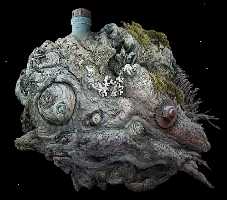
This game is just brilliant in design, storyboard and execution. Very otherworldly level designs and a brilliantly surreal game logic, paired with cuteness – its only fault is that it is too short.


4a
This ploy is quite popular among marketing fucks, it seems. This is the second one in two weeks I received. Send magazine advertisements that look like an invoice, and some percentage of recipients will be suckered into actually paying and thus subscribing to your quality rag. Why, it’s pure evil genius!
Update for this.
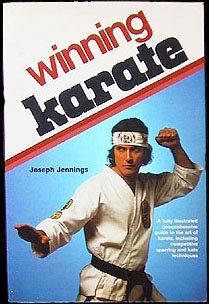
With martial arts training, it’s mre about the form, the spirit and the attitude of the student than it is about the actual specific movement or skill that’s trained. So a physical description of the basic techniques provides technical rather than spiritual insight – at least when it’s read rather than physically studied. On the other hand, the illustrations in this book demonstrating how to deal with an attacker armed with a gun, knife or rifle, are extremely spiritual. And by spiritual I mean funny.
A while ago, at an SfN meeting, I attended a ethics panel, where one of the questions discussed was the growing of human neurons in animal brain. Other than being vaguely creeped out by the concept in spite of my better knowledge, I only remember one of the researchers talking about how very, very much they discuss this in the ethics panel at Stanford. I guess he sorta knew that people would be vaguely creeped out.
Now the Frankenmice have made Yahoo News, and no doubt the religious nuts are already collecting their wits for an assault against the perversity of science! So let me be quick to point out that this mousebrained thing is a great idea, for it brings us one step closer to creating Franky and Benjy, the two mouse overlords from The Hitchhikers Guide to the Galaxy.
Read more at news.yahoo.com/s/ap/200…
It is a very common notion that the study of humour is a dry and boring thing to attempt. While that is true, it is not necessarily a bad thing. We wouldn’t expect hydrodynamics to be wet, or neuroscience to be clever, so why should humour theory have to be funny, or even just entertaining? It should, however, have substance, and here most attempts are lacking, this book being no exception. It is little more than a collection of quotes and tidbits from humour theorists over the centuries, with a lot of the name dropping which is so oddly popular in the humanities. “This is what X means, when he says Y” seems to take on the force and role of a stringent logical argument, and rather than being a mepotistic anecdote, it’s supposed to illustrate something deep. But I digress.
The main theses the reader is left with in the end are that the highest moral value o slaughter is achieved when it’s reflective; when we laugh at ourselves, and that humour is the uniquely human ability to counter the absurdity of physical existence with a psychological distancing movement, and a mocking finger pointed at the physical from afar. Which, of course, is just reactionary balderdash.
If you’ve watched this show at all, it doesn’t come as news to you that oftentimes hilarity is caused by it. But recent episode five of season three, titled Mr. F, surpasses anything they’ve done so far. The whole episode is an elaborate sequence of absurd coincidences that set up a climactic scene, where a group of Japanese investors is shown a miniature city (which they believe to be the real size model homes they are about to help finance) being trashed by Tobias in a mole suit and George Michael with a jet pack. I have not seen anything so funny on TV in quite a long time. Sheerr brilliance.
Children Learn by Monkey See, Monkey Do. Chimps Don’t. – New York Times
(If you don’t have one of the NYTimes accounts annoyingly required to read the story, consider BugMeNot and its Firefox Extension)
The study quoted reports that when shown how to open a box, chimps can leave out causally unnecessary steps, while human infants tend to reproduce everything, even if they know it to be unnecessary. The researchers conclude that this imitation may enable the learning of complex new behaviours, which the child wouldn’t understand at first sight, and thus couldn’t analyse causally.
Most intriguing about this is that the other obvious explanation, that the children are trying to conform in a social situation with an adult, and are willing to give up efficiency to do so, may be the same thing. Culture and tradition, after all, are the codified learning of behaviors which do not seem to make immediate causal sense.
Partly insubstantial ramblings, partly interesting Martial Arts stories, this was a nice and entertaining read. Slightly annyoing that he mixes fact and fiction in his anecdotes, without making clear, which is which. But judging from his website, he’s just too great to care.
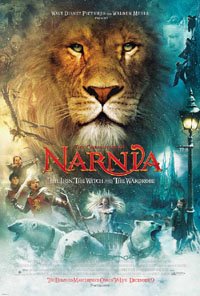
I should have known. While I enjoyed the charming simplicity of the plotlines in the Narnia series, and appreciated them as the children’s books they were intended to be, none of their story elements packs the mythological punch of Tolkien’s writing, and the Christian parable feels tired once you’ve spotted it. Which is hard not to.
To start with the positive, the movie is nicely done, devoid of cringe-inducing lines or badly done characters, wich is saying something for Disney. But it is also quite boring, and at least a half hour too long. To strip a story about an oppressive regime, war and an epic battle for the survival of a whole world of all the nastyness these things should involve, and leave it with decoratively frozen puppets and the frosty looks of Tilda Swinton, is to deny the book its impact. Sure, you shouldn’t frighten your underage audience into little whimpering heaps, but surely some sense of the consequence of evil would have been appropriate.
Plus, not surprisingly, seeing the crude metaphor for the New Testament, Aslan’s sacrifice for the reinforcing of the “old magic”, rather than reading about it, makes it’s crude and unsubtle symbolism so painfully apparent, that I change my initial statement above – there is a cringy moment there, but it’s all Lewis’ fault.
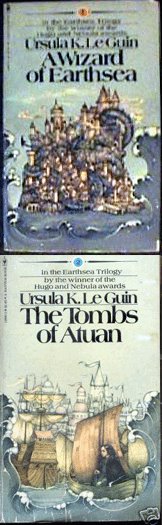
I loved Le Guins The Dispossessed and The Left Hand of Darkness, so even though I’m not very keen on people in pointy hats throwing speels (unless they’re called Gandalf, obviously) I thought I’d give Earthsea a shot, and I’m glad I did. Like with her other books, I found the most interesting element of these books their outright refusal to play by the base rules of the genre. While there are magical gadgets, spells, castles and monsters, it’s clearly not those that Le Guin is interested in. Where a Wizard of Earthsea was about one boy’s journey to discover and master the evil in himself, the Tombs is about a clash of worldviews and belief systems, one religiously closed and involved in power struggle, the other, though based in magic, rational and open, and striving to find balance. In a nutshell, these stories are driven by psychological archetypes (the dark of the tombs, the faceless evil) than by plot, in fact, so much so that I wondered why there needed to be any magic in them at all – the fantasy elements are, so far at least, quite superficial.