Search

English


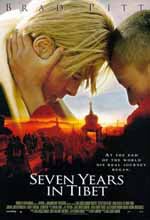
Expecting a filmed version of Harrer’s memoir, lending visuals and speed to the somewhat sluggish pace and skeletal outlines of the book, I was annoyed to see many changes in plot and a focus on the superficial events rather than their meaning. I also didn’t like the fact that in a movie about foreign places and experiences of strange cultures, everybody speaks english wich an accent to indicate the language used, except for a few places with correct language chunks thrown in. The latter double the problem, because now there’s not only an annoying accent, it’s also inconsisten. Harrer’s trek across the alien planes and up the bureaucracy of an unknown and bewildering country here comes down to lack of food, injured feet and a little brush with robbers; the fascination with the double nature of the wise leader/child is overshadowed by a dubious plotline of paternal guilt, and the overdramatized development of Harrer from cliched asshole to understanding wise man is in itself a chliche that could have done with some development. The chinese invasion in the end adds nothing but an uneasy feeling of activism, and the closeing scene in Austria is confusing. The cinematography is great though, even if it was shot in the Andes, because the Chinese wouldn’t allow filming in the Himalaya. I found myself oddly touched to find that Harrer died not a week ago, as though my having watched this movie so close to his death made it more meaningful. Mysteries of the human mind.

Wednesday, January 11th, 2006

Allan Mindel – Milwaukee, Minnesota (3)

This was supposed to be the heartwarming, quirky and funny, yet profound story of a mentally handicapped prodigy icefisher, who has the fish themselves tell him from under the ice how to catch them, but somehow it didn’t come together. Neither the characters nor the acting can convince, and the plot is so thoroughly overconstructed it doesn’t interest me for one second. While the final scene of Albert walking off into the white, trailed by his disciple icefishermen, who rather than laugh about him – as his overbearing mother would have him believe – submit to his superior authority, is very poetic, the rest of what this movie wanted to be stays under the ice. Someone should have listened more closely to capture it.

Sunday, January 8th, 2006

Yamamoto Tsunetomo – Hagakure (2)

The more I learn about Japanese history, the more I wonder how it is possible that the European captains found anybody alive there at all when they arrived. They should have disembarked, a fearful expression on their faces, and waded in blood, among the guts and remains of the honorable dead, who slashed themselves open to maybe make amends for an ill chosen colour of off-white for the master’s new lampshade, or some such. This makes for very fascinating reading, but it is indeed hard to understand how a society, in which disrespect leads to fights to the death, which in turn means seppuku for those who started them, could have functioned, Maybe, then, Yamamoto exaggerates wildly. This is somewhat more plausible for modern readers when they realize that some of his short texts read like they are the direct inspirations for Monty Python’s suicide squad lead by Otto in The Life of Brian, and the Black Knight in the Holy Grail – now of course available as a plush doll, which probably would have horrified old Tsunetomo right into killing himself.

Sunday, January 8th, 2006

Briski/Kauffman – Born into Brothels (2)

I guess I first have to say how touching this film is, nor how necessary it is to provide an, albeit small, window into a hidden world of hopelessness and despair, and the inspiring quality not only of the movie, but also of the photographers heartfelt need to do something to help save the futures, and indeed probably lives, of the children she taught in Calcutta’s red light district. Now that’s out of the way – I was actually wondering at several points during the movie, if the portrayal of these kids as very talented artists, while certainly true, does not mislead the audience into separating the victims of social injustice into those whose ruin will be a loss to us connoisseurs of the arts, and those who won’t be so sorely missed. Surely, if we could save the precious ones, things would already be much better.
Nobody should have to live in those conditions, whatever the quality of their drawings or their grades at school, and there remains a bitter taste of defeat in the end, when out of the nine kids all but three seem to be falling back into their doom. But in another sense, a single saved child is already a triumph, so maybe I’m quite wrong. It’s a great movie either way.

This book has won both the Hugo and the Nebula, and while I don’t fully agree with quite so much formalized praise, its central character, a geostationary tower 40.000 kilometers high, rising from the slightly shifted island of Sri Lanka, is a fascinating and awe inspiring invention. It’s story, intertwined with that of it’s engineer, Vannevar Morgan, is nicely contrasted to that of an ancient king, who reached for the stars of his time and found death in the process, just as Morgan does. I think it’s this undercurrent of engineering and progress as substitutes for religion, which is painted as their opposite, and seems to include anything not logically deducible, that makes this tiring to read. Not accidentally, the humans in the story are shallow and lifeless, and the final chapter betrays the mix of engineering and Nietzsche that seems to fuel Clarke’s world view: at the great noon, the superman will come in a chariot from the stars, to unite with the child and found the future. An engineer’s dream of electric sheep.

Saturday, January 7th, 2006

Robert Lieberman – Legends of Earthsea (5)

When I realized three minutes into the movie, that the script had swapped Ged/Sparrowhawk’s true and public names, I suspected impending doom. It’s a minor detail, but it betrays all the reckless disrespect and cluelessness, as well as the love affair with superficial deepness (Sparrowhawk! Doesn’t it just sound more magical!) that makes this one of the most horrid adaptations of written material to the screen I’ve ever seen. So much money and effort, so foolishly and pointlessly wasted, with some of the most subtle storytelling in fiction warped into a crude, martial mockery. The only good thing about this disgrace is that in contrast, Le Guin’s books shine all the more. If you think you want to watch this, shoot yourself in the foot instead and moan for three hours. At least that way you’ll have learned something.

Thursday, January 5th, 2006

Seeing words

ikeabears

A neat new study done right here at UC Berkeley finds that when the colours of a target has a different name from that of distractors, the left hemisphere is faster at finding the target than the right, while this advantage disappears for colours without a naming difference. The left hemisphere’s edge also disappeared when an additional task taxed verbal working memory, but not when spatial working memory was taxed instead.

So Worf had it right, after all, when he said “Sir, I protest – I am not a merry man!”. And Whorf was right, as well: language indeed does influence our brain’s operations on a very basic level.

Thursday, January 5th, 2006

Neil Diamond – 12 Songs (1)

Hell Yeah, he’s done it again. Though that might refer to Neil Diamond himself, whose work I’ve always liked a lot, and who has outdone himself on this new collection, the person I’m referring to is Rick Rubin, whose list of productions reads like a good part of my most favorite list. Johnny Cash, Slayer, System of a Down, now Neil Diamond. It’s humbling. What great piece of music did I produce recently? On the other hand, I’m wouldn’t even know how, so maybe I’m doing all right.

Wednesday, January 4th, 2006

Bruce Lee – Tao of Jeet Kune Do (2)

This is Lee’s posthumously published founding document for his own brand of kickass, Jeet Kune Do, that brought him both fame and severe criticism for boldly breaking with tradition and fusing different styles, taking what he would from each. The book, while roughly structured into chapters, reads more like a collection of small pieces than a unit. In part this reflects the limitations of editing somebody else’s work his untimely death put on the editor, his wife Linda, but I suppose to a degree this is a reflection of the inherent notion he expresses multiple times. Go with the flow, do not become rigid in rules, be flexible within your limit. The motto of Jeet Kune Do, set around the unique logo with the Yin/Yang encircled by two chasing arrows, reads ‘Using no way as way, having no limitation as limitation’. Which of course is all part of the ancient asian art of making sense through not making sense.

Wednesday, January 4th, 2006

Jeffrey Blitz – Spellbound (2)

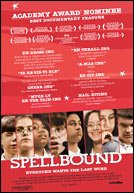
I will refrain from making any spelling jokes in this review, tempting though it may be. The spelling bee, to my still somewhat European eyes, seems a very alien tradition, though I’d be hard pressed to say just what exaclty it is about fidgety bespectacled eleven year old kids with overzealous parents spelling words much harder than “overzealous” or “bespectacled” that is so disturbing. But it is. It is also very funny and fascinating to get a look into a world of success and ambition that couldn’t be stranger to me if it were made of cheese and looked like the moon, but I think I said that already.