Search

English


Thursday, April 29th, 2010

MADDness

Reasons to keep the drinking age at 21: Since the drinking age in New Jersey was raised to 21, the number of young people killed in drunk driving crashes has dropped nearly 78%. Need we say more…

I’ve stared at this claim numerous times, while being carried hither and tither by PATH. In it, MADD, the non-profit that took its name from Alhazred’s infamous Acronomicon (A Complete Reference Of Nerdy Or Maximally Impossibly Convoluted Organization Names) is trying to rally support for their cause, and they’re doing it in a way that makes my number sense go off. To the Mathcave!

First: they don’t tell us what they base their numbers, excuse me, what they base their number on. 78% of what, taken from which source, and calculated how? I realize it’s just a small subway ad, but it does manage to mimic a statistical claim quite well. Which it frankly isn’t. It’s an unfounded and barely even meaningful assertion.

Second, they don’t mention when exactly this raising of the drinking age happened, do they? It happened way back in 1982. In the 28 years since, the number of fatal accidents overall might have dropped considerably. Given the safety advances since then, it’s a fair bet it has. If it had dropped by as much as 80%, the number MADD gives us for drunksters would be merely the average drop. The same were true if just the number of young people on the road, or the number of young involved in any kind of crash, had dropped by 80%. In fact, there is a whole host of variables that a claim like this one needs to be controlled against for it to have meaning.

Third, the drop is in “young people killed in drunk driving crashes”. Sounds like that also includes crashes caused by drunk adults. Which are irrelevant to the question of drinking age.

And fourth, how many saved lives do those 78% actually correspond to, and what fraction are they of the total number of young people killed in traffic accidents? If both were small numbers, would the good of the few really outweigh the good of the many here? While this argument assumes there is a net benefit from getting drunk, which itself may seem debatable, there is no foregone conclusion either way. Not allowing people under 21 to drive at all would make their fatalities drop even further, yet I don’t envision that implemented any time soon. The cost would be too high.

Just to be clear: I think drunk driving is irresponsible and stupid at any age, and young people, especially males, are much more likely than the average to do it. They can’t help it, their frontal lobes are hormonal mush. But whether or not raising the drinking age lowers the risk is an empirical question that deserves proper treatment. Mothers, do not mislead us! It makes us SADD (Scientists Against Data Distortion).

Wednesday, April 28th, 2010

A story about Fodor

And here [Pinker] is on why we like to read fiction: ‘Fictional narratives supply us with a mental catalogue of the fatal conundrums we might face someday and the outcomes of strategies we could deploy in them. What are the options if I were to suspect that my uncle killed my father, took his position, and married my mother?’ Good question. Or what if it turns out that, having just used the ring that I got by kidnapping a dwarf to pay off the giants who built me my new castle, I should discover that it is the very ring that I need in order to continue to be immortal and rule the world? It’s important to think out the options betimes, because a thing like that could happen to anyone and you can never have too much insurance.

Says Jerry Fodor, in his review of Pinker’s How the Mind Works. I am fascinated whenever clever people say stupid things, and this certainly looks like a prime specimen. Can Fodor really think that the above constitutes a valid argument of any kind? That stories, if they are useful as mental sandboxes, must be literal mental sandboxes? That rings must be rings, dwarves must be dwarves and immortals must never die? That, in other words, there is a naively naturalistic mapping for everything mentioned in a story to the identical thing in the world, and allegory and metaphor do not even exist, nor usually carry intentional and ofter moral arguments? Surely that would be ludicrous, but just as surely, the above “argument” seems founded on such ludicrosity.

There certainly are interesting things one could learn from this, about how one’s pet theories bias the mind, or how being too immersed in the dreamy Language of Thought will make one ignore reality. It’s called cognitive dissonance and quite a fascinating phenomenon itself. But I think what I’ll take away is not to read book reviews by people I heartily disagree with and listen to Das Rheingold instead. Wagala weia.

Thursday, April 22nd, 2010

Und was führt Sie her?

  • zucken tote Fische Kochsalz
  • brompton stupid
  • wie heißt das auf deutsch; Take it hau i t on the kopp of a to give of
  • fische sind feige
  • sex with animals
  • riesiger steinklumpen
  • rausgeschnittene zunge
  • kaputte typen homepage
  • stilles trinkwasser bunte getränkeflasche
  • kummer dose diktat
  • The Perfect Ass – Riesen-Po black
  • Feeling Like a Fraud german
  • fische selbstzerstörerisch
  • würmer in der küche
  • defenition of the word ¨untenrum¨
  • translate der hund ist ja sweet


Monday, April 19th, 2010

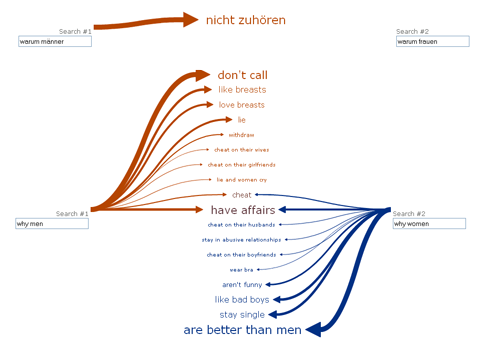
Kulturvergleich

warum Männer, warum Frauen
Ohne Worte.

Monday, February 22nd, 2010

metamechanics of driving

Researchers as far back as Leibniz have pointed out that if you looked into the brain with a full knowledge of its physical makeup and nerve cell activities, you would see nothing that described subjective experience. (Libet, Mind Time, p153)

This kind of argument, recurring in philosophy of mind texts, and frequently made by people who otherwise seem to have their wits about them, is quite flabbergasting, and the dogmatic fervor with which it usually is presented hints at its roots in the desire for metaphysics and transcendence. I literally groaned reading this, earning me some sideways glances in the commuter train.

So let’s see. First problem. The statement by itself is not empirical. All it is is a claim that if you looked, you would find nothing. But so far we have hardly looked at all, we barely even know how to frame the image yet. Put differently, Libet says that there is an explanatory gap between the physical and the mental, and that it can not be bridged. This may of course turn out to be true – though I doubt it – but it is not something we have very much evidence for either way. What evidence there is, however, seems to point pretty clearly to a causal relationship between brain physiology and mental processes and thus weaken the possibility of the gap being real.

But the more fundamental fallacy is that this view confuses the explained, that is, mental life, with the explanation, which is neurophysiological chatter of cells. Of course one does not look like the other. If they did we wouldn’t need a theory, for there would be nothing to explain. This is rather like opening the hood of your car, marveling at the pistons and the crankshaft and spark plugs and exclaiming “Why, there is nothing in here at all that resembles movement of a vehicle, there is just metal parts and gasoline mixture exploding! That there is such vehicular movement can not ever be explainable from these parts, because the two are so very different. There must therefore be an automotive substance in addition to the material one, and it is not governed by the laws of mechanics or physics. When cars die, they live on in their motion.” And so on.

Incidentally: what is it like to be a moving car? Mr. Nagel?

Tuesday, January 12th, 2010

the handy man

Who can take a Schutzblech
Thread it with a screw
Replace it on his bike, and make it look brand new?
The handy man.
Oh, the handy man can.
Cause he screws it up with love,
And makes the wheels turn good.

Who can stain his fingers
Blacker than the night
Full of grease and tar and dirt, reflecting zero light?
The handy man.
The handy man can.
The handy man can,
Cause he grabs the dirty parts
And makes them work all right.

Who can take a seat clamp
And add the right sized nut
Fix the saddle with it and then use it for his butt?
The handy man
The handy man can
The handy man can,
Cause he screws it really tight,
And makes the wheels turn right

And the wheels turn right,
Because the handy man hoped they might.

Tuesday, January 5th, 2010

2009 Leseliste

Bücher ins Regal zu stellen ist befriedigend. Der Abschluss einer Unterhaltung mit dem Autor ist erreicht, das Ende einer intellektuellen Reise, und das Ergebnis einer zusammengepuzzelten Wand aus Ideen ist stimulierend, eine Art gehobene Tapete, Bücherregale sind Innenausstattung des Kopfes und der Wohnung zugleich. Soweit, so banal. Aber würde man sein Bücherregal auf die Strasse stellen, damit Passanten sich die idiosynkratische Zusammenstellung der Gedanken ansehen und sich an den zufälligen und willentlichen Querverbindungen erfreuen können? Man würde nicht. Man wäre ja ein Esel, täte man das. Selbst Antiquariate stellen nur ihren Schrott vor die Tür, als Fliegenpapier, und die hätten doch nun wirklich Grund, zumal in, der Halbsatz passt ja überall, der heutigen Wirtschaftslage.

Andererseits: nur wenig hinter dem Medizinschränkchen zurückbleibend ist das Bücherregal in fremden Wohnungen ein kräftiger Anziehungspunkt. Was steht da, in welcher Ordnung, wer neben wem, wird der Quatsch versteckt, sind welche dabei, die mir gefallen, und falls ja, welche von den Unbekannten zwinkern mir zu, steht Unfug rum, faszinierend. Und trotzdem: der Impuls demselben Interesse, das die anderen ja auch haben müssen, entgegen zu kommen, schmeckt schmutzig. Seht her, das hab ich mir in den Kopf getan, was muss das für ein Kopf sein!, scheint die Leseliste zu brüllen, und zumal wenn sie lang ist im Verhältnis zur abgedeckten Zeit. Dabei kodiert sich darin doch nur Einsamkeit, oder Obsession, oder Notwendigkeit, das eigene Fragmentsein durch Einbindung von anderweitig Fragmentarischem notdürftig zu bedecken wie mit einem Feigenblatt.

Oder ist vielleicht die Nichtveröffentlichung die eigentliche Eitelkeit, weil sie impliziert, dass die Liste eine Leistung repräsentiert, die andere in Verlegenheit bringen könnte und dadurch erst den eigentlichen Irrtum begeht, aus den Zufälligkeiten des Aneinander Vorbeigehens von Buch und Mensch eine intellekwütige Mär zu stricken? Oder ist schliesslich dieses Offenlegen des blöden Hin- und Widers die finale Eitelkeit? Weil nämlich so nicht nur die ursprüngliche Pfauengockeligkeit entschuldigt, sondern die Tiefe der empfindenden Seele aufs schauerlich Blödeste behauptet und belegt wird?

Alles aber Quatsch, Kopfsalat, dummes Zeux, gerade auch in der heutigen Wirtschaftslage.

My year in Büchern, zweisprachig die Kommentare wie die Gegenstände:

Don DeLillo – Libra
After Ellroy, this. Left me unjustly untouched, in spite of delirious dialogue.
Iain M. Banks – Consider Phlebas
First read in German, a world away and a life ago. Rereading: surprised, both ways.
Phillip Roth – The Human Stain
Constructed, but no matter. Reads twice as intense while living close to Newark.
Jonathan Lethem – The Disappointment Artist
Lethem is at his best when he is not shrewdly inventing, but lucidly describing.
Graham Roumieu – Bigfoot – I not dead
Fun! Hit over head with like brick. Ouch, but good.
David Simon & Edward Burns – The Corner
Simon’s achievements are humbling, this being no exception. Half the basis of The Wire, the best show on TV ever. I case you hadn’t heard.
Michael Pollan – In Defense of Food
Poor food. Poor, poor food. Help, somebody! Eat it!
James Ellroy – LA Confidential
Take the land away, and you have a sign. Not sure what that means.
Cormac McCarthy – Blood Meridian
Tje judge will haunt your deepest, hm. Do you even dream, or is your night just a black abyss of nothing?
Robert Rudolph – The Boys from New Jersey
This thing of ours is alive and well in your back yard, thanks for asking.
Jonathan Zittrain – The End of the Internet and How to Stop It
Open source gospel. Minor truth.
Michael Pollan – The Botany of Desire
The domestication of man by apples and potatos.
Sam Keith / Richard Proenneke – One Man’s Wilderness
Someone needed to build this cabin and live this life, just so I can wonder whether I wouldn’t have, too.
John Harwood – The Ghost Writer
Deconstructing Victorian ectoplasm from remote Australia. Fun.
William Clup Darrah – Stereo Views
For fans of depth and crossed eyes.
Philip Roth – Portnoy’s Complaint
Live, life, liver. About time I read this one.
Lauren Slater – Opening Skinner’s Box
I know the book liked being read by me. You’ll have to ask it whether I liked reading it.
David Day – Tolkien’s Ring
Interesting, but slightly cheap juxtaposition of ring myths sold as part of the Jackson/Tolkien craze.
George Bernard Shaw – The Perfect Wagnerite
Pflichtlektüre for Wotansschüler. Heijatoho.
Norman Mailer – The Executioner’s Song
Interesting ways to fail, for both characters and author.
Sam Chamberlain – My Confession
The authentic diary McCarthy’s Blood Meridian is based on. America, you have it better.
BF Skinner – Beyond Freedom and Dignity
This is surprisingly sensible, if you read it as prejudiced by his fall from grace as I did.
Saul Kripke – Naming and Necessity
This is surprisingly sensible, if you read it as prejudiced by inane arguments from conceivability as I did.
Philip K. Dick – Martian Time Slip
Can’t go wrong with Dick.
Charles Seife – Zero: The Biography of a Dangerous Idea
After I had several barfights on the subject of the transfinite (Really. I did.), it’s soothing to find an ally. Cool stuff, any way you cut it.
David Hume – An Abstract of a Treatise on Human Nature
Epistemology should have ended that day, but evil was allowed to endure.
Philip K. Dick – Dr. Bloodmoney
More Dick. Yum.
Hannah Arendt – Eichmann in Jerusalem
I like the Danes. They’re great. The rest I needed to read, too, but none of it was much of a surprise.
Bob Ingle & Sandy McClure – The Soprano State
Skipped through it. A study of illegally acquired pocket lint, only it’s not even Gandolfini’s, but that of real people. Who needs real people?
Bert Hölldobler & E. O. Wilson – The Superorganism
Praise be to ants. Magnificent little buggers. And praise be to this book, a meandering story of the amazing wonders that are insect societies. There is so many awesome details here that it’s hard to focus on one, but maybe the story of the colony of millions of ants deciding somehow to move home, and then over the course of quite a long time sticking to it, and leaving their enormously intricate and huge nest, to build another one somewhere else. Breathtaking.
David Hume – An Enquiry Concerning Human Understanding
Epistemology should, wait, I said that already. Maybe I’ll say it all the time now. (Induction joke! I invented a new genre)
Carl Sagan – Broca’s Brain
Not about brains at all, for the most part! Fraud! Delicious, dated fraud from the eighties!
Audrey Niffenegger – The Time Traveler’s Wife
A disjointed, sweet story, skidding along on the border of Implausibla and Sugaryville. I will have had cried, in the future past.
Bryan Burrough – Public Enemies
The age of guns, the making of J. Edgar. Preparation for the coming of Ellroy.
Martin Bartholmy – Mit Karl Napf durch Deutschland
Wunderbare Stadtimpressionen. Bonustrack: Münstervorschau Fahrradtaufe. So wird das also werden, wenn es also so werden sollte.
Marcus Hammerschmitt – Der Glasmensch
Durchsichtiger Versuch, dem Raumschiff einen Doktorhut aufzusetzen. Suhrkrampf.
Robert Schneider – Schlafes Bruder
Nicht so schlimm wie ich dachte. Aber schon ein bisschen schlimm.
Bodo Kirchhoff – Ohne Eifer, ohne Zorn
Oh. Aha. Sieh mal an.
Jonathan Lethem – This Shape We’re In
This openend my third eye: I definitely prefer his shorter work.
Edward Tufte – The Visual Display of Quantitative Information
A beautiful book, and well worth reading for the discussion of the Napoleonic campaign plot alone.
Edward Tufte – The Cognitive Style of Powerpoint
1 Powerpoint kills! 2 Repent! 3 Next slide, please.
David Foster Wallace – Infinite Jest
This fell like a game changing grenade into my head, shredding its contents. They have since reassembled, but the old shape I can never regain. It’s like shuffling furniture in your Öberstubchen.
Stephen Burn – Foster Wallace’s Infinite Jest
Looking for things I missed. Mostly, I missed that all the dates actually had significance. And I neglected rereading the beginning after I had finished.
John Varley – The Persistence of Vision
Bought for the title, a very pleasant surprise. Smart and hearty.
Marshall Boswell – Understanding David Foster Wallace
Go away, academic clown, bore somebody else.
Jonah Lehrer – How we Decide
A sense of duty made me read it.
James Ellroy – Blood’s a Rover
A scary reading. Ellroy reveals: it’s redemption of man through woman he is after. Not as focused as the previous two, but still a good, solid kick in the gut.
James Ellroy – The Black Dahlia
Something is made in this. And someone.
Hermann Bräuer – Haarweg zur Hölle
Feuerstrahlen aus dem Schritt, Glitz und Glam.
Wolf Haas – Auferstehung der Toten
Es wurde Zeit dafür.
Tex Rubinowitz – Ramses Müller
Versteckspiel mit Murmel und Klo.
Wolf Haas – Der Knochenmann
Aber interessant: Plotschwächen harmlos, weil: Sprachbombe.
Wolf Haas – Komm, süsser Tod
Schön auch die Titel dieser Dinger, die die Auflösung immer zart umschmeicheln.
Wolf Haas – Silentium!
Das Schwächste der Reihe, fand ich, oder finde ich jetzt im Rückblick, obwohl ich eigentlich dieses geschmäcklerische Finden doof finde. Findfind.
Ori Brafman/Rom Brafman – Sway. The irresistible pull of irrational behavior
The myth of the dominance of ratio hit on the head until it cries. Or something. A little tedious.
Wolf Hass – Wie die Tiere
Der ganze Brenner eigentlich: reine Form. Was erzählt wird, insbesondere wenn es absurd oder völlig unrealistisch wird, ist völlig egal, die Erzählweise ist der Kern, das Medium die Message, ja was glaubst Du. Das ist dann, andererseits nicht viel Message am Ende, vielleicht, aber dafür macht es sehr Spass.
Wolf Haas – Das ewige Leben
Der mit Abstand schönste Brennerbuchtitel, als die Doppeldeutigkeit, die ich nichtmal erahnt hatte, aufgelöst wurde, durchwaberte mich ein Glücksgefühl.
Heinrich Steinfest – Cheng
Wurde mir vom der Buchhändlerin empfohlen, weil ich ja schon Regener und Haas und Goldt hatte. Die Empfehlung war verfehlt, vielleicht hätte mich misstrauisch machen sollen, dass sie von Goetz noch nie gehört hatte.
Frank Schulz – Morbus Fonticuli
Eine Wahnsinnskrise, toll von vorn bis hinten. Wegen Vergfiffenheit konnte ich nicht vorne anfangen, und wenn Kolk’s Bräute jetzt nicht bald mal hier im Exil ankommen, geh ich in den Wald und grabe ein Beschwerdeloch.
Max Goldt – Ein Buch namens Zimbo
Der Moralapostel der Apokalypse reitet wieder. Toll wie eh und je, ich fürchte nur, dass ich allmälich zu alt werde dafür, ich nicke zu oft und sage: jemine, das weiss ich doch, Herr Goldt.
Tex Rubinowitz – Der Bremsenflüsterer
Das möchte ich auch, so reisen, so denken, so schreiben. Ich krieg keins davon hin, aber danach streben kann ich ja.
Wolf Haas – Der Brenner und der liebe Gott
Der Anfangssatz ist natürlich schön, aber dass er eine eh schon fragwürdige Erzählsituation vollends ad absurdum führt ist ein bisschen schade. Die Jauchegrube hätts vielleicht auch nicht gebraucht, das geht jetzt nicht mehr weg, Jauchegrube im Kopf.
Christian Y. Schmidt – Allein unter 1.3 Milliarden
Noch so ein Reisebuch, das zum Mitreisen anregt, voller kleiner Puzzleteile, die sich zu einem Phantasiechina in meinem Kopf verbinden.
Oliver Maria Schmitt – AnarchoShnitzel schrieen sie
Der Titel machte mir Angst, macht er immer noch, aber das Buch ist ein schönes Tauchen in der Vergangenheit.
Iain M. Banks – Transition
A nice moment, discovering your favorite author published something new. A bit disappointing in that it reads like all exposition and no story, plus the internal logic of his Wheelerian multiverse doesn’t quite hold up, but something about his style just gets me.
Wolf Singer – Gespräche über Hirnforschung
Ein bisschen verschlafen, aber sehr kluge Einblicke in Herz und Hirn moderner Erkenntnis.
Tilman Ramstedt – Wir bleiben in der Nähe
Ein schönes Kleinod, fast keine Handlung, grosse Irrationalität in kleinen Gesten. Oder so. Schön.
Randall Munroe – XKCD
Instead of a comment I should do a mouseover for this one.
Tom Wolf – Mord nach jeder Fasson
Dieses Jahr habe ich mehr Bücher von mir persönlich bekannten Menschen gelesen als je zuvor. Hier noch eins, ein Berlin-Krimi aus der Zeit Friedrichs des Grossen. Chapeau.
Voltaire – Candide
Wanted to read this for ages, and the previous mystery novel had Voltaire as a character, so the best of all possible times was now.
Voltaire – Micromegas
Fun! Anticipating Flatland in approach and content.
Gerhard Roth / Klaus-Jürgen Grün – Das Gehirn und seine Freiheit
Eine fantastische Sammlung von Texten über die Willensfreiheit. Warum können nicht alle Philosophen so denken?
Rainald Goetz – Irre
Drei Dinge interessieren mich besonders an diesem Buch: die erstaunlichen Parallelen zu Infinite Jest, besonders auch weil Goetz kürzlich in loslabern ziemlich auf Wallace und seine Fussnoten eingedroschen hat. Gibt es das wirklich, die richte Erzählhaltung, oder muss Goetz das nur behaupten, weil das Abgrenzen Teil seiner entwickelten Ästhetik ist? Dann, die Verknüpfung von persönlicher Geschichte mit sachlichem Diskurs, und das Verschwimmen des Einen im Anderen, ist das Schrott oder der Wahrheitsfindung dienlich, oder beides? Und schliesslich: dass ich der gleichfalls in loslabern dokumentierten Ansicht Unselds, der dritte Teil müsse weg, zustimmte, spricht das für oder gegen mich, oder an mir vorbei?
Colin Blakemore – Mechanics of the Mind
An aged tome on how people used to think about the brain, but gorgeously illustrated and edited.
Roy B. Frieden – Physics from Fisher Information
I’m not going to pretend I read this, it has more formula than a midwest baby convention, but the premise: all of modern physics can be motivated from information and observation theory is so intriguing that I wish I did. (The bit about the midwest was made up, I have less of an idea on whether they feed a lot of formula there as I have on Fisher information.)
Rainald Goetz – Hirn
Der Stirnschnitzeltext ist hier drin, erstaunlich, dass man mit sowas also gewinnen konnte, nicht, weil er schlecht ist, sondern, weil der Gestus so schwerfällig wirkt heutzutage, so unsubtil. Vielleicht ist subtil ja scheisse.
David Lampe – Pyke, the Unknown Genius
The man who wanted to freeze saw dust and water into aircraft carriers. It works, too, I made a pseudo-pykrete bowl out of a few sheets of newspaper, and it was unbreakable.
Sven Regener – Herr Lehmann
Die jüngeren Element of Crime Platten finde ich peinlich, und auch die alten Sachen, die mir sehr gefallen, fände ich als Literatur anstrengend. Zum Glück ist das Buch völlig anders und sehr zurückgenommen.
Yann Martell – Life of Pi
Another surprise, the bestseller vibe I had gotten was nothing like this actual story. The final point: the magical story is better than reality, therefore god is better than no god made me cry a bit, I think because I want to believe that, but can’t. Which I suspect is the book’s point.
Rainald Goetz – Rave
Beschreibung einer fremden Welt, der ich mit einer Mischung aus Neid und Unverständnis gegenübertrete.
R. Sikoryak – Masterpiece Comics
Classic literature remade in pulp and serial comic form. A fun idea, surprisingly serious in the end. My favorite: the metamorphosis as a Peanuts strip.
Norbert Herschkowitz – Das Gehirn
Oberflächlich und an ein paar Stellen ein bisschen ungenau, aber eine hübsche Übersicht über die verbreiteten Hirnirrtümer. Ignorierbar.
John Varley – The Ophiuchi Hotline
It’s interesting to see how Varley took the ideas and themes of his short story collection and wove them into a coherent narrative. Full of neat ideas and people reacting relatably to the – to us – alien environments they are in.
Viktor Pelewin – Omon hinterm Mond
Eine ziemlich eindimensionale Satire auf den sowjetrussischen Propaganda- und Wissenschaftsbetrieb, aber in ihrer Absurdität doch sehr hübsch. Vor allem die Pointe, die man trotz der Vorbereitung nicht kommen sieht, gefällt.
Helmut Krausser – UC
Zum Jahresabschluss ein seltsames Buch mit einer Privatgeschichte. Vor Jahren schenkte mir Amazon.de einen Gutschein, joq empfahl in diesem Forum da UC, und wegen exorbitanter Portokosten liess ich den dann an die Adresse meiner Mutter liefern. Die verstand es als Geschenk, las an, wunderte sich sehr über Buch und mich, und hörte wieder auf zu lesen. Beim Besuch kürzlich las ich auch an, mir gefiels und ich kaufte es mir dann nochmal. Und jetzt wundere ich mich aber auch ein wenig, weil ich nicht recht weiss, was das virtuos gestrickte Ding eigentlich soll.

Wednesday, September 30th, 2009

for those about to search

If you are looking down the barrel at treatment of a latent TB infection, and are supposed to choose now between nine months of INH versus four of Rifampin, there is no helping you, just pick one evil. But hopefully this information will end up in search engines and help someone else trying to find the information I couldn’t when I was looking for it. Good luck.

Rifampin upregulates liver enzymes, and via this path interacts with other drugs. I was on Lipitor (for cholesterol reduction) when I started the Rifampin, and I acquired debilitating insomnia that got at least manageable once I stopped the Lipitor. I do not know whether the insomnia would be caused by the Rifampin alone, as I still take Cozaar along with it.

The same thing happened with Trazodone, an antidepressant I was given as an off-label prescription for the insomnia. Instead of putting me to sleep, it catapulted me into a near psychotic state of intense nervousness and racing thoughts that lasted for quite a while. No sleep that night at all. This was prescribed to me in spite of my mentioning the side effects of the Lipitor/Rifampin interaction and the liver activity of the Rifampin. Point being: second and third guess your physician.

The TB clinic did not prescribe anything against the insomnia. Instead they recommended I buy Benadryl, once again an off-label use, as Benadryl is normally taken for allergies. This, too, was a bad idea. Benadryl does make you drowsy, but that’s quite a bit different from actual sleep, and more importantly, continues through the next day. I was actually more awake the day after the Trazodone incident than I was after sleeping with the help of Benadryl, by a wide margin. Benadryl made me utterly useless the day after.

Finally, if you do have trouble sleeping with your anti-TB poison of choice, try Valerian. It’s not really a sleep inducer, but its relaxant powers might help counter whatever the Rifampin is making your liver churn out enough to let you doze off.

And once again, good luck.

Tuesday, September 29th, 2009

insomnia

My body is a supine landscape of thoughts, racing in tight circles around a center empty of spectators. Along the course little cards are placed, always vertical to the line of sight of the unnamed observer, like images in Google earth. Each of these cards is a sleep, is a state of rest and relaxation, and the observer sees all those states and counts them, over and over, circling the splayed out useless lump of flesh to a backdrop of tight humming, like something of high voltage charging but never quite reaching the level of release, the lightning bolt, the thunder that will clear the air. A stinging bolt of acid forces me upright and unable to stop the motion I tumble away.

There are sounds at the kitchen window, but none of them fit any of the theories about the sociographic composition of our neighborhood or the structure of the night that I think I have. Somewhere metal rattles against metal, a sharp noise, a yell in the distance. A twig snaps, leaves rustle in the wind, a piece of fabric on the fire escape above me howls quietly, as though in pain. Gibberish of the night, a rapidly stammering silence.

The pleiades are overhead, visible only when ignored, ghosts winking out of existence with each attempt to find them. Much lower, planes run through the belt of Orion in five minute intervals, close to Mintaka at first, then lower, until one almost hits Alnilam and I lose interest. Alnilam is four million years old and a supergiant.

The backyard has been purged. An unshaven man on his knees had ripped out all life while talking on the phone in the afternoon, maybe describing his progress as he went, Now I’m ripping out some low growing spread out dark green things, now I’m pulling some taller things with flowers on top, then had collected the dying plants in a bag and made off deep into the basement, and now in the oblique light of the nearby gas station’s lamps there is no structure left but the alternating texture of the trampled dirt and washed out earth from the neighbors slightly elevated, but incontinent garden, and the cracked layers of concrete, asphalt and brick, accumulated over lifetimes of misguided backyard management by people like the kneeling unshaven man, whose ghost lingers, too, visible from a corner of my eye. I expect an animal to pass through the zone of death, but none comes.

The windows across the garages promise stories, but after the black man kills the lights in his kitchen, switching on those in his bedroom and then stands staring in my direction for several seconds and then gets those lights, as well, there are none left to be told. Maybe I’m now being watched from the completely dark frame of his window, where his face vanished in the black a moment ago, but more likely he saw my posture, the chin rested too high on the pulled down window’s frame, arms held awkwardly at an angle, and deciphered me as unlikely to do anything worth reporting to invisible third parties, and went to sleep.

There is a lamp I can just see over the garage’s top the position of which is designed to illuminate the yard on the other side, switched on by a motion sensor, turned off by a timer, that goes on and off a few times. I barely hear car motors, which surprises me, since they’re only a few meters away. Maybe sound does rise, and I could hear them better on the roof. I consider going there, imagine what the sky will look like, the Pleiades maybe finally provably there, something to point a shaking finger at, but there is a slight chill in the air and I stay where I am.

The planes are barely grazing Alnitak now, a triple star, three close friends perhaps, closed off against intrusions by others, these starlets, chatting amiably among themselves, but sending only coolness and light down to meet the slowly drifting planes and me. Soon Newark’s landing corridor will be out of Orion’s belt entirely, floating freely in the sky, no longer bound to human considerations and folly. I imagine living people on these planes, their pasts and hopes confined for a moment, and held in stasis in my head, preparing to exit their fragile vessel and to resume their lives, and I hear all their voices at once, and I can make out not a single word that might make sense to me.

Saturday, September 26th, 2009

unendlicher humor

Today, pondering the very odd choice of the word Spass in the title of the recently released German translation of Infinite Jest, I googled the background, and found several disconcerting things. The first being a review in a German liberal newspaper, the Frankfurter Rundschau, that was almost as cluelessly stumbling through the cultural and philosophical themes of the book as it was blatantly ruining the reader’s experience by providing most of the major plot points. This, I imagine, was meant to reassure the paper’s audience that the reviewer indeed has read the work under discussion, but considering that the interplay of narrative, suspense and resolution, or lack thereof, is a defining feature and an integral part of what the book is about, this is more knuckleheadedness than I would expect from a national paper. Though I realize that this may be only because I’ve been away from the country for such a long time.

I also found that indeed Unendlicher Spass is not the classical German translation of Hamlet’s lament. That would have been “unendlicher Humor” from August Wilhelm Schlegel’s translation, which to my ear is infinitely more pleasing. Spass corresponds roughly to Fun in english, and carries completely inappropriate connotations of recent pop culture. To my surprise, and slight shock, I also came upon a post by the translator himself explaining his choice of Spass over Humor, pointing to the evocation of Spassgesellschaft as a positive. The word Spassgesellschaft to me represents a critique of entertainment’s pervasiveness on the level of a book by Neil Postman dumbed down to a soundbite and a headline phrase, and the whole complex of ideas represented by it is diametrically opposed to what Wallace was after in Infinite Jest. The book is brimming with reflective discourse and encyclopedic distractions that want to avoid easy questions or answers, and the word Spass with all its connotations to me undermines the whole enterprise.

Of course I’m also riled up because this touches on my pet peeve, the German obsession with dubbing every bit of foreign entertainment, and the devastation it wreaks on the art it mangles – just try watching a dubbed episode of the Sopranos without putting your own feet in concrete and jumping off the Palisades, I dare you. This has always infuriated me, from the moment when I saw Monty Python and the Holy Grail, and realized with a jolt I was watching a movie very different from Ritter der Kokosnuss (Knights of the Coconut), and not simply because there was no Eukalyptusbonbon am Stiel in Arthurian legend.

Also, of course, this tangles quite a bit with the very mixed nuts kind of feelings I have about contemplating leaving the US to return to this Germany place. Macadamia or low grade peanut? You tell me.

All of which is of course, completely incidental to the translation under discussion and quite unfair. For what it’s worth, here’s my reply sent to the German translation’s website:

Oje. Ich befinde mich in der Sonderposition, Infinite Jest parallel zum Erscheinen seiner Übersetzung in Deutschland gelesen zu haben, und deren Rezeption parallel zu meinem eigenen Entdecken des Werks zu verfolgen, die Übersetzung selbst aber leider gar nicht zu kennen. Von Anfang an habe ich mich über die Titelwahl gewundert, und dieser Kommentar macht es mir leider auch nicht verständlicher. Infinite Jest hat doch im Englischen auch einen altertümlichen und biederen Klang und ist zudem ein Verweis auf einen literarischen Klassiker. Das Übersetzerproblem, den verwendeten Ausdruck kontextualisieren können zu müssen, ist zwar nachvollziehbar, aber Unendlicher Humorist wäre gegangen, wenn auch zugegeben ganz nicht so schön wie der Spassmacher, und am Unendlichen Jim führt ja ohnehin kein Weg vorbei.

Das Hauptargument gegen den Spass ist für mich aber nicht, dass es eine bessere Wahl gegeben hätte, sondern eben just der Anklang an die Nullvokabel Spassgesellschaft, den Sie mir unverständlicherweise loben. “Spassgesellschaft” ist, was misanthropische Kulturkritiker aus dem Sack holen, wenn ihnen sonst nichts einfallen mag, und dieser Anklang holt meines Erachtens den komplexen Zielpunkt des Romans auf ein Reflektionsniveau, das Wallace selbst sorgfältig vermieden hatte, und nicht nur aus stilistischen, sondern vor allem aus werkimmanenten Gründen.

Ausserdem, um mit einem anderen Klassiker zu reden: Jeder Versuch, die Biederkeit zu vermeiden, indem ihr Anschein vermieden wird, führt nur um so tiefer in die Biederkeit. Will sagen, dass mir der Spass unendlich viel biederer klingt als Schlegels Humor, oder, wenn schon weg von Schlegel, warum nicht “Unendliche Komik”, mit einem endlosen Komiker?

Jetzt hab ich ein bisschen ein schlechtes Gewissen, weil ich von der Übersetzung buchstäblich nur den Titel kenne, und hier rummaule, ich hoffe, Sie nehmens mir nicht krumm. Die Übersetzung ist in jedem Fall ein unfasslicher Verdienst. My hat’s off to you.