Search

English


Saturday, March 11th, 2006

Andrew Horvat – Japanese Beyond Words (2)

It’s always hard to get a feeling for a foreign culture without being immersed in it, and it’s probably even more difficult when the gap is as large as it is sure to be between so called western countries and Japan. I find the insistence of most introductions to stress the quaintness and formality of Japanese customs a bit irritating, for the blind eye it turns on equivalent behaviours in the reader’s home culture. Generally, a big deal is made for instance of the different distinct levels of politeness or about set phrases for different social situations, as though neither of these existed in other cultures. While this issue crops up in this book as well, much of the specific information in it is really helpful, and it is a nice read to boot.

There is a song by Tom Lehrer called Send the Marines with the lines “We’ll send them all we’ve got//John Wayne and Randolph Scott”, which I ever only understood half. I had heard of and seen movies with the Duke, but not even the name of Scott sounded familiar. I’m happy to report that this sad state of affairs has changed. Other than that, I liked this early Peckinpah for a nice peek into how life has been not too far from here in both time and space. I remember watching Western movies as fairy tales set in a mythical country with no connection to reality as I knew it – but now that I’ve seen the Central Valley and the Sierra, suddenly all the little plot details, the solitude of the religious nut and his daughter on their farm, the rough digger camp, make much more sense. Unfortunately, the story itself is none too interesting, a somewhat trite tale of friendship, betrayal and friendship again, complete with a heroic death at the end. Maybe it was novel then to have shades of grey, instead of good/bad guy ensembles, and I can certainly see how breaking with such a convention could have given enormous tension to this plot, but from todays point of view, the moral struggle of the straying friend and his rash yet good hearted sidekick is just not very captivating.

Thursday, March 9th, 2006

Hongo Mitsuru – Outlaw Star (3)

Having cute and ferocious female tigers with big boobs might not be generally considered the peak of sophisitication among science fiction afficionados, but the level of plot and design in general is higher than the screaming tiger lady would have you expect. The Japanese is simple enough to give this apprentice at Japanese occasional thrills of recognition (He said Ikemashoo! He said Ikemashoo!), and that almost seals the deal. But I think I’ll still stop watching this after episode three. So much to see, so little time.

Wednesday, March 8th, 2006

Bent Hamer – Salmer fra kjøkkenet (1)

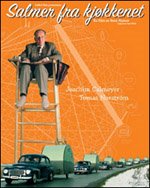
I can’t praise this movie enough. It’s premise is utterly absurd, it’s characters subtle and lovable, the ending uncompromising, yet uplifting, and the undertones of the political and cultural history of Sweden and Norway masterfully woven in. The movie is about an old Norwegian farmer with a sick horse, who is sick himself. With promises of a new horse a Swedish research team lures him as a subject into a study of kitchen efficiency. The horse he receives is a little wooden one, and the study involves a Swedish researcher sitting in high chair in the subject’s kitchen, observing everything he does and taking notes, but forbidden to interfere. After initial hostilities the two become friends, to the chagrin of the study’s director, who insists on a positivist approach. A simple message – involvement begets understanding – in a marvellously absurd and laconically poetic setting. Go see it.

To anyone following European public discourse and politics, the anti-American bias should be obvious. It is a curious fact of human psychology that an argument based on correct facts can still be wrong, and this complication afflicts this book as well. There is no way to defend the current American administration against the criticisms leveled against it, nor is there a way to dispel the other prominent myths about American held in Europe, namely that its capitalist forces are out of control and that it’s wealth is based on exploitation. But when these criticism are voiced by powers that have no inherent interest in solving the underlying problems, but rather are the competition. As much as I would have liked to think of the European protest against the Iraq war as an outpouring of compassion, and to view the piles of Michael Moore’s books in german bookstores as the proof of genuine interest in opposing ruling power they would have been in the US, I know both are at least to a good degree expressions of less pure motives. Reading this book made me question my own approach in my parallel blog, where I collect little stories that seem to me to reflect tendencies of isolation and aggressive competition, somehow equating that with my experience here – as though I weren’t appalled by the cold and unfriendly behaviour of many Germans, too, every time I visit.

Tuesday, March 7th, 2006

hardware meditation

control

I post this so others don’t have to go through hours of painful hardware research, not because I think it is a particularly interesting story. If you just bought a new, large harddrive which is running inexplicably slow in windows, this story is for you. If you didn’t, it’s not.

The players in this particular story are a 250GB Seagate drive, a K7AMA ECS motherboard with an ALi chipset on it. The problem is, the harddrive runs extremely slow. And I mean extremely, about 15 times slower than the old, small one it was meant to replace.

Whenever you try to solve a simple hardware problem, like a harddrive running slowly, you invariably learn more about hardware than you wanted to know. You even learn more than your brain is capable of learning. It’s a mystery.

In this case, what I learned is that there are numerous operating modes for harddrives under windows. THere are several DMA and Ultra DMA modes, conveniently numbered for easy reference, and something dreadful called PIO. You don’t want PIO. But whenever something goes wrong with your harddrive, windows reduces the number of your DMA mode by one, and if enough things have gone wrong, and there are no more DMAs left to take away, to PIO you go. This is pretty much the only thing that comes up on first google searches of the problem, but unfortunately this has nothing to do with the problem. There should be a name for the particular feeling you get when you tracked down a solution for a nasty problem and realize it doesn’t work; that quick, thorough switch from elation to dread. I’ll call it Metus Repens, because latin sounds cool.
Just for the record: if your drive is ever stuck in PIO because of past errors, uninstalling the IDE channel it’s on will probably fix it. Or it might not. Good luck.

But fortunately we’re dealing with something else here. Upon booting, the BIOS properly reported the drive as UDMA 5 capable, and S.M.A.R.T., both of which Windows proved W.R.O.N.G.. But there was a small hint indicating that this was not a problem specific to windows. When autodetecting the drive in the BIOS setup, it was identified as a 137GB drive, which is a magical limit for some reason or another. If the BIOS didn’t properly recognize the drive, maybe there is some hardware issue windows is struggling with.

So now I did a Google search on K7AMA, PIO and hard drive, and indeed found about a dozen other people stuck with the same problem. There should be a name for that feeling, as well: the realization that your problem is common and does not have a solution. Its about the same feeling people must get when they are told they have an incurable disease. Horror Fatui. I’m not sure that’s even proper Latin, but it sounds good, so it’ll do.

What it came down to is that the cheapass chipset that ECS chose to put on the K7AMA motherboard does not, when run with its original drivers, like large disks. While both IDE channels should be fully capable of UDMA 5, they actually are not. And since the chipset is cheapass, there are no updated drivers to be found, anywhere. Not on ECS’s website, which has everything but the IDE drivers, not on ALi’s, which inexplicably doesn’t offer any downloads at all, but still has a few references to a drivers section strewn through the pages, all dead links, of course. Bastards.

At that stage I discovered this page, just because I had been searching for hours. Tracking it down again for linking to it just cost me fifteen minutes, in spite the fact that I knew it existed and remembered many keywords and that it was on a .edu server. This site had the ALi integrated IDE driver in a version compatible with my ALi chipset. I don’t know where the author got it from, and I don’t know why it changed both my IDE channels to SCSI, but I don’t care much either, since installing it fixed the speed problems.

I’m glad I got that off my chest. Aren’t you, too?

PS Sorry to add this, but after a few days of operationality, the PC died the true death. I suspect something in the mainboards IDE bridge circutiry was fried, but I can’t be sure. I’ve replaced the mainboard, reinstalled Windows, and everything’s fine now. So was it all for naught? Yes.

Come Oscar time, I usually display a reasonable level of excitement, and like to watch the ceremony if possible. This year, however, like all his other urban slacker fans – to paraphrase O’Reilly – I absolutely had to, because Jon Stewart hosted, promising more than the usual detached entertainment narrative for a show that is, after all, the biggest self-reflective event for today’s dominant art form. And Stewart, while maybe not as hilariously funny as his fans are used to seeing him, did a terrific job of bringing relevance to the self-congratulation. Edgy comments abounded, yet he never got sharp enough to allow easy dismissal. The awards themselves were less exciting, with the winning of Best Picture by Crash and, of course, the Oscar for Best Original Song going to Three 6 Mafia – which you can view either as the victory of black underground culture, or the completion of its sellout, depending – and the endless stream of masturbatory montages being outright painful to watch.

The most interesting thing I learned, however, wasn’t directly related to the Oscars at all. We do not have cable, and to see the ceremony I had to cycle through the rain and buy some rabbit ears at RadioShack. And after a full night of ABC, with its utterly stupid society journalists and a barrage of advertising cutting everything into debilitating chunks of fast paced cutting, I fully recall why it is I don’t watch TV any more. It’s because that shit makes me agressive, bitch. I guess it’s finally all right to write stuff like that on a family oriented blog. Big thanks to Three 6 Mafia for that.

Monday, March 6th, 2006

Takeshi Kitano – Kikujiro (2)

Not before I looked the movie up on IMDB did I realize that the reason the main character looked familiar was that I had just seen him in Zatoichi, playing the title blind swordsman. As with Zatoichi, Kitano wrote the script, directed and played the lead in Kikujiro, the odd tale of a summer vacation a young kid spends with Kikujiro, a smalltime crook and loudmouth with a good heart. The movie felt a bit too long, but that might in part have been due to the strangeness of it all. Most of what the main character did didn’t make much sense to me emotionally, but not in the sense of it being written badly. Rather, all the relationships and communications here were partially opaque to me – in other words, adhering to strange conventions. Not knowing whether these are Kitano’s conventions, or those of Japanese culture in general, I can but try and unravel the mysteries of a character who is very abusive and mean, yet respected and humoured by everybody except the tough criminals he runs into at a fair. Cultural mysteries aside, there are wonderful images and ideas here, and lots of little surprises.

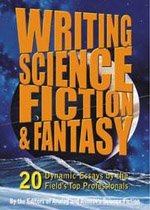
An interesting anecdote which maybe doesn’t sum up this volume of writing advice, but certainly illuminates it, has Mozart being asked for hints on symphony composition by a young, aspiring composer. He advises to start with small pieces and work up, and when the composer is confused by this and points out that Mozart himself wrote symphonies at quite an early age, Mozart replies “Yes, but I never asked for hints”. That doesn’t necessarily mean that the advice in this volume only applies to writers of mediocre talent, or that it isn’t useful for experts. While the individual essays in this volume vary greatly in quality, with Asimov providing the largest number of essays, and has the least substance to his superficial und uncultered boasts, there are a few pieces that delve deeply into the problems of building entire worlds from scratch. This problem is arguably one of the most important reasons for the gap in literary quality between science fiction and the rest of it – where ordinary narrative can rely on the reader’s ability to fill in gaps in background, characterization and psychology, science fiction must often close them, using original material for it. The seams of implausibility that result whenever this goes wrong wreak havoc with characters, plot and world plausibility, requiring the aspiring writer to pay much more attention to minute details and work it all out. Incidentally and as an aside, the other big reason for the quality gap would be the fact that writers genuinely interested in general themes of human existence rather than scientific what-if-narrative will naturally shy away from setting their plots against an artificial background, leaving a large faction of people like Asimov, who openly admit that they care not one bit about subtelties of storytelling and characterization, and that ideas are all that matters. It’s too bad, really.

The high points of this collection are the essays by Poul Anderson on world building, Norman Spinrad’s somewhat dated sounding advice on how to project current trends using simple cyclical models – it’s a funny moment when he reports in awe that the spreadsheet he uses is a file of gargantuan 600 kilobytes. Good old days -, Hal Clements advice on how to create believable psychologies in an unknown world, and Connie Willis treatise on humourour writing – though technically that last one doesn’t belong here, since she herself points out that there is nothing peculiar to writing funny SF opposed to funny anything else. Also entertaining is Stanley Schmids list of cliches editors will not ever want the read, though I have to say that if you indeed want to write an Adam and Eve story because you think the idea is highly original, another line of work might be better suited.

Friday, March 3rd, 2006

John Junkerman – Power and Terror (4)

Chomsky doesn’t deserve the movies made about him. Manufacturing Consent was an adequate representation in both content and style of the man who often appears to be the only sane person in a large room full of fanatics, but Distorted Morality and Power and Terror, both done by Jon Junkerman, are little more than badly edited recordings of public lectures, with no thread or narrative at all. What quality there is, is in Chomsky’s arguments, with the few ideas of moviemaking that went into it actually detracting from that. Junkerman opens chapters with a blank screen and a sentence or phrase taken from the lecture or interview segment that is to follow. The the original segment follows without a noticeable gap, making for a logical jump between the two things we hear Chomsky say, and the confusion is intensified when seconds later he repeats word for word what we just heard him say. It’s meant to structure the movie, but it’s entirely superficial and doesn’t work anyway. In the final scene, we see Chomsky on a stage far away, asking us whether we can hear him, clumsily alluding to the fact that he’s not very widely listened to and a lone caller in the darkness. It’s too bad that bad movies like this one contribute to that.