William C. Speidel – Sons of the Profits (2)
 A curious feature of downtown Seattle is its underground, a collection of basement like areas below the streets, that include sidewalks and doorways. In places it looks like an older city got covered in an avalanche of road, and the inhabitants just accepted the new road levels. Speidel’s book, besides telling the story of early Seattle, centers on an account of how this underground city came to be. He claims that both sanitation (sewer backflow on high tides) and road layout of the downtown area left much to be desired, but attempts to widen and raise the roads met with fierce opposition by the downtown merchants and with legal and bureaucratic obstacles. When in June 1889 a big fire leveled all of downtown, the time had finally come, the city widened and filled in the roads over the following years, and the merchants rebuilt their houses from the ground level up, having to abandon these ground levels once the roads reached their final height and rebuild an entrance in a higher story. Both the books and the guided tours that Speidel’s company still provides in Seattle are a lot of fun – though I hear historians aren’t all too happy with his dramatizations, inaccuracies and lack of proper documentation of dubious sources. But with that caveat as to it’s truthfulness kept in mind, the book is quite entertaining, and the Underground well worth a visit.
 Sadly, this collection of cartoons mostly shows why Science and Humour are commonly considered to be unmixable substances. A few of the jokes are actually funny, but they’re rarely the ones that actually deal with scientists, or science as such, but rather ones inspired by or loosely based on scientific ideas. A few years back, Carl Djerassi wrote several novels in a genre he calls science-in-fiction (early Science Fiction writers probably would have been horrified by the necessity for that distinction), and if I remember correctly, none of them turned out particularly funny, though he sure tried. These cartoon have the additional disadvantage of stemming from strange, past decades, and so are mainly of interest to historians. Ah, historians, don’t get me started on those. Hilarious!
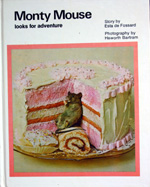 This is the story of Monty Mouse, his adventures in the world, and his eventual return to his mother and his home. No need to leaf through the thing, for the cover shows all that’s wrong with this book in a nutshell. To wits: Monty “Mouse” is not a mouse, he’s a stuffed, dead rat, or, more likely, a collection of similar looking, stuffed dead rats. Upon realizing this, the adventurous and quirky photographs instantly turn very tasteless and cruel, not to mention the fact that I feel fooled by the author selling me one mammal for another. Some learning experience. But the worst fault lies with the story itself, for young Monty’s ingenious adventures invariably turn sour, and in the end send him running home for mom with nothing to show for all his inventiveness but a dirty coat. What a rotten message. Look at Monty’s stuffed carcass hanging miserably in what should be the world’s sweetest spot. No doubt he just spoiled his appetite for a nice Brussel sprout dinner, because he is sick from all the cake. That’ll teach him – and it teaches me, too: to run.
 Crank science is fascinating to me, and the more elaborate the unfounded theories get, the more so. Just as a collection and overview of some of the classics of the cranks, this book is already invaluable. Above and beyond the pure review of mad scientists’ view of the world, this book raises the issue, in several places, of whether or not these cranks should be allowed to do what they do, and how the public should and should not receive them. Gardner wrote this in the late 1950s, and his perspective is clearly heavily influenced by the Velikovsky incident. Velikovsky published fairly outrageous and quite original theories on the influence of catastrophic astronomical events on world history, most notable the two near crashings of a comet that was later to become the planet Venus into historic Earth, and caused a big stir when scientists objected against Worlds in Collision having been published at all, and defenders of free speech rushed to the madman’s defense. Gardner’s position, as that of so many scientists, is unforgiving. He doesn’t want to restrict the ability of cranks to do their thing, but he doesn’t like them getting publicity when very clearly their work is not up to scientific standards. I am somewhat torn on this. I love the strange poetry and creativity in the these works, abd it would be a shame to lose these voices, even if their contributions to scientific discourse are not of the usual, incrementally explarative, kind.
  With a subject as intriguing as the history of the beloved vocalist combo, and their struggle with the rising Third Reich, and a freebie soundtrack treasurechest, it is hard to see how a movie could fail even as much as this one does. A stale and wooden script, endless repetitions of one single song (Veronica, der Lenz ist da) instead of a representative collection of the Harmonists’ work, and a simplistic notion both of human character and historic processes make this a less than splendid experience – especially when compared to Aimee and Jaguar, which is a entirely different league on a fairly similar subject.
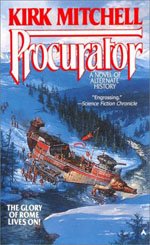 The central idea of this book – Pilate pardons Jesus, the Roman empire thus survives the centuries and still dominates in modern times – seemed ludicrous yet original enough for me to buy the book, and the task of depicting a modernized roman empire promised to be interestingly amibitious. But, not surprisingly, the execution falls quite a bit short of the aim. Counterfactual history requires a depth of understanding and elaborate world building skills, and Mitchell posesses neither. His Roman empire is the cliched version of B movies, with a few gadgets added without rhyme, reason or technological context. The story itself is uninspired, too, dealing with an uprising of psychic rebels in the Anatolian province and an intrigue inside the empire, both told in brief abstract dialogues, interspersed with random action sequences, making the book a failure on pretty much all levels. It’s too bad, I still think the idea is cute.
 It is a disturbing fact of post-war German history that plenty of active National Socialists continued on to positions of power and influence in the Bundesrepublik, partly because of a lack of skilled leadership personnel not involved with the regime, but also because the anti-communist notions of the old criminals fit well into the new political struggle emerging in Europe. Against this historical background, Riefenstahls particular story becomes all the more fascinating. Her unsettlingly effective propaganda documentaries, Triumph des Willes and Fest der Völker, on the 1935 Nuremberg rally and the 1936 Olympic Games, created a fame for her that was probably the reason for her fall after the war. She wasn’t able to make any more movies, and all her other creative efforts – most notably her photography of the people – got subjected to close scrutiny and harsh criticisms for suspicions of a fascist esthetic, and were always contextualized with her past. This movie portrays her both as the victim of scapegoating and a stubborn denier of aspects of her life, but most of all it paints the fascinating picture of a multifaceted woman, who had the misfortune to live in evil times. You might not like her after this documentary, but you won’t regret having seen it.
 If some of the battling nerds on the movie’s IMDB page are to be believed, Miyazaki’s adaptation of this beloved children’s classic was a disgrace. I read the book (the existence of neither it nor its author I suspected until I checked said IMDB page) with that criticism in mind, and have to say: balderdash. While it is true that the two stories diverge in minute details, and that Miyazaki added elements typical for his work, and created visuals not prescribed in Jones’ book, the two are remarkably congruent. The story does make a bit more sense in the book, but then I’m not sure that’s necessarily a good thing in a book about demons falling from the sky and stealing hearts. I was smitten with the strangeness of Miyazaki’s take, and the straightforward resolution left me a bit underenchanted. On the other hand, the character’s behaviour makes more sense in the book, making them both more likeable and more interesting than the somewhat randomly bouncing anime folk.