Search

Engine


Saturday, July 2nd, 2005

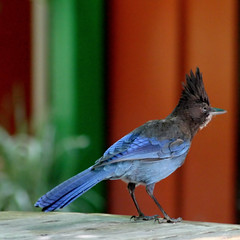
lynch’s jay

he has no arms!

Sometimes just looking at birds makes me realize how patently absurd they look with their amputated torsos. I wonder if they think mammals queer with the superfluous appendages, so useless for flight.

Monday, June 20th, 2005

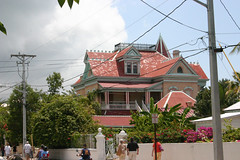
Key West

street scene

No legs, they walk, not ever stopping.
No eyes, they stare, the blinkless blind.
No hearts, their blood runs cold in circles.
No mind; no mind to step aside
and stop and breathe and rest.
The tourist, that most beneficial pest.

Thursday, June 9th, 2005

Eine kleine Nachtmusik

construction is at the center of all things

Die Pumpe des Heliumkühlsystems scharrt regelmaessig, vor einer Weile habe ich das mit dem Atmen eines grossen, respekteinflössenden Tiers verglichen, aber jetzt klingt es wie ein Schlagzeug. Die Lüftung, die Pumpe und das monotone Rattern des Scanners vermischen sich zu einem breiten Rauschcocktail unbekannter Farbe, das klingt wie ein Konzert am Ende einer sehr grossen, sehr leeren Halle, eine winzige Bühne steht da, man kann die Musiker kaum sehen, und hört auch nicht, was sie spielen, weil das entfernte Geräusch von allen Wänden wiederhallt. Ich glaube, Blasinstrumente zu hoeren, aber das ist natürlich Quatsch. Es ist ja keine Musik.

Mein Koerper ist betäubt, ein dummes Klischee, aber es fühlt sich wirklich an, als wäre ich in Watte gepackt. Wenn ich den Kopf drehe, hinkt er etwas hinterher, ein billiger Rückkopplungseffekt im Video. Hinter mir auf dem Bildschirm werden Herzschlag und Atmung eines anderen Menschen abstrahiert, die Atmung kann man kaum erkennen, das Signal ist zu verrauscht, ein dickes grünes Band aus sich überlagernden Zickzacklinien.

Manchmal meine ich für Sekunden, einen Sänger ausmachen zu können in der Geräuschkulisse, aber das ist natürlich Quatsch. Es ist ja gar keine Musik.

Monday, May 23rd, 2005

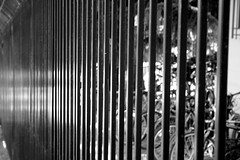
fenced

hiding bikes

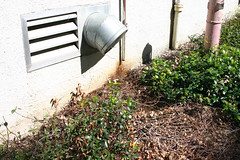
Is this to keep the bikes in or to keep the humans out? A silly question – or is it?

It is.

Thursday, May 19th, 2005

Nase in Wolken

tumbling

Den Konferenzgedächtnisschirm aus dem Jahre 2002, kaum getragen, in der linken, das Buch in der rechten, nähere ich mich der Kreuzung. Von allen Dächern tropft und rinnt es, und eine Hand habe ich ohnehin nicht frei, und drücke den Ampelknopf also mit dem Fuss. Ein leichtes, schliesslich habe ich ja den violetten Gürtel. Es dauert zwanzig Sekunden, in denen die Hauptfigur vom Mitansehen einer Auspeitschung ohnmächtig wird, dann schaltet das Gerät. Die Kreuzung ist Teil des Bicycle Boulevards, ausserhalb der Rush Hour geht es hier immer so schnell. Aus der Gegenrichtung fährt ein Auto an, aber links abbiegen ist hier verboten und ich gehe los. Ich suche die Zeile, in der aus der Ohnmacht wieder erwacht würde, aber ehe ich sie finde lenkt mich das abbiegende Auto ab, das aus schneller Fahrt einen Meter von mir entfernt zum Stehen kommt. Ich schaue vom Buch auf, mein Blick trifft sich kurz mit dem der Fahrerin. Sie hat mehrere Verkehrsregeln missachtet und mich beinahe angefahren. Es scheint ihr gleichgültig. Als ich an der anderen Strassenseite ankomme, ist sie weitergefahren und der Protagonist erwacht.

Monday, May 2nd, 2005

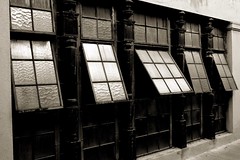
empty

five

Draining the color is justified this time by the atmosphere of decay and lifelessness in this building. It was designed by Julia Morgan, who also designed Hearst Castle down the coast. Like all big buildings meant for large numbers, it never feels empty. Instead, when nobody is there, there is a dense crowd of nonpeople, like a Dirac sea of people suddenly drained. The long hallways will look carnivorous, the peeling, dirty paint take on a melancholy shady and reflect the words not spoken and the unheard laughter back onto the visitor.

Or so I say.

Sunday, May 1st, 2005

Gifthauch

a building's bad breath II

Vor ein paar Tagen endlich den Vorzeichenfehler gefunden, der mir den Horopter verbog. Mit einem Plastikball hantierten wir, drehten ihn ratlos in Händen, denn die Linien seines billigen Designs widersprachen der Ausgabe einer aufwendigen Simulation, und gegen eine Plastikball haben Matlab und Megahertz keine Chance. Aber kaum ist das Vorzeichen korrigiert, sind Ball und Gerät sich einig. Hurra.

Vorgestern dann finde ich einen Sinus statt eines Kosinus und drehe dem Kopf in der Maschine die Augen ins Geviert. Und so zurechtgerückt lösen sich die Ergebnisse unserer Studie, vor einem Jahr auf einer Konferenz vorgestellt, in wildgezackten Flächen auf. Ein schönes Ergebnis welkt vor meinen Augen und wird Staub.

Ich suche den dritten Fehler, der die Balance wiederherstellt.

Thursday, April 28th, 2005
infected minds

portrait

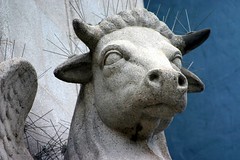
Richard Dawkins argues that religion is like biological and digital viruses, spreading from mind to mind, epidemically. Unlike science, which Dawkins likens to nonviral software, religion spreads not because people willfully accept its ideas, but because these ideas carry a “Copy Me!” command.

While I like his description of the spread of ideas as an epidemic, and the notion that complexes of ideas, just like complexes of genes, will tend to spread together if they favour each other, I think the fundamental thrust of his argument, which tries to taint religion by likening it to disease, is flawed.

As he readily admits, the phenomenology of the spread of scientific ideas is indistinguishable from that of any other belief system. The difference, Dawkin’s argues, is that science adheres to empirical testing, while religion does not. But that alone establishes a perfect symmetry, where the zealot could triumphantly cry “exactly! and that’s why religion is superior. Quia absurdum!”

The problem with religion is not that it’s an attractive set of mutually enforcing beliefs that spreads through populations of minds – that’s true for science, as well. It’s that these beliefs claim jurisdiction over empirical matters, when at their very core is a disdain for empirical process.

In short, not the viral form of religion, but its content, is what should bring us in opposition. Its virulence just makes it a more formidable and frustrating enemy.

Thursday, April 28th, 2005

new bird

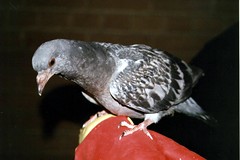
pigeon, clueless

When we moved into our Toronto apartment in early december, we found a pigeon had already moved in before. There were two chicks in the “nest”, so we decided to let them be. The quotes are there to signify to disparity between the mental image of a bird’s nest and the crude heap of birdshit, twigs and dirt that they scrambled together.

We observed the chicks growing up through a window, and it seemed that one of them was a bit stronger than the other. It started pushing the other away when food was served. The size difference grew, and one day we found the smaller one dead and pushed out of the “nest”. Which, combined with Tak’s story, makes me think that this is a fairly common occurence in urban pigeons.

We removed the dead bird (alas, no burial. Down the chute it went), and let the other one grow up before I went in in protective gear (That smell is something else) and removed the mess.

And if you’ve ever wondered why there is no pigeon babies anywhere: the young was almost fully grown before it dared the jump off our balcony for the first time. But even though it looked like a real pigeon at that point, it remained fairly clueless, as the above picture shows.

Wednesday, April 27th, 2005

Vremd und Fertraut

home on the grid

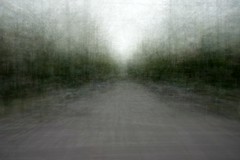
Die Anlage amerikanischer Städte lädt ein zu diesem Experiment. Die meisten Strassen folgen einem Gittermuster, zwei treffen sich an den Kreuzungen. Die Stadt und Strecken in ihr zerfallen in identische Blocks.

Oben zu sehen ist der Durchschnitt aus 50 Strassenabschnitten, je gesehen von der Kreuzung aus. Man erkennt Leitungen, Strassenmarkierungen und geparkte Autos als geisterhafte Schatten, die Vegetation verschmilzt im grünen Nebel, die Häuser zu einer dunklen Wand. Zeigt dieser Durchschnitt Essenz oder Verfremdung? Und wie weit ist jene von dieser entfernt? Einen Block?

(Der Titel dieses Posts ist der Titel eines bei Elefanten-Press erschienen Buches)