Search

Geekstuffs


Sunday, May 7th, 2006

Kirk Mitchell – Procurator (4)

procurator.jpg The central idea of this book – Pilate pardons Jesus, the Roman empire thus survives the centuries and still dominates in modern times – seemed ludicrous yet original enough for me to buy the book, and the task of depicting a modernized roman empire promised to be interestingly amibitious. But, not surprisingly, the execution falls quite a bit short of the aim. Counterfactual history requires a depth of understanding and elaborate world building skills, and Mitchell posesses neither. His Roman empire is the cliched version of B movies, with a few gadgets added without rhyme, reason or technological context. The story itself is uninspired, too, dealing with an uprising of psychic rebels in the Anatolian province and an intrigue inside the empire, both told in brief abstract dialogues, interspersed with random action sequences, making the book a failure on pretty much all levels. It’s too bad, I still think the idea is cute.
Monday, January 23rd, 2006

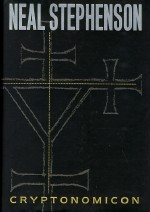
Neal Stephenson – Cryptonomicon (2)

This book has it all, geeky and cool facts about cryptology, military, social and technological history, a fairly believable conspiracy plot, insights into high-tech investment politics and an epic breadth and richness of materials that stunds. So why did reading it feel so tedious, and why was I glad when it finally was over? Maybe it’s because of the odd feeling of detached interest that perfuses the work. Stephenson describes the human dimension of his adventure with the emotions of a boy watching ants through a magnifying glass on a sunny day, just before he decides to see what happens when he burns them. It’s a terrific story, but it felt like someone else was reading it.

Monday, January 2nd, 2006

Peter Jackson – Lord of the Rings (1)

Ever since the first of the Lord of the Rings trilogy came out, Middle Earth has been a holiday* staple for me. I liked the original theatrical versions well enough, but it’s only in the extended cuts that the story’s pacing works and the rich undertones of Tolkiens mythology get a chance to resonate through the plot. Aragorn’s singing of the Lay of Luthien is one specific example among many, and not by accident is it in the Fellowship of the Ring, which after this year’s repeat watching of the whole trilogy (split over quite a few days – I’m a geek, not a nerd) is still my favorite. It’s also the one part that doesn’t have cringe inducing dialog in it (“A red sun rises. Blood has been spilled this night” – Yeah, that would be my brain hemorrhaging, you Elf twat), but they’re all precious, of course. Go, looks at them.

Monday, December 19th, 2005

Munching pills in darkened rooms

Cognitive Daily ? Video games: Are the myths true?

It’s a contentious issue – do computer games add to behavioral problems or are they a mere symptom. Every time I hear someone claim that violence is caused by games, I just want to whip out the rocket launcher and splash their brains on the pixelated wall; luckily I always remember the number one lesson playing the Doom series games taught me: don’t use a rocket launcher in a tight space. So I have to resort to reasoned arguments, like those presented by Dave Munger over at Cognitive Daily (link above). Doesn’t that prove somethingor other?

Worth mentioning in that context is the fabulous quote/joke “Computer games don’t affect kids; I mean if Pac-Man affected us as kids, we’d all be running around in darkened rooms, munching magic pills and listening to repetitive electronic music.” That quote is usually misattributed by non-factchecking geeks to some Nintendo CEO named Kristian Wilson. In fact, it’s been written by comedian Marcus Briggs, who is rightly proud of it.

Monday, December 19th, 2005

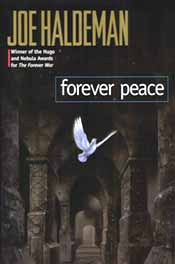
Joe Haldeman – Forever Peace (2)

This is a story of many plots, ranging from the destruction of the universe, or a substantial fraction thereof, by nanotechnology, to modern warfare and social philosophy to moral conundrums of modern life – interracial dating, for example – and it tries to both set up these varying fields as enormous problem zones, and then present realistic solutions. Most of the central ideas and technologies, and the problems caused by them – the social impact of full automation both on the society controlling it and the societies controlled by it, or the psychological and military implications of remotely controlled superwarriors, to name two – are daring and impressive, and the extrapolation of US foreign policy into the year 2048 seems frighteningly believable. But against the tapestry of these towering problems, Haldemans solution falls somewhat short, both within the universe of his novel and our own. Still, with its very gripping, thoughtful and empathic plot, Forever Peace fully deserves the Hugo and Nebula awards it won.

Friday, December 16th, 2005

Amanita Design – Samorost (1)

This game is just brilliant in design, storyboard and execution. Very otherworldly level designs and a brilliantly surreal game logic, paired with cuteness – its only fault is that it is too short.

Samorost | Samorost 2

I should have known. While I enjoyed the charming simplicity of the plotlines in the Narnia series, and appreciated them as the children’s books they were intended to be, none of their story elements packs the mythological punch of Tolkien’s writing, and the Christian parable feels tired once you’ve spotted it. Which is hard not to.

To start with the positive, the movie is nicely done, devoid of cringe-inducing lines or badly done characters, wich is saying something for Disney. But it is also quite boring, and at least a half hour too long. To strip a story about an oppressive regime, war and an epic battle for the survival of a whole world of all the nastyness these things should involve, and leave it with decoratively frozen puppets and the frosty looks of Tilda Swinton, is to deny the book its impact. Sure, you shouldn’t frighten your underage audience into little whimpering heaps, but surely some sense of the consequence of evil would have been appropriate.

Plus, not surprisingly, seeing the crude metaphor for the New Testament, Aslan’s sacrifice for the reinforcing of the “old magic”, rather than reading about it, makes it’s crude and unsubtle symbolism so painfully apparent, that I change my initial statement above – there is a cringy moment there, but it’s all Lewis’ fault.

Tuesday, November 1st, 2005

Networking, Not Working?

strung

I’m growing increasingly weary of people linking to Amazon for books they want to recommend. Shouldn’t there be a website where people can search books online and then order them at their neighbourhood independent bookstore? buchhandel.de does this for german books, but a quick search unearthed nothing similar for the american market. The closest match I could find was BookSense.com, but that’s not a catalog at all, just a store directory. Does this really not exist yet?

don't look, but i'm right behind you

1) Öffentliche Telefongespräche werden von den Widerwärtigen meist zu laut geführt, aus eingebildet technischen Gründen, und sind schon allein deshalb aufdringlich und lästig.

2) Zusätzlich wirken die Widerwärtigen, besonders wenn man das Telefon nicht sieht, aber auch sonst, wie taumelnd Schizophrene, die Stimmen hören, und ohne äusseren Anlass emotionale Stürme durchleben. Nicht schön, und instinktiv beunruhigend.

3) Der Inhalt der Gespräche der Widerwärtigen ist, soweit er mitgehört werden kann, eklatant banal und dreht sich meist ums Treffen, Getroffenwerden oder Befindlichkeiten. Dergleichen ist nicht öffentlich und laut abzuwickeln, wenn denn schon überhaupt.

4) Die Körperhaltung der gehenden, radfahrenden, autofahrenden Widerwärtigen spricht von ihrer Abwendung von der Umgebung. Das ist im besten Fall milde unhöflich mir gegenüber, der ich ja in ihrer physischen Umwelt mich aufhalte, in der Regel aber ein verkappter Angriff. Zweimal wurde ich beinahe von einem Widerwärtigen überfahren, auf den Gehsteigen hat man ihnen auszuweichen. Man möchte sich unmütig erregen, manchmal.

5) Man muss nicht erreichbar sein. Man muss nicht über jeden Scheiss reden. Man muss nicht dauernd reden. Man soll auch mal allein sein. Jedes ans Ohr gepresste Piepsding erinnert mich daran, dass ich diesen Grundprinzipien der Würde des Individuums als Quasiquastenflosser anhänge. Das machen die Widerwärtigen doch extra.

6) Verschlimmert wird all das Genannte dadurch, dass nichts davon ja in einem einsehbaren Sinn nötig wäre. Sie verlören keine Zeit, wenn sie erst zu ihrem Ziel gingen und dann rasch telefonierten, weil sie ja telefonierend ohnehin viel langsamer latschen und sich vermutlich dreimal verfransen unterwegs. Sie verlören keinen Tick Respekt im Freundeskreis, wenn sie nicht aus der Schlange in der Cafeteria meldeten, jetzt grade kurz vor dem Erwerb eines Kaffees zu stehen. Sie tuns trotzdem, und weil das Tun all die geschilderten Nachteile für die Umwelt mit sich bringt, und ein Mensch von Gefühl und Verstand das Vorhersehen kann, tun sie es also aus reiner, schwarzer Bosheit. Die Focker.

7) Die Klingeltöne. Muss ich mir wirklich den Nussknacker auf der Eichhörnchenorgel anhören, jedesmal wenn einem jungen Menschen die kalte Kralle der Einsamkeit das Herz zu Mus ballt, und er also Ansprache sucht? Offenbar – jedoch.

8) Das Klingeln in Veranstaltungen. Ein Lehrer in Florida hatte kürzlich die pfiffige Idee, allen klingelnden Telefonen in seinen Stunden selbst auf den Grund zu gehen. Natürlich kommt er jetzt kaum noch zum Unterrichten und sagt dauernd pfiffig “Ja hallo, wer ist denn da” in ein kleines Gerät. Die Schüler sind zwar widerwärtig, aber ja nicht blöd. Eine leider verbreitete Verwechslung unter Studenten des menschlichen Charakters.

9) Das Klingeln überhaupt. SCHALTET DEN VERFOCKTEN VIBRATIONSALARM EIN, IHR KRANKEN! Wozu hat der Herrgott ihn denn gemacht? Hä?

Soweit ersma.

Wednesday, April 27th, 2005

Vremd und Fertraut

home on the grid

Die Anlage amerikanischer Städte lädt ein zu diesem Experiment. Die meisten Strassen folgen einem Gittermuster, zwei treffen sich an den Kreuzungen. Die Stadt und Strecken in ihr zerfallen in identische Blocks.

Oben zu sehen ist der Durchschnitt aus 50 Strassenabschnitten, je gesehen von der Kreuzung aus. Man erkennt Leitungen, Strassenmarkierungen und geparkte Autos als geisterhafte Schatten, die Vegetation verschmilzt im grünen Nebel, die Häuser zu einer dunklen Wand. Zeigt dieser Durchschnitt Essenz oder Verfremdung? Und wie weit ist jene von dieser entfernt? Einen Block?

(Der Titel dieses Posts ist der Titel eines bei Elefanten-Press erschienen Buches)