Saturday, December 20th, 2008
Kleine Poesien oder: Bruchstücke aus dem Tagesgeschäft

leghand = [leghand; newline];
vox.confusion = zeros(length(vox.nvox),vox.ncond,vox.ncond);
vox.dist.l1(n) = fminbnd(@(a) abs(interp1(tmpbins, vox.dist.cum{n},a)-.95), min(tmpbins),max(tmpbins));
% leave motion in
set(handles.RegMot,'Value',0); drawnow;
DoAnalyze_Callback(handles.DoAnalyze, eventdata, handles);
wgt = cat(3, mwgt, dwgt, wgt-handles.vox.wgt, wgt, handles.vox.wgt, mw_m, handles.vox.mw(:,:,1,:));

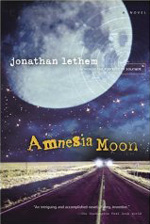 The premise is a marvelous riff on the post-apocalypse theme. Starting out as a classic, nuclear holocaust story set in the desert, complete with mutants and vigilantes in old cars. But we soon realize something isn’t quite as it seems, and as the protagonist makes his way from the desert back to San Francisco, we slowly understand that what has happened is much more apocalyptic than the mere destruction of the physical that bombs bring about: mental coherence, the very fabric of reality itself, has somehow been damaged, and dreams, paranoia and neuroses bloom freely and infest the world of the real. In keeping with the very lost feeling that pervades the story, we never learn the truth about what people call “the break”, though several alternatives of it are offered. And this, I feel, is also the shortcoming of Amnesia Moon: the exchangeability of the different narratives robs the story of some of its impact – when everything seems possible, nothing can mean much any more.
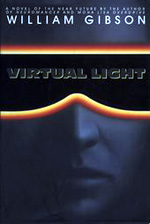 I am not a fan of Gibson’s – or indeed any of the cyberpunk writers’ – plotlines. I find the constructions they come up with to throw the little guy into the arena of big corporations and social and economic powers of great thrust hard to swallow, and the conclusions shallow. On the other hand, the intricacies of the worlds created are meticulously worked out, and just for imagining the community of people dwelling on the abandoned structure of the west span of the Oakland Bay Bridge this is well worth reading. The characters are memorable, and the ideas have enough Gibson cool to make the ultimate shallowness of it all less of an issue.
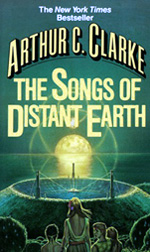 This is horrible. Not because it is just obviously bad, for it isn’t. The science is as solidly done as you’d expect of Clarke, and the outline of the story sort of makes sense, if you buy that we can predict novae from looking at neutrinos. But the details all are oh, so wrong. All the mistakes that give science fiction a bad name are here, in a thickly layered mistake cake, with an extra topping of whipped mistake cream. Things that we should understand from what we witness we are told in the abstract, dialogue stilts around just to get information to us, instead of of its own merit, characters psychology makes no sense whatsoever, the underlying wordview is deeply technocratic and single minded – he creates a utopian society of love and respect that sounds like a hippie teenager’s wet dream by having past artistic output censored and culture start from a carefully prepared blank slate. That notion alone already has so many things wrong with it, I won’t count. Bah.
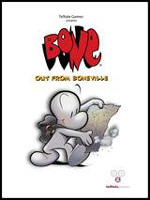 The comic series created by Jeff Smith started off as a quirky lighthearted adventure story and ventured into more complex territory, creating a comic hybrid of Tolkien and Lucas, including a creation myth, an evil archvillain and the restoration of balance to a force, here called the dreaming. While the background plotline may be derivative, the storytelling and character design wasn’t, and Bone was a delight to read. Now Telltale Games, consisting of game designers who left Lucasarts after the announced Sam and Max sequel was canned after a decade of development, has started to make the comic epic into a series of adventure games with a SCUMM like interface. Smith’s design and dialogue are completely preserved, so much so that one might object that the result is an animated comic strip rather than a true game. This is less true of the second installment (The Great Cow Race) however, and isn’t a big criticism anyway. Unfortunately, the third installment will be a while in the making, with a brand new Sam and Max game (yes) scheduled for release later this fall.
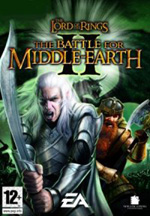 I readily confess that I am a sucker for real time simulation. I loved playing Warcraft and Starcraft, and I enjoyed this game, too, though it seemed to me that the gameplay in the campaigns is slightly unbalanced, with little freedom for strategy. In one mission in the evil campaign in particular, any straying from a predescribed path of action would lead to disaster, which is not very enjoyable. But since the main action presumably is supposed to lie in online gaming, I guess that’s quite all right.