Search

Philosophy


I should have known. While I enjoyed the charming simplicity of the plotlines in the Narnia series, and appreciated them as the children’s books they were intended to be, none of their story elements packs the mythological punch of Tolkien’s writing, and the Christian parable feels tired once you’ve spotted it. Which is hard not to.

To start with the positive, the movie is nicely done, devoid of cringe-inducing lines or badly done characters, wich is saying something for Disney. But it is also quite boring, and at least a half hour too long. To strip a story about an oppressive regime, war and an epic battle for the survival of a whole world of all the nastyness these things should involve, and leave it with decoratively frozen puppets and the frosty looks of Tilda Swinton, is to deny the book its impact. Sure, you shouldn’t frighten your underage audience into little whimpering heaps, but surely some sense of the consequence of evil would have been appropriate.

Plus, not surprisingly, seeing the crude metaphor for the New Testament, Aslan’s sacrifice for the reinforcing of the “old magic”, rather than reading about it, makes it’s crude and unsubtle symbolism so painfully apparent, that I change my initial statement above – there is a cringy moment there, but it’s all Lewis’ fault.


I loved Le Guins The Dispossessed and The Left Hand of Darkness, so even though I’m not very keen on people in pointy hats throwing speels (unless they’re called Gandalf, obviously) I thought I’d give Earthsea a shot, and I’m glad I did. Like with her other books, I found the most interesting element of these books their outright refusal to play by the base rules of the genre. While there are magical gadgets, spells, castles and monsters, it’s clearly not those that Le Guin is interested in. Where a Wizard of Earthsea was about one boy’s journey to discover and master the evil in himself, the Tombs is about a clash of worldviews and belief systems, one religiously closed and involved in power struggle, the other, though based in magic, rational and open, and striving to find balance. In a nutshell, these stories are driven by psychological archetypes (the dark of the tombs, the faceless evil) than by plot, in fact, so much so that I wondered why there needed to be any magic in them at all – the fantasy elements are, so far at least, quite superficial.

Friday, December 9th, 2005

Sapir, Whorf and History

food

When we toured all the big monuments on our recent visit to DC, I got gut feelings about them, I was left cold by the World War II memorial, touched by the Vietnam Memorial’s somber simplicity, avoided what looked like a bad kitschy joke, but was in fact the Korean War Memorial, looked up with a sarcastic smile at Lincoln’s face covered in scaffolding for renovation, and stood with an even more sarcastic smile in the midst of the great words of Jefferson and, again, rubble and scaffolding. Jefferson’s statue, a park ranger had explained, looked north toward the White House, because Jefferson was highly suspicious of authority. This statue, apparently, keeps the administration honest.

It is an interesting experience to then revisit this only a short while later when Slate’s Witold Rybczynski walks the same walk. The substance of his article is interesting, but I’m most intrigued by my reception: some of the things he says I have the impression of having felt while visiting – like the inappropriateness of the fountains and the cold oddness of the columns in the WW2 memorial, but I could never have said them. Now the fact that I can think that this man says what I think, while at the same time I would not have been able to say it myself, pretty much refutes the Sapir-Whorf hypothesis. If you’ll accept that jump.

On a related note, I bought Roth’s The Plot Against America for the flight back, and was delighted by it’s thoroughly constructed plot and the clever way it turned it’s counterfactual premise back into the real flow of events at the end. I felt pretty stupid when I read what feels now like pretty obvious criticism on Salon, saying that a book that talks about how close American society was to prosecution of minorities while hardly mentioning the situation of the black, seems counterfactual indeed. Sadly, I didn’t notice that at all, explicitly or implicitly, but don’t think that’s an argument for Sapir-Whorf. Least I don’t feel it is.

Edit: It’s a bit misleading to talk about Sapir-Whorf in this context, since the thesis has a hard and a softer formulation. While the hard formulation says that there is no thinking but what is mediated by language, hardly anybody adheres to that any more. The softer variant is that language influences what we can think, and there some cool evidence to that end has just come out. I’ve added an entry on that further up.

Thursday, December 8th, 2005

Warmgefönt

don't do that

Nature berichtet in seiner aktuellen Ausgabe, dass man einen britischen Tierversuchs-Lobbyisten für eine Fernsehsendung den Alltag eines Versuchsnagetiers nacherleben liess. Unter anderem musste er dabei teuflisch warme Fussböden und brutal trockengefönte Haare erdulden. Wir Nagerfreunde begrüssen dergleichen Kaspereien natürlich, nicht nur als soliden Beitrag zu einer komplexen Diskussion, sondern auch als ersten Schritt in eine bessere Welt; denn erst wenn alle Menschen leben wie die Ratten ist unser Auftrag erfüllt. Oder Karnickel. Oder eben Vizcachas, wir sind da flexibel.

Vielleicht darf man sogar hoffen, bei der Ausstrahlung der Sendung am 14. Dezember auch eins der berüchtigtsten Rattenexperimente am Lobbyisten nachgestellt zu sehen; das nämlich, bei dem ermittelt wurde, um wieviel länger Ratten sich durch Strampeln vorm Ertrinken retten, wenn man ihnen zuvor den Eindruck verschafft hat, man würde sie schon beizeiten da rausholen. Zugegeben, das Originalexperiment ist recht alt, wurde schon in den 50er Jahren durchgeführt und würde heutzutage von keiner Ethikkomission mehr genehmigt. Aber ein kleines bisschen Unsachlichkeit ist ein geringer Preis für eine unterhaltsame Sendung, und zudem sind Lobbyisten ja in der Regel auch nicht mehr die Jüngsten.

(Dieser Beitrag erscheint parallel bei der Riesenmaschine).

Thursday, December 1st, 2005

Mainstreaming

captive audience

A few years ago at a Society for Neuroscience meeting, there was an ethics panel discussing animal research. I quickly realized that the panel’s discussion was not about whether or not animals should be used in research, but rather how to propagandize their use properly and avoid lawsuits and flamebombs. This seemed a somewhat conservative and backwards approach – if only in contrast with the discussion of animal consciousness and its consequences I had, in fact, expected to hear.

This year, one of the large talks – which are always held in a ludicrously big room, making them seem less well attended or received than they are – was on the subject of cognitive enhancement, and once more I expected to see some innovative debate of emerging technology and knowledge, and the dangers and opportunities inherent in messing with the very organ that creates experience, when we hardly understand the first thing about it.

Instead I heard a talk on performance enhancers in sports, with some lame joke about how everybody in the audience had taken some congnitive enhancer that very morning (meaning, of course, caffeine) coming the closest to the advertised subject.

It might be naive to expect cutting edge, or even just mildly surprising statements in presidential lectures at monster meetings like this. But that the most daring and controversial moment in the biggest meeting on Neuroscience comes when the Dalai Lama speaks for a few minutes on his understanding of meditation, something seems amiss.

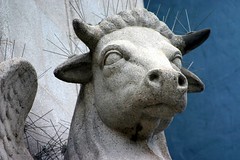
(The foto above, by the way, was taken during a talk on animal consciousness, specifically on whether mental timetravel was unique to humans, presenting evidence from chaching behaviour of scrubjays, suggesting it might not be)

Tuesday, November 1st, 2005

On a Monkey’s Back

teeth

One of Frans de Waal’s objectives in publishing his Chimpanzee Politics in 1982 was to destroy the notion that only us humans are capable of complex social behaviour and congition, and that we are not so special after all. It was, I believe, mainly advocating a recasting of social human psychology in terms of primate behaviour.

Read today, though, it has an opposite effect on me, and throws the personality of the apes into sharp focus. I don’t read so much that we are apes, but that these animals are people, and the fact that they are kept in enclosures, that their habitats are being destroyed, and that we humans have taken full control over their fate without accepting the responsibility for it, gives this book a very melancholy undercurrent. And the fact that chimps are scheming, power hungry bastards, doesn’t change that one bit.

Thursday, April 28th, 2005

infected minds

portrait

Richard Dawkins argues that religion is like biological and digital viruses, spreading from mind to mind, epidemically. Unlike science, which Dawkins likens to nonviral software, religion spreads not because people willfully accept its ideas, but because these ideas carry a “Copy Me!” command.

While I like his description of the spread of ideas as an epidemic, and the notion that complexes of ideas, just like complexes of genes, will tend to spread together if they favour each other, I think the fundamental thrust of his argument, which tries to taint religion by likening it to disease, is flawed.

As he readily admits, the phenomenology of the spread of scientific ideas is indistinguishable from that of any other belief system. The difference, Dawkin’s argues, is that science adheres to empirical testing, while religion does not. But that alone establishes a perfect symmetry, where the zealot could triumphantly cry “exactly! and that’s why religion is superior. Quia absurdum!”

The problem with religion is not that it’s an attractive set of mutually enforcing beliefs that spreads through populations of minds – that’s true for science, as well. It’s that these beliefs claim jurisdiction over empirical matters, when at their very core is a disdain for empirical process.

In short, not the viral form of religion, but its content, is what should bring us in opposition. Its virulence just makes it a more formidable and frustrating enemy.

Tuesday, April 26th, 2005

Formtrieb

Während ich meine Kreise ziehe, frage ich mich, warum ich sie ziehe. Nicht dass das Umgraben der rindenstückbestreuten Scheibe unberührte Natur zerstörte. Aber seltsam ist es doch, dass der Schaffensimpuls inmitten der vollständig durchgestalteten Campuslandschaft sich eine Nische sucht, der ein persönlicher Stempel aufgedrückt werden kann. Es liesse sich argumentieren, dass der Frühmensch suchte, was er zu formen verstand, und experimentierte, und spielerisch die Kräfte meisterte, die jetzt uralte Farnwälder in quadratkilometergrosse Plastikteppiche verwandeln, und der Gestaltungswille also in der Fähigkeit zur Technologie aufginge.

Aber selbst wenn das stimmte, legten sich doch um den mechanischen Verhaltenskern Schichten von Komplikationen, persönliche Eitelkeit, Trotz gegen die Anonymität, Ä?sthetik reiner Formen, Kontraste auf etlichen Abstraktionsebenen, um nur ein paar zu nennen, und zuletzt schliesst sich die Zwiebel aus Motiven zur ganzen Frucht:? und gefällt.