Thursday, June 29th, 2006
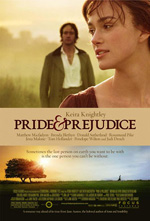 I am exactly a fan of the romantic movie genre, often citing its lack of explosions as a reason. More accurately stated, the romantic comedy and drama in general lack an element that allows me to overlook faults in plot or character exposition, or overall execution. This is because I am unwilling to let myself become emotionally involved with people whose existence has clearly been disproven by shoddy filmmaking. I harbor no such objections against unrealistic explosive devices, and I blame my genes for said unfounded bias.
Having said that, I did enjoy this newest version of Austen’s book a lot. Both for the believable historic background of lower class struggle and upper class overfed ennui, and for the entirely likable main characters, whose eventual pairing up I did look forward to. Donald Sutherland as the father was an added bonus that made it possible to ignore the somewhat annoying rest of the family. I found it interesting that the actors all agreed on the likability of the characters, when half the family were self-absorbed, hysterical and irresponsible, but given that I can see historic reasons for why this would have been so, it’s interesting more than really bothersome.
Drama, English, Europe, Good, History, Movies | No Comments »
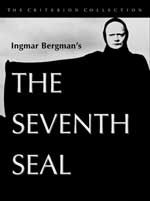 Never before has the decay of society, the random death and destruction, and the hopeless metaphysical void that was left by the scourge of the black death depicted as stylish as in this chessgame action thriller. I expected dreary symbolism and found a wonderful meditation on death and life.
 For years I had suspected that the historic truth is being stretched and bended, possibly even mutilated, in order to make Dresden into the innocent symbol of allied war atrocities dominating the German discourse of the bombings. Now, having read Schubert’s book on the subject, I am better equipped to dispel the myths, and predictably find my inferences confirmed. No liquid phosphor rained down, the city was not full of fugitives or innocents any more than any of the other cities inhabited by Nazis was, and the local industry was neither insignificant nor unimportant for the war. Dresden has turned into a monumental tool for relativists, for whom the outcome – the destruction of human life and property – is the only determinant of the morality of an action, and for whom dead Nazis and their dead victims form one soppy canvas to paint a kitschy portrait of their nationalism disguised as benevolent peacefulness upon.
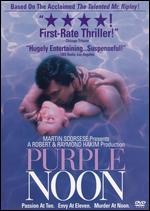 Better than its modern incarnation, this thriller might not capture Highsmith’s story completely, but it works fairly nicely as a movie standing on its own. The moral ending is disappointing in principle, but also because it’s unconvincing, it being such a stupid oversight for Ripley not to have gotten rid of the anchor, and it seeming unlikely that people would drag a yacht out of the water with its anchor still lowered.
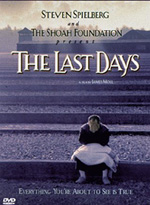 Watching movies about the holocaust, even – or especially – ones that are as well made as this one, is exhausting and disturbing, and I’m not entirely sure why I keep doing it again and again. Partly it’s the general feeling that an evil forgotten is one likely to be repeated, but there also is the irrational, yet very compelling obligation to understand the monstrosity which seems to stem from my being a member of the culture that committed this singular crime. These matters aside, this particular documentary, drawn from material collected for Spielberg’s Visual History Foundation, is masterfully composed and edited, and should be seen by many, including you.
 A powerful meditation on innocence lost and the mixed blessings of civilization and progress, this is essential Malick. Of course that also means a healthy dose of pathos and a certain slowness of plot, but when so beautifully shot and arranged, who would want to bicker. I have not seen the story of Pocahontas told any other way before, and I don’t think I shall.
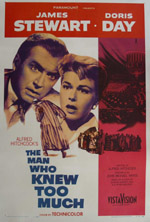 It’s fun watching the two stabs Hitchcock took at this story almost back to back, seeing the development of his style and technical proficiency, as well as the parts of storytelling that work in neither story. There is an interesting remark on the DVD of the producer of the remake being told by Hitchcock to watch the original Lorre vehicle, to see if that could be remade. The producer made some remarks about Hitchcocks development since then, which apparently hurt the man’s pride – odd, since the earlier work is so obviously flawed. When interviewed by Truffaut much later, he himself made the talented amateur / professional comparison between the two version’s directors, but in the early fifties he obviously still didn’t have the necessary distance from his earlier work. Maybe that’s why he only went half the distance in fixing the flaws, leaving the quite unconvincing spy splot of assassinating a politician in a public auditorium, and the cartoonish police.