Search

Martial Arts


Friday, February 3rd, 2006

Takeshi Kitano – Zatoichi (3)
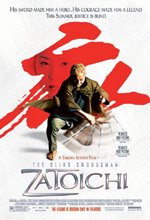
This could have been a marvelous homage to martial arts movies in general and the Zatoichi series in particular, full of references to details of Japanese culture, and funny little scenes. But unfortunately the plot, which should have been a simple story of evil oppression and the lone swordsman who breaks it, is told in such a fragmented and oblique style, that it gets into the way, rather than providing the frame upon which all the fine details are hung. It’s too bad, there is so much to love in here, but it all just doesn’t come together.

Monday, January 16th, 2006

Robert Clouse – Enter the Dragon (2)

There is quite a few gaffes in this movie, the plot is nonexistent, the action drags on forever in places, and the acting oscillates between solid and silly. Still, this is one of the finest martial arts movies ever made. Lee’s technique is amazing, and the surroundings and characters are just done well enough not to intrude.

Sunday, January 8th, 2006

Yamamoto Tsunetomo – Hagakure (2)

The more I learn about Japanese history, the more I wonder how it is possible that the European captains found anybody alive there at all when they arrived. They should have disembarked, a fearful expression on their faces, and waded in blood, among the guts and remains of the honorable dead, who slashed themselves open to maybe make amends for an ill chosen colour of off-white for the master’s new lampshade, or some such. This makes for very fascinating reading, but it is indeed hard to understand how a society, in which disrespect leads to fights to the death, which in turn means seppuku for those who started them, could have functioned, Maybe, then, Yamamoto exaggerates wildly. This is somewhat more plausible for modern readers when they realize that some of his short texts read like they are the direct inspirations for Monty Python’s suicide squad lead by Otto in The Life of Brian, and the Black Knight in the Holy Grail – now of course available as a plush doll, which probably would have horrified old Tsunetomo right into killing himself.

Wednesday, January 4th, 2006

Bruce Lee – Tao of Jeet Kune Do (2)

This is Lee’s posthumously published founding document for his own brand of kickass, Jeet Kune Do, that brought him both fame and severe criticism for boldly breaking with tradition and fusing different styles, taking what he would from each. The book, while roughly structured into chapters, reads more like a collection of small pieces than a unit. In part this reflects the limitations of editing somebody else’s work his untimely death put on the editor, his wife Linda, but I suppose to a degree this is a reflection of the inherent notion he expresses multiple times. Go with the flow, do not become rigid in rules, be flexible within your limit. The motto of Jeet Kune Do, set around the unique logo with the Yin/Yang encircled by two chasing arrows, reads ‘Using no way as way, having no limitation as limitation’. Which of course is all part of the ancient asian art of making sense through not making sense.

Monday, December 26th, 2005

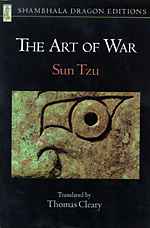
Sun Tzu – The Art of War (3)

When a dog pees on a mountain, does the mountain care? Depends on the size of the dog, you might answer, but in general it won’t. General – what better segway than that to lead into my two cents on Sun Tzu’s Art of War, commonly hailed as the essential read for business strategists, soldiers, garbage collectors, and, really, everybody, for war is a metaphor for life, and we all have one of these, after all. In spite of that Master Sun’s strategic nuggets of wisdom were a bit lost on me. I don’t object to anything said, and the style of the translation, and, I presume, the original, is very concise and poetic in it’s condension, but what in this book I find applicable is obvious, and what isn’t obvious doesn’t seem applicable. On top of that this edition has been translated an edited by Thomas Cleary. Cleary follow every few sentences of Sun’s text with serveral different commentaries, and the sequence of Sun’s dense, poetic writing, and the commentators clumsy, wordy rephrasing makes this an odd comedic experience.

Thursday, December 22nd, 2005

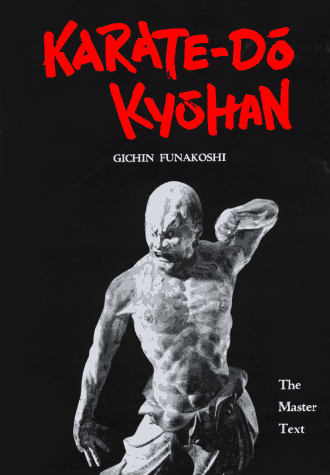
Gichin Funakoshi – Karate-do Kyohan (1)

This is a wonderful and concise introduction to all mayor aspects of karate, from the basics and kata to free sparring. What I found most fascinating – besides the insightfully detailed kata descriptions – was how meaningful those detailed notes become when you don’t read them as descriptions or recipes, but as commentaries on something you already know – or, even more interesting, know in a similar shape. Since I’ve been studying all the Kata’s in their Wado form, Funakoshi’s reasoning is most intriguing where he describes the rationale for doing something different from how we do it. The dialectics of form become apparent, the fact that one needs to be restricted, to see the unfoundedness of that restriction, and thus overcome it. Which makes me realize that Hegel was a very eastern kind of Swabe.

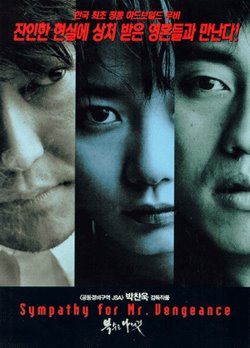
A nice coincidence that this movie would be the next on our Netflix-list after Dirty Harry – this is the movie Dirty Harry should have been (of course that’s somewhat unfair, considering the time gap, but would Harry want me to be fair? There). Where Eastwoods cop sets out to right wrongs in a very private moral (or lack-of-moral) code, this movie unfolds as a giant tragedy, where we can have empathy with everybody, even as they do things that are wrong to begin with, and turn out even worse. “I know you’re a good guy” says the vengeful industrialist in the climactic scene, “so you’ll understand why I have to kill you”. So do we, caught in the same violent logic, and as unable to escape it as any of the characters. Terrific and terrifying.

Friday, December 16th, 2005

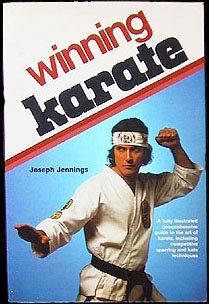
Joseph Jennings – Winning Karate (3)

With martial arts training, it’s mre about the form, the spirit and the attitude of the student than it is about the actual specific movement or skill that’s trained. So a physical description of the basic techniques provides technical rather than spiritual insight – at least when it’s read rather than physically studied. On the other hand, the illustrations in this book demonstrating how to deal with an attacker armed with a gun, knife or rifle, are extremely spiritual. And by spiritual I mean funny.

Wednesday, December 14th, 2005

The Karate Dojo – Peter Urban (3)

Partly insubstantial ramblings, partly interesting Martial Arts stories, this was a nice and entertaining read. Slightly annyoing that he mixes fact and fiction in his anecdotes, without making clear, which is which. But judging from his website, he’s just too great to care.

Thursday, March 16th, 2000

Oder

Wie seit einigen Tagen regelmäßig ziehe ich behutsam, dann kräftiger, am Rand, und beobachte mit leichter Irritation, wie das nachgebende Material zurückweicht und ihn freigibt. Ich halte kurz inne, aber nein, ich spüre nichts, keinen Schmerz, kein Bedauern. Nicht einmal Mitleid.
Wieder ziehe ich, und tatsächlich, langsam löst er sich, der leicht faulige, üble Geruch steigt wieder auf, und dann sehe ich ihn ganz. Er ist größer als ich dachte, auf der Unterseite längsgeriffelt und insgesamt ungesund verfärbt. Merkwürdiger allerdings ist sein Bett, in dem weit hinten der Ersatz heranwächst und sonst alles blank liegt. Behutsam ziehe ich die Socke über den linken Fuß und lege den Zehennagel beiseite. Trophäe oder Müll? Das überleg ich mir später.