Search

Fantasy


Neil Gaiman’s work is a bit of a paradox to me. I like his storytelling and inventiveness – if sometimes reluctantly, for excessive use of pathos -, but visually he consistently seems to be balancing on the fringes of a realm of exuberant quirkyness and fantasy running wild that gives me the creeps for all the wrong reasons. This movie is no exception, with a neat twist on good/evil dichotomies, a likable set of characters, and oodles of visual frills. But several of the ideas here are so enjoyable (the birdmonkeys, sphinx/cats and the pair of giants being just three of the more memorable), that the flaws don’t much matter. Maybe I can even bring myself to read the Sandman one of these days. Why? Because it’s there.

Thursday, April 13th, 2006

Hayao Miyazaki – Hauru no Ugoku Shiro (1)

I still remember being blown to pieces by Mononoke-hime, and it’s hard to imagine anything ever will surpass Sen to Chihiro no Kamikakushi, but Hauro ranks a close (Totoro!) third in the Miyazaki charts. While the plot becomes impenetrable in more than one place, the mysteriousness of what’s going on just adds to the dreamlike quality of the story. The fire demon is a delight, the design a visual triumph, and the characters, in their moral murkyness typical for Miyazaki, likable even when they are the closest anyone can come to evil in his universe. I could maybe have done with a little less screentime for his usual themes of the evils of war and industrialism, but since even those looked good, I won’t bicker. See it if you haven’t, see it again if you have.

Wednesday, March 22nd, 2006

Myst IV: Revelation (2)

The Myst game series has an odd quality about it. Some of the puzzles are frustratingly complex, and hardly make any sense within the stories, which in addition tend to abound with psychological cliches. But of course the strength of Myst lies in the design of the worlds, called Ages, in which it is set, and Revelation is no exception to these rules. The cliched story is accompanied here by some pretty horrific acting efforts, and the difficulty of at least one of the puzzles verges on the ridiculous, with another one being bad enough for a character within the game to suggest that if you get too frustrated, you should go away and try again later. But, oh, the Ages. Tomahna is a cluster of buildings in a sheltered cove that I wouldn’t hesitate to move into in an instant, Spire a marvellously desolate and forbidding hovering crystal tower, Haven a lush jungle full of strange creatures, and Serenia a cool looking mix of several stone masonry cultures. Just walking around in these environments would be a pleasure, and the occasional riddle adds to that a nice sense of involvement.

Friday, March 3rd, 2006

Stephen Chow – Kung-Fu Hustle (1)

The best martial arts movies combine poetry and action into something unique, and boy, does this one ever succeed at it. At once a parody of the genre, and a masterful example of it, humor and inventiveness make this an exhilarating masterpiece. The feeling of sheer delight was heightened considerably by the fact that for some reason I expected a Jackie Chan type comedy, with conventional humorous dialogue and moderately original fighting. I was completely unprepared for the cigarette smoking landlady, the dancing axe gang, the lion’s roar megaphone or the toad fighting technique or the numerous other elements of mayhem, and so was entirely without defences. Which is just as well.

Saturday, January 7th, 2006

Robert Lieberman – Legends of Earthsea (5)

When I realized three minutes into the movie, that the script had swapped Ged/Sparrowhawk’s true and public names, I suspected impending doom. It’s a minor detail, but it betrays all the reckless disrespect and cluelessness, as well as the love affair with superficial deepness (Sparrowhawk! Doesn’t it just sound more magical!) that makes this one of the most horrid adaptations of written material to the screen I’ve ever seen. So much money and effort, so foolishly and pointlessly wasted, with some of the most subtle storytelling in fiction warped into a crude, martial mockery. The only good thing about this disgrace is that in contrast, Le Guin’s books shine all the more. If you think you want to watch this, shoot yourself in the foot instead and moan for three hours. At least that way you’ll have learned something.

Monday, January 2nd, 2006

Peter Jackson – Lord of the Rings (1)

Ever since the first of the Lord of the Rings trilogy came out, Middle Earth has been a holiday* staple for me. I liked the original theatrical versions well enough, but it’s only in the extended cuts that the story’s pacing works and the rich undertones of Tolkiens mythology get a chance to resonate through the plot. Aragorn’s singing of the Lay of Luthien is one specific example among many, and not by accident is it in the Fellowship of the Ring, which after this year’s repeat watching of the whole trilogy (split over quite a few days – I’m a geek, not a nerd) is still my favorite. It’s also the one part that doesn’t have cringe inducing dialog in it (“A red sun rises. Blood has been spilled this night” – Yeah, that would be my brain hemorrhaging, you Elf twat), but they’re all precious, of course. Go, looks at them.

Though the lack of meaning and its pulpy plot development are part of the concept of this highly stylish science fiction comic come alive, it drags a bit toward the end, when even the vestiges of development devolve into a series of ever fancier military gadgetry being deployed. The design is quite nice, but with a bit more reflection on the history and significance of the original artwork it could have also had significance. Ah, well.

Tuesday, December 20th, 2005

Abe’s Exoddus (1)

I just revisited the second installment in the Oddworld series of games, and the last I played – the third and fourth, sadly, are only available for the Xbox. If you like platform games at all, this quirky mix of ironic oddness, fascinating story and character design, tough puzzles and fast paced jump and run episodes will entertain your for many, many hours. And even if you don’t, you’ll have to appreciate some of the lovely, innocative ideas in game design.

Also pretty cool is the list of influences the game designers list on their website.

Monday, December 19th, 2005

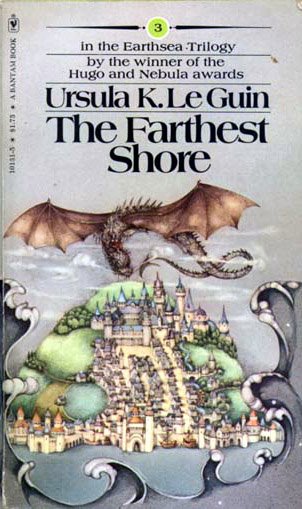
Ursula K. Le Guin – The Farthest Shore (2)

The final volume of the Earthsea Trilogy, and, to me, the strongest of the three. It’s main theme, the struggle caused by the realization that life and death are intricately linked (a thought which is part of the dualist/taoist thinking that weaves like a thread through the whole trilogy, and indeed much of Le Guin’s other writing) and one is impossible without the other, unfolds against a backdrop of exciting encounters, and the overall athmosphere of impending doom caused by the widespread refusal to accept mortality still has a very realistic tone today, more than 30 years after it was originally written.

I should have known. While I enjoyed the charming simplicity of the plotlines in the Narnia series, and appreciated them as the children’s books they were intended to be, none of their story elements packs the mythological punch of Tolkien’s writing, and the Christian parable feels tired once you’ve spotted it. Which is hard not to.

To start with the positive, the movie is nicely done, devoid of cringe-inducing lines or badly done characters, wich is saying something for Disney. But it is also quite boring, and at least a half hour too long. To strip a story about an oppressive regime, war and an epic battle for the survival of a whole world of all the nastyness these things should involve, and leave it with decoratively frozen puppets and the frosty looks of Tilda Swinton, is to deny the book its impact. Sure, you shouldn’t frighten your underage audience into little whimpering heaps, but surely some sense of the consequence of evil would have been appropriate.

Plus, not surprisingly, seeing the crude metaphor for the New Testament, Aslan’s sacrifice for the reinforcing of the “old magic”, rather than reading about it, makes it’s crude and unsubtle symbolism so painfully apparent, that I change my initial statement above – there is a cringy moment there, but it’s all Lewis’ fault.