Bob Larson – Your Swabian Neighbors (3)
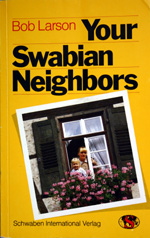 There is mythological evidence from the middle ages, suggesting the Swabians were a jolly, lively people then, full of vigour and joy. You wouldn’t think it today, and the introductory section of this book, meant to show Swabians in the best possible light and endowed with a preface by Cleverle Späth, is a case in point. The most salient features of the Swabian mind, his thriftyness, his shrewdness, his xenophobia, take some stretching to be made into qualities, and with some, most notably the Kehrwoche, even Larson’s well meaning prose fails to create any appeal or sense. The anecdote of Larson interacting with Willy Reichert, Arnulf Klett and the likes are positively painful, but admittedly that might be just to me, and just because they hit too close to home.
Much more interesting and entertaining are his broad sweeps through Swabian history, overloaded in places with genealogical details of the Dukes, or obscure military history of possible interest to his American military audience, but quite boring to me. The book is valuable for its benevolent outsider’s view on my home, that contrasts interestingly with my malevolent insider’s perspective.
Most interesting, however, was this response to the infamous Lied der Schwaben, which, though reviled by true Swabians for its unflattering depiction of local customs, I remember being hung on a plate in our home when I was a kid. I never thought the Lied der Schwaben problematic, in fact considered it quite accurate and liked it for its candidness, if not literary quality. The response, on the other hand, in its attempt to restore Swabian honor is quite utterly horrible. So here you go:
Das “Lied der Schwaben”? –
Der dies ausgebrütet,
aus welchem and`ren deutschen Stamm er sei.
Wo Roheit in der Gossensprache wütet,
sind Art und Herkunft weltweit einerlei!
Humor? –
Der Schwabe liebt ihn tiefer, leiser;
als Geistesfunke stillvergnügter Welt.
Die Leute leben hierzulande weiser
als grobe Torheit grölend dargestellt.
Das Lied der Schwaben:
Uhland hat`s gesungen!
Es schwingt im Fleiß, in Daseinsheiterkeit!
In Schiller, Mörike ist`s aufgeklungen –
und in Motoren dröhnt es erdenweit!
Das Kraftzitat des Götz von Berlichingen
ist menschheitsalter Allgemeinbesitz, –
drum hört man`s auch im Schwabenland erklingen:
zum Beispiel für “Poeten” ohne Witz!
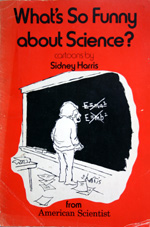 Sadly, this collection of cartoons mostly shows why Science and Humour are commonly considered to be unmixable substances. A few of the jokes are actually funny, but they’re rarely the ones that actually deal with scientists, or science as such, but rather ones inspired by or loosely based on scientific ideas. A few years back, Carl Djerassi wrote several novels in a genre he calls science-in-fiction (early Science Fiction writers probably would have been horrified by the necessity for that distinction), and if I remember correctly, none of them turned out particularly funny, though he sure tried. These cartoon have the additional disadvantage of stemming from strange, past decades, and so are mainly of interest to historians. Ah, historians, don’t get me started on those. Hilarious!
 With a subject as intriguing as the history of the beloved vocalist combo, and their struggle with the rising Third Reich, and a freebie soundtrack treasurechest, it is hard to see how a movie could fail even as much as this one does. A stale and wooden script, endless repetitions of one single song (Veronica, der Lenz ist da) instead of a representative collection of the Harmonists’ work, and a simplistic notion both of human character and historic processes make this a less than splendid experience – especially when compared to Aimee and Jaguar, which is a entirely different league on a fairly similar subject.