Search

Good


Monday, February 27th, 2006

XGen Studios – Stick Arena (2)

I’ve spent so much time on this thing in recent weeks, I should at least pretend that there is something meaningful that can be said about this timekiller. The concept is ingeniously simple: have a multiplayer shoot’em’up with low level technology, Flash in this case, so you can just play it in your browser. As usually, less fancy technology means purer gameplay. In the fights in Stick Arena, there is a lot of strategic movement, feinting, anticipation of opponents’ moves, and trying to be fresh and surprising on one’s own, and it all moves so fast, that it makes for quite pleasurable fights. Maybe it can even teach you a thing or two about fighting, but I fear I’m stretching my credibility a bit. And besides, I need to go back now, and sledge a few stick men.
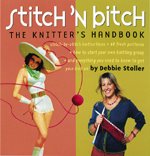
I’m not likely to read the whole of it, but I found the basic knitting instructions very satisfying – they got me from zero to 50 (rows) in just a few hours – and I’m very happy with the project I picked and modified from it. A striped scarf (of course), with a subtle pattern created by switching between left and right stitches. I guess that makes me a knitwit now. Yay!

Sunday, February 26th, 2006

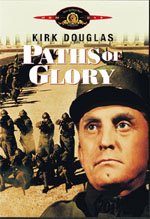
Stanley Kubrick – Paths of Glory (2)

Just having talked about how Sunset Boulevard is still haunting after all these years, here is an example of the opposite effect. A great and important script, great acting, impeccable direction and photography, indeed the whole things reeks of masterpiece, yet the story and message seem pale to me. Maybe it’s the fact that this was followed by so many movies after this one painfully driving home the message of war being hell inflicted by the powerful on the poor. That being said, the final scene, where Douglas’ character listens to his soldiers first degrading a german woman, and then sentimentally singing along with her, is very touching, in spite of its kitschy message: War may be hell, but not everyone condemned to it is an unreconcilable sinner.

Sunday, February 26th, 2006

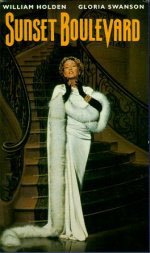
Billy Wilder – Sunset Boulevard (2)

It is always risky to watch the classics, because the time that has passed since they wowed the world has changed viewing and storytelling conventions in often profound ways, and what used to be a captivating thrillride can turn out to be boring or emotionally incomprehensible. With Sunset Boulevard, the problem exists on two levels, as the subject of the film itself is the sinking into oblivion of one medium – silent movies – and its stars. The haunting scene where the looming figures of the silent era – Buster Keaton among them -, are playing cards in Norma Desmonds house is doubly spooke, because they are Has-Beens within the movie as well as without. Wilder has applied this eery unity to many of his characters, with Gloria Swanson, who is playing Norman Desmond, herself being a former silent movie star, with Erich von Stroheim playing Max von Meyerling – essentially himself, and with the added twist of Strohheim’s having shot the movie that ended Swansons career. This movie is an epitaph on a dead art. And, coming full circle, it works marvellously well today, adding one more layer, as though the person giving a gripping speech at a funeral themself was dead.

Wednesday, February 22nd, 2006

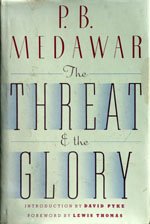
Peter Medawar – The Threat and the Glory (2)

Some names have a positive aura for reasons we have forgotten since we first encountered them. Maybe it was something we read, someone talking about the person, or quoting them in an interesting context. So it was with me and Medawar, and I’m very happy I bought the book at the yard sale I found it at. Medawar treats his often complex subjects with amazing clarity and levity, yet never compromises in terms of accuracy, and the problems he writes about are as unsolved today as they were thirty years ago. How do we balance the benefits of science with its dangers, to fulfill the inherent promise of progress rather than invoking an army of brooms that will sweep us away? Medawar doesn’t have answers, of course, but he does ask the right questions, and that is the bigger achievement anyway.

Tuesday, February 21st, 2006

Chadwick / White – Bleak House (2)

It is probably a bit unfair to review this while I’ve only seen less than half the episodes, but already it’s very obvious that the strength of this series lies in the meticulous presentation of Victorian England. Costumes, sets, acting and direction are masterfully recreating the times of Dickens, and are a pure pleasure to watch. The plot itself, is typical for Dickens, a big, crude soap opera, full of drama and dark secrets, but if it is presented so lusciously – who cares?

Tuesday, February 21st, 2006

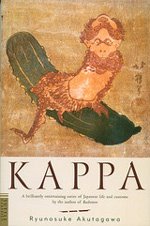
Akutagawa Ryunosuke – Kappa (2)

The cover blurb calls this a satire on Japanese society and its customs, and when I randomly opened at some place, it indeed seemed a very funny and acerbic recasting of the Japanese into the Kappa. While this turned out to be quite misleading, it also turned me onto a book I probably wouldn’t have read otherwise. A lucky turn. The story is of a human being suddenly cast into Kappa society, the Kappa being somewhat malevolent mythological creatures of Japanese rivers, scaly amphibians apt to drag children into the water and drown them. The tone and setting is more than a bit reminiscent of Abbott’s Flatland, which Ryunosuke well might have read, and the absurdity of the goings on in the land of the Kappa reminded me of Daniil Kharms, but all in all, this is quite a solitary achievement. Born, as Ryunosuke himself said, out of his disgust with everything, especially himself, this story presents a caricature of humanity unlike anything I’ve read before.

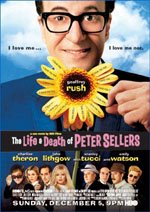
Peter Sellers was a very funny person, but he was also deeply disturbed and, this movie suggests, refused to become a responsible adult all through his life. This movie is often hilarious, incredibly well acted, especially on the part of Geoffrey Rush, who is as amazing and chameleonlike as Sellers himself used to be, but unfortunately lacks coherence. More a collection of individual snippets than a single story arc, the plot leaves out a lot, and the frequent breaks in the narrative, with Rush taking on the roles of people important in his life, walking literally off the stage of the scenes, while an ingenious device, add confusion to an already meandering tale. Still, very impressive and entertaining.

Monday, February 13th, 2006

Paola Cavalieri – The Animal Question (2)

The caveat first: this is not exactly a book written for a general audience. It is a treatise of ethical philosophy, and the reasoning and phrasing is, I felt, even denses in some places than reverence to the esteemed traditions of academic discourse, let alone the subject matter, should have had it be (Though not having tried to set a thorough study of the intricacies of a system of moral acting in popular prose, I of course might be entirely mistaken and this book the closest anyone can get to simplicity in what is without a doubt an discomfortingly complex matter).

Cavalieri sets out to evaluate what entities are moral entities, in the sense that they figure into moral considerations of the actions of moral agents. A thorough review of opinions of the past reveals that none of them can be made consistent. Cavalieri then suggests that the best possible solution for our current state of knowledge of the cognitive life of other species is to extend the notion of human rights to all mammals and birds. Unfortunately, her case is solid, so this is the rare case of a book that has the potential to change my life. No more burgers. Poor me.

Most of what this movie reveals about the criminal mastermind Kissinger was already known to me, and while the detached way the material was presented made the movie seem much more objective and unassailable as any movie ever could be, it also produced a feeling of heavy handed redundancy. I think if my choices are polemic hilarity, as in Moore’s borderline scenes in Bowling for Columbine, and serene factuality, I’ll take the raving fat man any time. The most interesting suggestion came at the very end, when either the author of the book this movie is based on, or the films director, suggested that the reason the US hadn’t joined the international court yet was that they were very afraid of public scrutiny of Kissinger’s files. It almost makes too much sense.