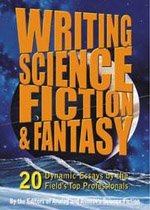
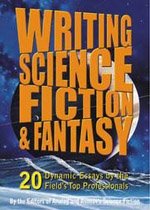
 An interesting anecdote which maybe doesn’t sum up this volume of writing advice, but certainly illuminates it, has Mozart being asked for hints on symphony composition by a young, aspiring composer. He advises to start with small pieces and work up, and when the composer is confused by this and points out that Mozart himself wrote symphonies at quite an early age, Mozart replies “Yes, but I never asked for hints”. That doesn’t necessarily mean that the advice in this volume only applies to writers of mediocre talent, or that it isn’t useful for experts. While the individual essays in this volume vary greatly in quality, with Asimov providing the largest number of essays, and has the least substance to his superficial und uncultered boasts, there are a few pieces that delve deeply into the problems of building entire worlds from scratch. This problem is arguably one of the most important reasons for the gap in literary quality between science fiction and the rest of it – where ordinary narrative can rely on the reader’s ability to fill in gaps in background, characterization and psychology, science fiction must often close them, using original material for it. The seams of implausibility that result whenever this goes wrong wreak havoc with characters, plot and world plausibility, requiring the aspiring writer to pay much more attention to minute details and work it all out. Incidentally and as an aside, the other big reason for the quality gap would be the fact that writers genuinely interested in general themes of human existence rather than scientific what-if-narrative will naturally shy away from setting their plots against an artificial background, leaving a large faction of people like Asimov, who openly admit that they care not one bit about subtelties of storytelling and characterization, and that ideas are all that matters. It’s too bad, really.
The high points of this collection are the essays by Poul Anderson on world building, Norman Spinrad’s somewhat dated sounding advice on how to project current trends using simple cyclical models – it’s a funny moment when he reports in awe that the spreadsheet he uses is a file of gargantuan 600 kilobytes. Good old days -, Hal Clements advice on how to create believable psychologies in an unknown world, and Connie Willis treatise on humourour writing – though technically that last one doesn’t belong here, since she herself points out that there is nothing peculiar to writing funny SF opposed to funny anything else. Also entertaining is Stanley Schmids list of cliches editors will not ever want the read, though I have to say that if you indeed want to write an Adam and Eve story because you think the idea is highly original, another line of work might be better suited.
Books, English, Good, Guides, Science Fiction | No Comments »
 While parts of the second season of the new Galactica drag just as badly as the first – in particular the plot elements concerned with the Cylon masterplan and the impending birth of the child of doom are stretched so thin as to be practically impreceptible. Also, the density of journalists and the political and social structure of the fleet still don’t make much sense other than as commentary on the US today. On the plus side, the acting, set design and the general military mood are great, and the writing, which is generally quite good, of the last few episodes of the second season in particular was excellent. Partly because the main plotline, stalled by the arrival of the Pegasus and its semifascist admiral, finally started moving, but also because the usual seriousness was spiced up with some nice humorous elements. A welcome relief from the heavy handedness which some of the political and moral issues were presented with. The explanation for how the humans were detected (the atomic blast was picked up a year later and a light year away) is a nice nod to physics (though you have to wonder where this nebula clad planet is located for there to be something of interest just a lightyear away. Ah, well). I’m looking forward to the next season, which is slated for airing starting October.