Thursday, June 15th, 2006
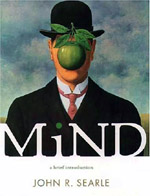 I consider this a great book, not so much because I agree with what Searle says in it. In fact, I don’t agree with hardly anything he says. But it does provide a nice, comprehensive introduction into the philosophy of mind, and it lists several recent major arguments in the field. Searle’s deliberately naive style, calling whole schools of thoughts “complete desasters”, is fun to read, and invites counterarguments. The downside might be that it encourages half baked criticism and opinionation much like what I’m putting down here. Did I say downside? Upside, I meant. So let’s start ranting.
The main thrust of his book is to provide an alternative to materialism and dualism, both of which Searle perceives as having failed to explain the mind. In the case of dualism, the arguments are hardly worth repeating, I’ll restrict myself to the main one, which is: if there is something that is distinct from the physical, how can it work as a causal agent or indeed, interact with the physical at all? Let’s leave it at that, dualism is a straw mean not worth beating on.
Much more interesting are the arguments against materialsm, in other words, the notion that the mental is nothing but the physical and identical with it. Cowardly shirking the technical arguments about type-identity and token-identity, for I admit a certain shakyness on the terminology, I find the rest of the bunch entirely unconvincing. Be it Mary the color scientist, the hapless bat whose experience we will never have, the Zombie arguments, the argument of history-without-mind, Searle’s own chinese room. All are designed to bring out an apparent contradiction, in effect saying: look, I assumed that the mental is the physical, and I arrive at an absurd or impossible conclusion, therefore it can’t be so.
For example, to pick one: assume we know everything there is to know about bat’s brains. Then we still don’t know what it’s like to be one, i.e. there is something about being a bat that all our knowledge doesn’t reveal to us. On a brief glance I see three things wrong with the argument. First, it’s not at all clear to me that it is possible to know everything there is to know about a bat’s brain. It might just turn out to be too complex a process to hold in a human mind. Second, I don’t see any evidence one way or the other that would allow me to conclude that knowing all there is to know about the bat would or would not allow me to have the experience. I think it’s unlikely, but as long as we don’t know what experiences are, arguing with hypothetical situations and claiming to know what experiences would and would not arise seems premature. Third, and most importantly, I’m pretty sure wanting to have the experience of being a bat is confusion. In a physical analogue, if I know everything there is to know about hydrodynamics and the physics of waves, will I physically be like a wave? More to the point, will the fact that I will not be physically like a wave prove there is something in addition to the physical about a wave? Some wavy-ness not capturable by any physical theory? Of course the answer is no, and the question is the result of a mixup: the theory is not the object.
Back to the bat: even if I could know all there is to know, and even if that didn’t give me access to everyhting it means to be feeling like a bat myself, all that says is that the actual object of my theory, the experience, exists independent of the theory. And it’s just silly shamanism to demand that we obtain properties of the described by describing it. The confusion arises because in the case of experiences the theory and its object seem to both be mental processes, but that is not relevant. The experience of the bat is a state of the bat’s brain, and of course I can’t be in that state. I’m not a bat’s brain, silly.
None of the other arguments work any better, they all are a mix of unfounded assumptions and unwarranted conclusions. The Chinese Room for example slyly axiomatically uses the common sense notion that following a bunch of cards will not produce understanding, and then, Heureka!, concludes triumphantly that algorithms can’t produce understanding. True, if you put it in as an assumption. Assume that they do, and suddenly the ficticious Searle in his room will shuffle cards and understand what he’s doing, whatever that means.
The main reason all these arguments have to be fallacious is that they try to deduce an empirical fact from first principles. Whether or not the mind is physical, algorithmical or reducible is an empirical question for neuroscience, and all the counterarguments tell us more about the internal structure of our minds, the things we take for granted and the things we can think than they do about these empirical facts. Searle sees this for some of the issues, but is blind to it whenever his own beliefs are concerned.
So his eternal mantra that the syntacic can’t cause the semantic, and his argument for freedom of will, based mostly on his hunch that nature wouldn’t have made us think we have freedom of choice if we didn’t, share their weaknesses with those of the strawmen of materialism criticism his naive realism originally set out to burn.
Books, English, Good, Neuroscience, Nonfiction, Philosophy, Science | No Comments »
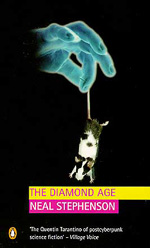 With the Cryptonomicon in mind, I expected a story similarly overfraught with meandering detail, but found myself pleasantly surprised. A well worked out future world, centered on changes in politics brought about by the development of nanotechnology, provides a nonintrusive background for a neo-victorian play on education and the value of the individuum that is as much fun as it is solid. While the psychology and character development, as is so unfortunately common in Science Fiction, take second stage after the geeky technostuff and the equally geeky ramifications of the technostuffs effects, the result is a delightful study. While the end is maybe a bit forced, this still makes me want to read Snowcrash now, Stephensons debut.
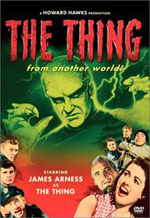 I had heard that his movie was good, but I was surprised to find just how well this 1951 SciFi-Horror crossover has withstood the test of time. An intelligent script and believable characters, a stroy relying on try suspense instead of cheap effects, a truly frightening creature and well acted and filmed scenes all make this a gem worth remembering. While Carpenter’s remake, especially its intense atmosphere of paranoia, is superior in some ways, I would find it hard to compare the two overall. Which means that for its sheer age, Nyby’s version wins. Yay Nyby!
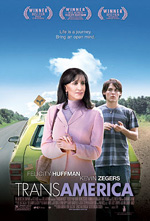 This could have been another movie using a feel-good story to enahnce understanding an accepance for a minority by depicting some of its members as struggling, but good humans-like-us. That is an approach that is both commendable for its beneficial impact on society mores and slightly suspicious for its tendency to avoid the more troubling aspects or consequences of the problem under study. On an abstract level this movie falls into this category, as the storyline feels improbably constructed from the standard ingredients of such fare, but the detail, and the performance of its leads, catapult it onto a different level. It’s too bad Huffman was up against Witherspoon’s more broadly appealing performance in Walk the Line at the Academy Awards.
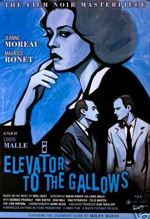 Jeanne Moreau’s sulking femme-fatale act is annoying to watch, and parts of the story don’t seem to make sense – why did Tavernier not escape through the floor after the elevator had gone almost all the way down to the ground floor? Why would a Jury let the murderer off easily, while being harsh on Moreau’s scheming wife? But these minor quibbles aside, it’s a very original story, and a very entertaining movie. As a window into history, I found the German characters, with their obvious postwar Wirtschaftswunder wealth and ruthless joviality particularly fascinating.
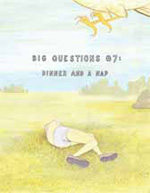 Not much happens in this cute little comic, a bird investigates a human walking and napping in the woods, another bird gets eaten, and a snake behaves out of character of species, but the reduced, calm way its drawn makes this a little gem. The bird exploring the sleeping human is particularly endearing.
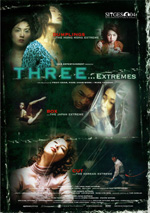 The odd and interesting concept of combining three short disturbing cinematic visions from Korea, Hong Kong and Japan into a single feature film pays off mostly because of the contrast between the three directors’ very distinctive approaches to scaring or shocking the audience. Where Chan uses colourful unscrupulous hedonism to post a moral warning, Park delves almost sadistically in his usual subject of revenge, guilt and the impact of violence and Miike creates a rigid, melancholy and inescapable atmosphere of enormous and unresolvable guilt. I’m not sure any of the three stories would have worked as standalone works, but seen together they seem to take on a deeper meaning and complement one another.
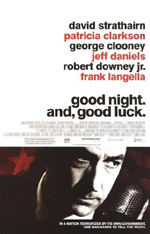 While Clooney did seem a bit too proud of the things he’s been doing lately at the Oscar’s, the things he does are indeed pretty great, and he wasn’t quite deserving of the scorn heaped upon him by pop reactionaries Parker and Stone in a recent South Park episode (that puts him in a league with recently mocked Al Gore. Apparently poop jokes aren’t controversial enough any more. But I digress). This movie depicts, in rather beautiful black and white cinematography, the courageous act of a few TV journalists at CBS defying overpowering senator Joe McCarthy, and contributing significantly to his eventual downfall. An inspiring and encouraging story at any time, the present context makes this indispensable.
 This should by rights have been an awesome movie, with awesome music and an intriguing story, and it didn’t quite fail at achieving it, but it didn’t quite make it, either. Phoenix and Witherspoon were doing an amazing job, especially with the music, but several aspects of the script left me wanting more. We don’t really understand why any of the people do what they do, especially so for the negative influences, his father and his first wife. We get hardly a glimpse of why they act the way they do, and I didn’t really connect to Cash’s reactions to them, either. And the predictable story arc of success – gutter – redemption and it’s edifying connotations may have been unavoidable in a Cash biopic, but still disappointed me in its simplicity. The music made up for much of that, though, and the cinematography and design helped a lot, too.
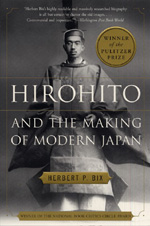 I’m not sure whether entering a field of knowledge through a basic introduction, or from the middle of an ongoing controversial debate is preferable. Bix’s book represents both aspects, being aimed at those familiar with Japanese history, arguing the case for a change in the perception of wartime emperor Hirohito, from benevolent onlooker and powerless figurehead to bearing full responsibility for Japanese war atroctities and aggression both before and during the second world war. At the same time, it adresses the general reader, using the Sh?wa emperor’s biography as the focal point for depicting the making of modern Japan. The balance between these two different books is worked out fairly well, with some passages dragging on a bit too long, due partly to an overabundance of detail and a flurry of Japanese names and concepts that are sometimes not introduced well enough to properly keep track of for the non-initiated reader.