Search

Good


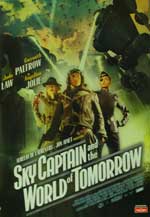
Though the lack of meaning and its pulpy plot development are part of the concept of this highly stylish science fiction comic come alive, it drags a bit toward the end, when even the vestiges of development devolve into a series of ever fancier military gadgetry being deployed. The design is quite nice, but with a bit more reflection on the history and significance of the original artwork it could have also had significance. Ah, well.

Friday, December 30th, 2005

Jeffrey Eugenides – Middlesex (2)

A fiction so convincing that I needed to remind myself several times that I was not reading an autobiographical account. The story of a hermaphrodite growing up in Detroit, and his/her family’s history stretching back into Turkey are told in epic breadth, and with a lot of fascinating historic detail. The narrative holding it all together, that of the girl Callie turning into the man Cal, seems to dissolve to little significance against that background, making me wonder if more focus on the story and main character itself wouldn’t have served the overall experience better.

Wednesday, December 28th, 2005

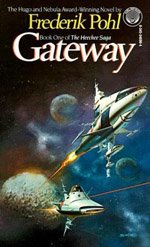
Frederik Pohl – Gateway (2)

I’ve been busy checking out the Hugo and Nebula award winners, and this one was a particular delight. An unknown alien species, the Heechee, disappeared a long time ago, but left some artifacts, most notable a space station equipped with hundreds of interstellar ships attached. The ships are mostly operational, but nobody knows how the course setting machine works, what the destinations are, and how long the trip will be. Mortality on these trips is high, with most coming back emptyhanded, so the exploration of the Heechee legacy is run as a kind of lottery, where explorers might die or disappear, but might also come back with incredible new artifacts or knowledge, making them rich for life. This is the background to the story of one man, who struck it rich on one of these trips, but can’t cope with what happened, and what he had to do to survive. We witness his therapy sixteen years later, and the original events unfolding in parallel, with documentary material, like classifieds from the station’s newspaper, ingeniously strewn in.

Monday, December 19th, 2005

Joe Haldeman – Forever Peace (2)

This is a story of many plots, ranging from the destruction of the universe, or a substantial fraction thereof, by nanotechnology, to modern warfare and social philosophy to moral conundrums of modern life – interracial dating, for example – and it tries to both set up these varying fields as enormous problem zones, and then present realistic solutions. Most of the central ideas and technologies, and the problems caused by them – the social impact of full automation both on the society controlling it and the societies controlled by it, or the psychological and military implications of remotely controlled superwarriors, to name two – are daring and impressive, and the extrapolation of US foreign policy into the year 2048 seems frighteningly believable. But against the tapestry of these towering problems, Haldemans solution falls somewhat short, both within the universe of his novel and our own. Still, with its very gripping, thoughtful and empathic plot, Forever Peace fully deserves the Hugo and Nebula awards it won.

Monday, December 19th, 2005

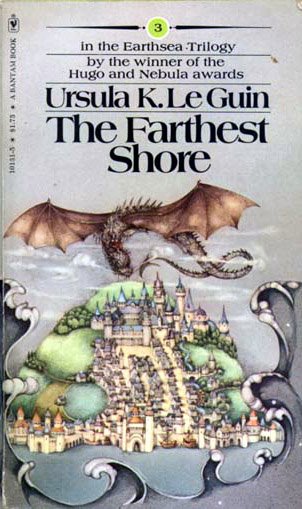
Ursula K. Le Guin – The Farthest Shore (2)

The final volume of the Earthsea Trilogy, and, to me, the strongest of the three. It’s main theme, the struggle caused by the realization that life and death are intricately linked (a thought which is part of the dualist/taoist thinking that weaves like a thread through the whole trilogy, and indeed much of Le Guin’s other writing) and one is impossible without the other, unfolds against a backdrop of exciting encounters, and the overall athmosphere of impending doom caused by the widespread refusal to accept mortality still has a very realistic tone today, more than 30 years after it was originally written.

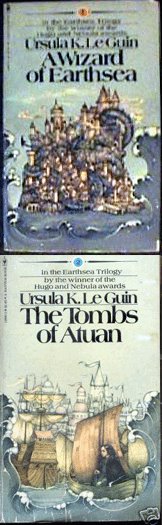
I loved Le Guins The Dispossessed and The Left Hand of Darkness, so even though I’m not very keen on people in pointy hats throwing speels (unless they’re called Gandalf, obviously) I thought I’d give Earthsea a shot, and I’m glad I did. Like with her other books, I found the most interesting element of these books their outright refusal to play by the base rules of the genre. While there are magical gadgets, spells, castles and monsters, it’s clearly not those that Le Guin is interested in. Where a Wizard of Earthsea was about one boy’s journey to discover and master the evil in himself, the Tombs is about a clash of worldviews and belief systems, one religiously closed and involved in power struggle, the other, though based in magic, rational and open, and striving to find balance. In a nutshell, these stories are driven by psychological archetypes (the dark of the tombs, the faceless evil) than by plot, in fact, so much so that I wondered why there needed to be any magic in them at all – the fantasy elements are, so far at least, quite superficial.

Monday, December 12th, 2005

Way Station – Clifford D. Simak (2)

Simak won the Hugo in 1964 for this quiet piece. Enoch Wallace, a civil war veteran from southwestern Wisconsin, is chosen by Galactic Central to operate a way station on earth, where alien lifeforms pass through on their way elsewhere.

While there is a dramatic plot, Simak clearly puts the emphasis on fleshing out the central idea of a brotherhood of all beings, to which humanity, even though standing on the brink of self-extinction from an atomic war, seeks admission. It is a nice read – and also an interesting piece of 60s optimistic pessimism.

While in the end the brotherhood of sophonts is sustained, nuclear war averted, and balance is returned to the force (possibly one more “inspiration” for all-around plot-thief Lucas, otherwise just a common cliche), this is achieved only because of sheer luck, the special sensibilities of an outcast, and a magical Deus-Ex-Machina superdevice.

Friday, November 4th, 2005

Frans de Waal – Chimpanzee Politics (2)


Ein Klassiker der Primatenforschung, und faszinierender Einblick in die seelische Verfassung unserer nächsten Verwandten. Ein Gutteil dieser Faszination speist sich daraus, dass trotz aller Parallelen zu menschlichem Verhalten die Gefühlswelt und das Verhalten der Schimpansen von anderen Prinzipien regiert werden als unsere, die Tiere uns aber ähnlich genug sind, dass wir ihnen die dem äusseren Verhalten entsprechenden menschlichen Regungen unterstellen. Eine Lektion nicht nur in Primatenpsychologie, sondern auch in den Mechanismen, durch die unsere Vorurteile unsere Wahrnehmung gestalten; vermutlich sind diese aber ohnehin Teil jener.

Eine der rührendsten Anekdoten des Buches erzählt vom Moment im Frühjahr, in dem die den Winter über im Primatengebäude verstauten Schimpansen die unsichtbare Klappe ins Freie sich am Ende des Ganges öffnen hören, und sofort in lautes Geschrei, aufgeregte Sprünge und Umarmungen ausbrechen.