John Searle – Mind (2)
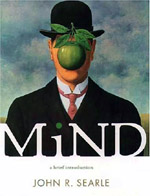 I consider this a great book, not so much because I agree with what Searle says in it. In fact, I don’t agree with hardly anything he says. But it does provide a nice, comprehensive introduction into the philosophy of mind, and it lists several recent major arguments in the field. Searle’s deliberately naive style, calling whole schools of thoughts “complete desasters”, is fun to read, and invites counterarguments. The downside might be that it encourages half baked criticism and opinionation much like what I’m putting down here. Did I say downside? Upside, I meant. So let’s start ranting.
The main thrust of his book is to provide an alternative to materialism and dualism, both of which Searle perceives as having failed to explain the mind. In the case of dualism, the arguments are hardly worth repeating, I’ll restrict myself to the main one, which is: if there is something that is distinct from the physical, how can it work as a causal agent or indeed, interact with the physical at all? Let’s leave it at that, dualism is a straw mean not worth beating on.
Much more interesting are the arguments against materialsm, in other words, the notion that the mental is nothing but the physical and identical with it. Cowardly shirking the technical arguments about type-identity and token-identity, for I admit a certain shakyness on the terminology, I find the rest of the bunch entirely unconvincing. Be it Mary the color scientist, the hapless bat whose experience we will never have, the Zombie arguments, the argument of history-without-mind, Searle’s own chinese room. All are designed to bring out an apparent contradiction, in effect saying: look, I assumed that the mental is the physical, and I arrive at an absurd or impossible conclusion, therefore it can’t be so.
For example, to pick one: assume we know everything there is to know about bat’s brains. Then we still don’t know what it’s like to be one, i.e. there is something about being a bat that all our knowledge doesn’t reveal to us. On a brief glance I see three things wrong with the argument. First, it’s not at all clear to me that it is possible to know everything there is to know about a bat’s brain. It might just turn out to be too complex a process to hold in a human mind. Second, I don’t see any evidence one way or the other that would allow me to conclude that knowing all there is to know about the bat would or would not allow me to have the experience. I think it’s unlikely, but as long as we don’t know what experiences are, arguing with hypothetical situations and claiming to know what experiences would and would not arise seems premature. Third, and most importantly, I’m pretty sure wanting to have the experience of being a bat is confusion. In a physical analogue, if I know everything there is to know about hydrodynamics and the physics of waves, will I physically be like a wave? More to the point, will the fact that I will not be physically like a wave prove there is something in addition to the physical about a wave? Some wavy-ness not capturable by any physical theory? Of course the answer is no, and the question is the result of a mixup: the theory is not the object.
Back to the bat: even if I could know all there is to know, and even if that didn’t give me access to everyhting it means to be feeling like a bat myself, all that says is that the actual object of my theory, the experience, exists independent of the theory. And it’s just silly shamanism to demand that we obtain properties of the described by describing it. The confusion arises because in the case of experiences the theory and its object seem to both be mental processes, but that is not relevant. The experience of the bat is a state of the bat’s brain, and of course I can’t be in that state. I’m not a bat’s brain, silly.
None of the other arguments work any better, they all are a mix of unfounded assumptions and unwarranted conclusions. The Chinese Room for example slyly axiomatically uses the common sense notion that following a bunch of cards will not produce understanding, and then, Heureka!, concludes triumphantly that algorithms can’t produce understanding. True, if you put it in as an assumption. Assume that they do, and suddenly the ficticious Searle in his room will shuffle cards and understand what he’s doing, whatever that means.
The main reason all these arguments have to be fallacious is that they try to deduce an empirical fact from first principles. Whether or not the mind is physical, algorithmical or reducible is an empirical question for neuroscience, and all the counterarguments tell us more about the internal structure of our minds, the things we take for granted and the things we can think than they do about these empirical facts. Searle sees this for some of the issues, but is blind to it whenever his own beliefs are concerned.
So his eternal mantra that the syntacic can’t cause the semantic, and his argument for freedom of will, based mostly on his hunch that nature wouldn’t have made us think we have freedom of choice if we didn’t, share their weaknesses with those of the strawmen of materialism criticism his naive realism originally set out to burn.
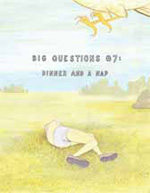 Not much happens in this cute little comic, a bird investigates a human walking and napping in the woods, another bird gets eaten, and a snake behaves out of character of species, but the reduced, calm way its drawn makes this a little gem. The bird exploring the sleeping human is particularly endearing.
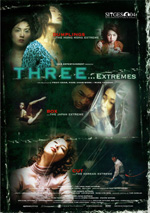 The odd and interesting concept of combining three short disturbing cinematic visions from Korea, Hong Kong and Japan into a single feature film pays off mostly because of the contrast between the three directors’ very distinctive approaches to scaring or shocking the audience. Where Chan uses colourful unscrupulous hedonism to post a moral warning, Park delves almost sadistically in his usual subject of revenge, guilt and the impact of violence and Miike creates a rigid, melancholy and inescapable atmosphere of enormous and unresolvable guilt. I’m not sure any of the three stories would have worked as standalone works, but seen together they seem to take on a deeper meaning and complement one another.
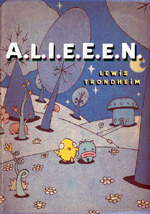 Trondheim’s marvellous style, applied to a quirky story of alien mishaps, told in hardly decodable symbol language and asynchronously. The result is a delightfully trippy little comic book. An interesting side note concerns the preface, which seems to have been written specifically for the american edition (which I assume is otherwise identical to the french edition, unless there are different kinds of unintelligible geometric symbols in the two cultures) and mentions a camping trip of Trondheim’s into the Catskills. Merely translation of ideas rather than words, or an attempt to conceal the European original of the work for sales’ sake?
  A powerful meditation on innocence lost and the mixed blessings of civilization and progress, this is essential Malick. Of course that also means a healthy dose of pathos and a certain slowness of plot, but when so beautifully shot and arranged, who would want to bicker. I have not seen the story of Pocahontas told any other way before, and I don’t think I shall.
 It could have been a delightful superhero spoof, with touching undertones of melancholy and underdog happyness. But bad direction, design and editing destroy much of the movie, which occasionally shines (the confrontation betwen Captain Amazing and Casanova Frankenstein is hilarious, for example), but most of the time drags. It’s too bad, the writing is good, and some of the acting and improv (Stiller mentions in the specials that the script wasn’t fixed and actors would ad lib) could have been quite hilarious. Maybe it was meant to be watched in large groups, and the gaps are so people can finish laughing without missing a joke, but I’m not sure whether that would make the bad editing better or worse.
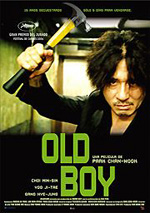 I enjoy watching movies with advertised surprise endings, not attempting to guess the twist beforehand so that it can have maximum impact. Here, I vaguely suspected the ending about halfway through, enough to take away the bottomless feeling I distinctly remember from having in The Sixth Sense, which is too bad. That doesn’t say anything bad about the movie, and I just mention it to justify my not talking at all about the plot of Oldboy. I cherish surprises, and so should you. Besides, if you want to be spoiled, there are plenty of places online for that.
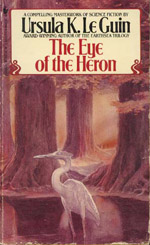 I like LeGuin’s work in general, but this tale of freedom and repression is not her best work. Two groups of exiles coexist on a wild, uncharted planet, one composed of the descendants of prisoners, the other of political exiles, sent away for their disturbing pacifism. When some people in the city try to increase their power and wealth by exploiting the pacifists, whom they perceive as weak, a struggle ensues, that ends in a murky compromise and further exile for a subgroup of the pacifists, who realise that they can only live their dream in complete isolation.
 Oh boy, where do I start? It was sombering to see that the concept that so beautifully worked in In the Mood for Love could fall so flat. While this loose sequel explores similar themes, none of the characters got me the least bit interested, the plot was see-through-thin both in terms of what happened and the emotional content, and the pretentiousness of it all just unbearable. Had I seen this in a theater, it would have been one of the rare occasions for me to walk out (though the cinematography, admittedly lost on a TV, might possibly have kept me). At home I sat through it, and I’m glad I did, for the last half hour picked up a bit. But not remotely enough to make this worthwhile. Stay clear.
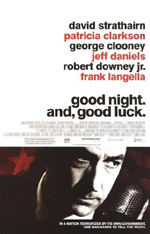 While Clooney did seem a bit too proud of the things he’s been doing lately at the Oscar’s, the things he does are indeed pretty great, and he wasn’t quite deserving of the scorn heaped upon him by pop reactionaries Parker and Stone in a recent South Park episode (that puts him in a league with recently mocked Al Gore. Apparently poop jokes aren’t controversial enough any more. But I digress). This movie depicts, in rather beautiful black and white cinematography, the courageous act of a few TV journalists at CBS defying overpowering senator Joe McCarthy, and contributing significantly to his eventual downfall. An inspiring and encouraging story at any time, the present context makes this indispensable.