Thursday, June 29th, 2006
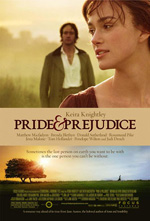 I am exactly a fan of the romantic movie genre, often citing its lack of explosions as a reason. More accurately stated, the romantic comedy and drama in general lack an element that allows me to overlook faults in plot or character exposition, or overall execution. This is because I am unwilling to let myself become emotionally involved with people whose existence has clearly been disproven by shoddy filmmaking. I harbor no such objections against unrealistic explosive devices, and I blame my genes for said unfounded bias.
Having said that, I did enjoy this newest version of Austen’s book a lot. Both for the believable historic background of lower class struggle and upper class overfed ennui, and for the entirely likable main characters, whose eventual pairing up I did look forward to. Donald Sutherland as the father was an added bonus that made it possible to ignore the somewhat annoying rest of the family. I found it interesting that the actors all agreed on the likability of the characters, when half the family were self-absorbed, hysterical and irresponsible, but given that I can see historic reasons for why this would have been so, it’s interesting more than really bothersome.
Drama, English, Europe, Good, History, Movies | No Comments »
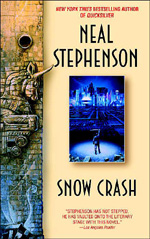 A very inventive story and cool story, with the same weakness Stephenson’s other books have in my opinion, a forced ending. Creating complexity, just to then shoehorn it into some resolution so readers can feel better is not something I approve of. Otherwise it’s quite flawless, though. It’s also quite interesting to see how Stephenson obviously churned on the themes he scratched upon in this novel for the later Diamond Age, and then took them into more realistic contemporary fiction with the Cryptonomicon.
 If you need to be told that Familiy Guy is funny, you shouldn’t be surfing the web, you should watch TV and fill the gaping hole in your life. Go. Now.
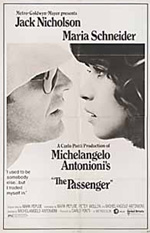 This movie exudes an almost physical sense of emptyness and ennui. Oddly, while not entirely successful, that is actually a good thing, as Nicholsons character has lost all interest and drifts along mindlessly, trying without success to find meaning in taking over other another person’s life. The opening sequence, unfolding in mysterious wordlessness in a gorgeous desert landscape, are particularly effective at recreating the existential despair of Nicholsons character in the viewer, but all of the movie actually does a terrific job. Which unfortunately is also something of a bad thing.
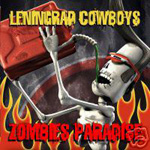 I recently remembered that a Leningrad Cowboys album was lying abondoned in some basement in Germany, and was happy to find that the songs I remembered so fondly still sound great. I was even happier when I learned that the Cowboys had just released a new album, but subsequently disappointed to find it badly cliched and uninspired. Where the earlier stuff is tightroping the quirk above a sea of ethnic cliche, this collection is right down in the deepest, darkest abyss of hardrock hubris. Why, oh why?
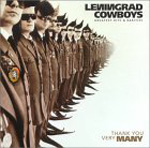 I fondly remember the songs from my first Cowboys record, We Cum From Brooklyn, such wonderful playful sounds and humour. I was happy to find that much of this best of collection is taken off that older album. Together with the new album this unfortunately also confirms my suspicion that the Cowboys have lost their mojo.
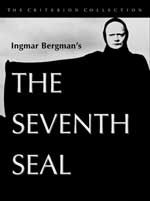 Never before has the decay of society, the random death and destruction, and the hopeless metaphysical void that was left by the scourge of the black death depicted as stylish as in this chessgame action thriller. I expected dreary symbolism and found a wonderful meditation on death and life.
 I am not sure how this album will go over for somebody who does not understand the lyrics, as to me much of the appeal of Licht’s music rests in the relationship between the clash of childish naivete and intellectualism in his words and the innocent music he chooses to sing them to. I am also not sure how the lyrics would work on their own, I suspect they’d be shallow novelty poetry, but the combination is just delicious. If you know German, or intend to learn it, give this a spin.
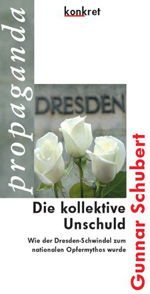 For years I had suspected that the historic truth is being stretched and bended, possibly even mutilated, in order to make Dresden into the innocent symbol of allied war atrocities dominating the German discourse of the bombings. Now, having read Schubert’s book on the subject, I am better equipped to dispel the myths, and predictably find my inferences confirmed. No liquid phosphor rained down, the city was not full of fugitives or innocents any more than any of the other cities inhabited by Nazis was, and the local industry was neither insignificant nor unimportant for the war. Dresden has turned into a monumental tool for relativists, for whom the outcome – the destruction of human life and property – is the only determinant of the morality of an action, and for whom dead Nazis and their dead victims form one soppy canvas to paint a kitschy portrait of their nationalism disguised as benevolent peacefulness upon.
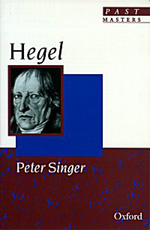 I came across this book on one of the shelving carts in the main UC Berkeley library while searching for a completely different one that had gone missing (and sadly hasn’t been located since). Its author, briefness and subject matter immediately commanded my attention, and after having read it, I’m happy I stumbled upon it. This brief treatment of Hegel’s work is a small miracle, capturing his theory of history, dialectics and the master/slave dichotomy rising from his theory of Selbstbewusstsein, and in turn giving rise later to Marx’ alienated labor. A wonderful introduction, and a solid argument for libraries where books are accessible rather than being ordered from closed stacks through a catalogue.