Search

History


Monday, April 17th, 2006

Alex Gibney – Enron (2)

The biggest corporate scandal of our time, explained. Before I saw this, I feared to see the ruthless and ingenious machinations of evil people would get me agitated without offering a way out. But to see the ruthless machinations of evil people leaves me incredulous for their lack of ingenuity, and the problem turns out not to be a few crooks, but a fundamentally flawed system. None of it should have happened, but scores of investment bankers and brokers fell for the nude emperor, because they had stock in non-clothing. Sure enough, there are a few monstrous moments, as when the Californian energy grid is played for money, but overall, it’s just business as usual. How horrible.
Thursday, April 6th, 2006

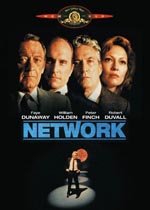
Sidney Lumet – Network (3)

A justified message hardly ever gets better, when it is preached instead of told subtly, and Network makes no difference. This drama of a unscrupulous bunch of network executives turning TV news into a quota hungry travesty akin to a televangelism sideshow would have been much stronger if there weren’t several droning monologues of the main character about the evils of television. It is somewhat ironic that a movie that accuses audiences of blindly gobbling up sensationalism and following any and every leader, if he shouts loud enough, and the executives of ruthlessly exploiting this lack of maturity, resorts to propaganda to try and get its message across, not trusting its own audience, either. Just who, one wonders, are the writers trying to talk to here, and what do they really want to say? As it stands, the message seems to be that since audiences are dumb sheep, the producers of media need to be responsible shepherds. That message is snobbery so close to the opinions held by the films villains as to make it hard to take its scathing criticism of western society seriously. Network has its nice moments – some of Peter Finch’s madman preaching is quite cute, as is the cinematography and the acting -, but overall, it disappoints.

Saturday, March 25th, 2006

John Wyndham – The Kraken Wakes (1)

How refreshing, after reading a lot of idea driven, gimmicky SF, to discover this. I found it in the bookstore run by the Friends of the Berkeley public library, among pulp paperbacks, and though I’d never heard of Wyndham, was intrigued by the cover art and the fact it had come out on Penguin. The story is a crossover between Capeks wonderful War with the Newts and Well’s War of the Worlds, with an extraterrestrial menace, quite possbily flying in from Jupiter, settling in the deeps of earths oceans, and proceeding to exterminate the bothersome land mammals. The story is gripping – though the solutions’s alomost perfect parallel to Wells’ is a bit disappointing – but the true strength of the book lies in the two main characters, a married couple of radio documentary writers, who witness most of the events from close up, but have hardly any active part in the matters at all. This viewpoint lends the story enormous credibility, based on the one hand in the strong execution of characterization and background, but also in the familiarity of events unfolding on a large scale that one is powerless to stop or alter, yet keeps reflecting upon and discussing as though one did. Finally, the acerbic depiction of cold war diplomacy at the height of madness is the crowning piece on a very nice cake.

Wednesday, March 15th, 2006

Michelangelo Antonioni – L’Avventura (3)

This was praised and much discussed when it came out in the late sixties for its refreshingly novel cinematic way of storytelling – or so the Netflix cover blurb tells us. The story is that of a bunch of rich people, bored to glassy stares byu their eventless lives, vacationing among the Aeolic Islands. One of the women vanishes, and her best friend and her lover embark on a quest to solve the mystery and find her, and get close in the process. Or the equivalent of closeness in artsy cinema overcharged with undertones and cranked up to a maximum of meaning with a minimum of substance. That might seem unfair, but I find it unfair to have to watch beautiful women and great cinematography without plot or point, so I guess we’re even, Mr. Antonioni.

To anyone following European public discourse and politics, the anti-American bias should be obvious. It is a curious fact of human psychology that an argument based on correct facts can still be wrong, and this complication afflicts this book as well. There is no way to defend the current American administration against the criticisms leveled against it, nor is there a way to dispel the other prominent myths about American held in Europe, namely that its capitalist forces are out of control and that it’s wealth is based on exploitation. But when these criticism are voiced by powers that have no inherent interest in solving the underlying problems, but rather are the competition. As much as I would have liked to think of the European protest against the Iraq war as an outpouring of compassion, and to view the piles of Michael Moore’s books in german bookstores as the proof of genuine interest in opposing ruling power they would have been in the US, I know both are at least to a good degree expressions of less pure motives. Reading this book made me question my own approach in my parallel blog, where I collect little stories that seem to me to reflect tendencies of isolation and aggressive competition, somehow equating that with my experience here – as though I weren’t appalled by the cold and unfriendly behaviour of many Germans, too, every time I visit.

Sunday, February 26th, 2006

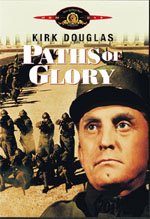
Stanley Kubrick – Paths of Glory (2)

Just having talked about how Sunset Boulevard is still haunting after all these years, here is an example of the opposite effect. A great and important script, great acting, impeccable direction and photography, indeed the whole things reeks of masterpiece, yet the story and message seem pale to me. Maybe it’s the fact that this was followed by so many movies after this one painfully driving home the message of war being hell inflicted by the powerful on the poor. That being said, the final scene, where Douglas’ character listens to his soldiers first degrading a german woman, and then sentimentally singing along with her, is very touching, in spite of its kitschy message: War may be hell, but not everyone condemned to it is an unreconcilable sinner.

Sunday, February 26th, 2006

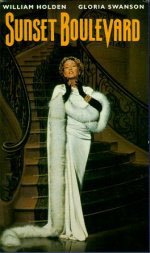
Billy Wilder – Sunset Boulevard (2)

It is always risky to watch the classics, because the time that has passed since they wowed the world has changed viewing and storytelling conventions in often profound ways, and what used to be a captivating thrillride can turn out to be boring or emotionally incomprehensible. With Sunset Boulevard, the problem exists on two levels, as the subject of the film itself is the sinking into oblivion of one medium – silent movies – and its stars. The haunting scene where the looming figures of the silent era – Buster Keaton among them -, are playing cards in Norma Desmonds house is doubly spooke, because they are Has-Beens within the movie as well as without. Wilder has applied this eery unity to many of his characters, with Gloria Swanson, who is playing Norman Desmond, herself being a former silent movie star, with Erich von Stroheim playing Max von Meyerling – essentially himself, and with the added twist of Strohheim’s having shot the movie that ended Swansons career. This movie is an epitaph on a dead art. And, coming full circle, it works marvellously well today, adding one more layer, as though the person giving a gripping speech at a funeral themself was dead.

Saturday, February 25th, 2006

John Muir – My First Summer in the Sierra (1)

A young man goes into the mountains to herd sheep and falls deeply in love, changing the rest of his life? Sound familiar? It took me until I was almost done with this exuberant diary to notice the funny parallels to this years Oscar winner. Since Proulx’ story and Lee’s movie are a commentary on the myth of rugged wilderness and the lone, heroic men populating it, it’s interesting to compare the two on that level. Muir in this trip and the path it set him on for his life, shaped another pervasive myth – that of unspoiled nature being more than a resource waiting to be used, but of value in itself. While the overpowering enthusiasm of his prose (written long after the trip), and his referring to plants and animals alike as “people” sound very quirky, and certainly his habit to talk to the flower people does, they are also part and parcel to his view of nature as a vast society, of which man is but a small part. His awe in the face of everything nature throws his way is a great inspiration, and Dan Simmons’ suggestion in the Hyperion novels, that with time Muir he might turn into the patron saint of his own religion seems very convincing. He certainly was crazy enough for the job.

Tuesday, February 21st, 2006

Chadwick / White – Bleak House (2)

It is probably a bit unfair to review this while I’ve only seen less than half the episodes, but already it’s very obvious that the strength of this series lies in the meticulous presentation of Victorian England. Costumes, sets, acting and direction are masterfully recreating the times of Dickens, and are a pure pleasure to watch. The plot itself, is typical for Dickens, a big, crude soap opera, full of drama and dark secrets, but if it is presented so lusciously – who cares?

Tuesday, February 21st, 2006

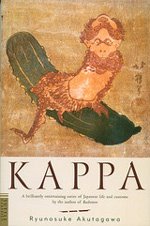
Akutagawa Ryunosuke – Kappa (2)

The cover blurb calls this a satire on Japanese society and its customs, and when I randomly opened at some place, it indeed seemed a very funny and acerbic recasting of the Japanese into the Kappa. While this turned out to be quite misleading, it also turned me onto a book I probably wouldn’t have read otherwise. A lucky turn. The story is of a human being suddenly cast into Kappa society, the Kappa being somewhat malevolent mythological creatures of Japanese rivers, scaly amphibians apt to drag children into the water and drown them. The tone and setting is more than a bit reminiscent of Abbott’s Flatland, which Ryunosuke well might have read, and the absurdity of the goings on in the land of the Kappa reminded me of Daniil Kharms, but all in all, this is quite a solitary achievement. Born, as Ryunosuke himself said, out of his disgust with everything, especially himself, this story presents a caricature of humanity unlike anything I’ve read before.