Bob Larson – Your Swabian Neighbors (3)
 There is mythological evidence from the middle ages, suggesting the Swabians were a jolly, lively people then, full of vigour and joy. You wouldn’t think it today, and the introductory section of this book, meant to show Swabians in the best possible light and endowed with a preface by Cleverle Späth, is a case in point. The most salient features of the Swabian mind, his thriftyness, his shrewdness, his xenophobia, take some stretching to be made into qualities, and with some, most notably the Kehrwoche, even Larson’s well meaning prose fails to create any appeal or sense. The anecdote of Larson interacting with Willy Reichert, Arnulf Klett and the likes are positively painful, but admittedly that might be just to me, and just because they hit too close to home.
Much more interesting and entertaining are his broad sweeps through Swabian history, overloaded in places with genealogical details of the Dukes, or obscure military history of possible interest to his American military audience, but quite boring to me. The book is valuable for its benevolent outsider’s view on my home, that contrasts interestingly with my malevolent insider’s perspective.
Most interesting, however, was this response to the infamous Lied der Schwaben, which, though reviled by true Swabians for its unflattering depiction of local customs, I remember being hung on a plate in our home when I was a kid. I never thought the Lied der Schwaben problematic, in fact considered it quite accurate and liked it for its candidness, if not literary quality. The response, on the other hand, in its attempt to restore Swabian honor is quite utterly horrible. So here you go:
Das “Lied der Schwaben”? –
Der dies ausgebrütet,
aus welchem and`ren deutschen Stamm er sei.
Wo Roheit in der Gossensprache wütet,
sind Art und Herkunft weltweit einerlei!
Humor? –
Der Schwabe liebt ihn tiefer, leiser;
als Geistesfunke stillvergnügter Welt.
Die Leute leben hierzulande weiser
als grobe Torheit grölend dargestellt.
Das Lied der Schwaben:
Uhland hat`s gesungen!
Es schwingt im Fleiß, in Daseinsheiterkeit!
In Schiller, Mörike ist`s aufgeklungen –
und in Motoren dröhnt es erdenweit!
Das Kraftzitat des Götz von Berlichingen
ist menschheitsalter Allgemeinbesitz, –
drum hört man`s auch im Schwabenland erklingen:
zum Beispiel für “Poeten” ohne Witz!
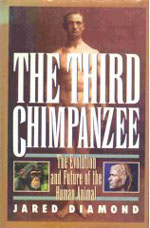 I have a weakness for the crop of evolutionary psychology and anthropology that has sprung up in recent years, and this one on the evolution of the human chimpanzee and the specific problematic baggage he brings from this evolutionary history is no exception. Of particular interest, both for content, as well as for the insight into the genesis of such book it provides, is the chapter on differential development of human societeties, that later bloomed into a full grown book of its own: Guns, Germs and Steel. Diamond writes delightfully entertaining, and his examples are fascinating. The only drawback is the bleak picture he paints for the future of this planet and our species, sounding just as correct today as it did 15 years ago, when he wrote it. The only difference being that the monster of major climate change caused by us monkeys no longer is something to be feared decades in the future, but seems to wait just around the corner. Maybe we can gang up on it, kill it and eat it. That strategy served us well in the past.
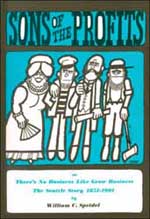 A curious feature of downtown Seattle is its underground, a collection of basement like areas below the streets, that include sidewalks and doorways. In places it looks like an older city got covered in an avalanche of road, and the inhabitants just accepted the new road levels. Speidel’s book, besides telling the story of early Seattle, centers on an account of how this underground city came to be. He claims that both sanitation (sewer backflow on high tides) and road layout of the downtown area left much to be desired, but attempts to widen and raise the roads met with fierce opposition by the downtown merchants and with legal and bureaucratic obstacles. When in June 1889 a big fire leveled all of downtown, the time had finally come, the city widened and filled in the roads over the following years, and the merchants rebuilt their houses from the ground level up, having to abandon these ground levels once the roads reached their final height and rebuild an entrance in a higher story. Both the books and the guided tours that Speidel’s company still provides in Seattle are a lot of fun – though I hear historians aren’t all too happy with his dramatizations, inaccuracies and lack of proper documentation of dubious sources. But with that caveat as to it’s truthfulness kept in mind, the book is quite entertaining, and the Underground well worth a visit.
 Crank science is fascinating to me, and the more elaborate the unfounded theories get, the more so. Just as a collection and overview of some of the classics of the cranks, this book is already invaluable. Above and beyond the pure review of mad scientists’ view of the world, this book raises the issue, in several places, of whether or not these cranks should be allowed to do what they do, and how the public should and should not receive them. Gardner wrote this in the late 1950s, and his perspective is clearly heavily influenced by the Velikovsky incident. Velikovsky published fairly outrageous and quite original theories on the influence of catastrophic astronomical events on world history, most notable the two near crashings of a comet that was later to become the planet Venus into historic Earth, and caused a big stir when scientists objected against Worlds in Collision having been published at all, and defenders of free speech rushed to the madman’s defense. Gardner’s position, as that of so many scientists, is unforgiving. He doesn’t want to restrict the ability of cranks to do their thing, but he doesn’t like them getting publicity when very clearly their work is not up to scientific standards. I am somewhat torn on this. I love the strange poetry and creativity in the these works, abd it would be a shame to lose these voices, even if their contributions to scientific discourse are not of the usual, incrementally explarative, kind.
  With a subject as intriguing as the history of the beloved vocalist combo, and their struggle with the rising Third Reich, and a freebie soundtrack treasurechest, it is hard to see how a movie could fail even as much as this one does. A stale and wooden script, endless repetitions of one single song (Veronica, der Lenz ist da) instead of a representative collection of the Harmonists’ work, and a simplistic notion both of human character and historic processes make this a less than splendid experience – especially when compared to Aimee and Jaguar, which is a entirely different league on a fairly similar subject.
 The central idea of this book – Pilate pardons Jesus, the Roman empire thus survives the centuries and still dominates in modern times – seemed ludicrous yet original enough for me to buy the book, and the task of depicting a modernized roman empire promised to be interestingly amibitious. But, not surprisingly, the execution falls quite a bit short of the aim. Counterfactual history requires a depth of understanding and elaborate world building skills, and Mitchell posesses neither. His Roman empire is the cliched version of B movies, with a few gadgets added without rhyme, reason or technological context. The story itself is uninspired, too, dealing with an uprising of psychic rebels in the Anatolian province and an intrigue inside the empire, both told in brief abstract dialogues, interspersed with random action sequences, making the book a failure on pretty much all levels. It’s too bad, I still think the idea is cute.
 It is a disturbing fact of post-war German history that plenty of active National Socialists continued on to positions of power and influence in the Bundesrepublik, partly because of a lack of skilled leadership personnel not involved with the regime, but also because the anti-communist notions of the old criminals fit well into the new political struggle emerging in Europe. Against this historical background, Riefenstahls particular story becomes all the more fascinating. Her unsettlingly effective propaganda documentaries, Triumph des Willes and Fest der Völker, on the 1935 Nuremberg rally and the 1936 Olympic Games, created a fame for her that was probably the reason for her fall after the war. She wasn’t able to make any more movies, and all her other creative efforts – most notably her photography of the people – got subjected to close scrutiny and harsh criticisms for suspicions of a fascist esthetic, and were always contextualized with her past. This movie portrays her both as the victim of scapegoating and a stubborn denier of aspects of her life, but most of all it paints the fascinating picture of a multifaceted woman, who had the misfortune to live in evil times. You might not like her after this documentary, but you won’t regret having seen it.